 |
|
|
|
|
|
|
|
|
|
|
|
|
|
|
|
|
|
|
|
|
|
|
Cold War Olympics |
|
|
|
The Olympic games, when won by your country, are a symbol of national pride and accomplishment. During the Cold War and Olympic medal meant more than just a title, it was a symbol of national unity, and of victory over your aggressors. The Soviet Union had begun to spread communism though the eastern part of the world after World War II. During the games they were engaged with countries that were with then in their spread of communism, and countries that were against them. The United states and the Soviet Union, now Russia, to this day compete fiercely against each other in the Olympic games. Some of the more memorable sporting events in history are: the Soviet Union's victory over the United States in a basketball game in the 1972 Olympics, and the United States victory over the Soviet Union in a hockey game back in 1980. Both victories meant more to their countries than just another game. For us, it meant one step closer to beating the communism spread. |
|
|
|
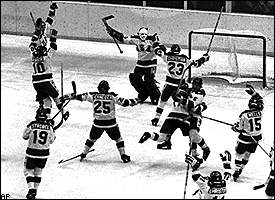
The final seconds of the third period were ticking away. The scoreboard read 4-3 in favor of the underdog American hockey team. If you were listening to the game you would have heard the much repeated phrase: "Do you believe in miracles?". Huge American flags on thirty foot poles. The hockey arena in Lake Placid radiated Patriotism, ecstatic groups broke out into renditions of "God Bless America", and "The Star Spangled Banner". No other Olympic event has stirred such national pride and celebration. The 1980 American hockey sqaud was made up of discarded NHLers and college players. Together, the were able to beat the all-mighty Russian squad that had dominated the sport since the 1964 Olympics. The funny thing about the game was that it wasn't even a contest for a medal but might have well have been because of the political backgroung that was effect by game. The Americans went on to win the gold medal, beating Finland in the championship game |
|
|
The Miracle on Ice |
|
|
|
|
|
 |
|
|
|
|
|
|
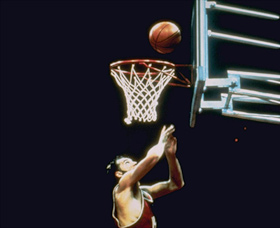
During the gold medal basketball game in 1972 Olympics between the US and the Soviet Union, a big dispute arose. With only one second left on the clock, and the score in favor of the Americans at 50-49, the horn sounded. The Americans rejoiced, but not all was how it seemed. Apparently the soviet team had called a timeout with three seconds left. The Soviets were granted the timeout and three seconds were put back on the clock. The Soviets played out the 3 seconds again, but failed to score again. Once again the Americans began to celebrate. But, for the second time, another 3 seconds was put back onto the clock. This time the ball was inbounded to Alexander Belov, who scored as time expired (for the third time). The Soviets won the game and were awarded the gold medal. In protest, the American team didn't accept their silver medals. Today, the medals are stored in a Swiss bank vault, still unclaimed. |
|
|
|
Basketball Controversy |
|
|
|
|
|
 |
|
|
|
|
|
The 1952 Helsinki Games |
|
|
|
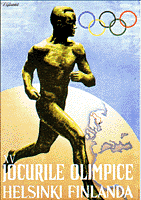
The Finns had the amibition of hosting the Games earlier, and this almost happened when the Iternational Olympic Committee recalled the hosting of the 1940 Olympic games from Japan, because of the Sino-Japanese war, electing Finland as the repacement. However, the start of the second world war followed, causing the games to be cancelled. The Finns finally got the games in 1952. The Helsinki games consited of 4900 athletes from 69 countries, including the Soviet Union. The Russians had not participated in an Olympiad since 1912. The Cold War was in progress and the Olympics provided the best means to create a good impression. The Russian delegation, therefore, set up a huge results board in their training field, to follow the medals battle with the US. In the end the US dominated, even though they were in second place for the largest part of the competiton . |
|
|
|
 |
|
|
|