| Properties of Water |
| Chemical |
| Physical |
| Water is a mixure of the elements Hydrogen and oxygen. Each element has there own unique properties. They have chemical properties and Physical properties. Now you might ask "Whats the difference between chemical and physical properties?" Chemical properties are "reactions with other substances", while physical properties "observable". |
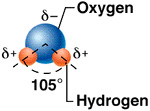
| The first thing you should know, or may already know, is the chemical make-up of water. A water molecule is formed when two hydrogen atoms combine a single oxygen atom. Thats why it's called H20. Two hydrogen for one oxygen. Diagram below. |
 |
| The substance of water is a pure substance. Water is chemically active and will react with many metals to form bases. It will |
| also react with the oxides of many nonmetals to form acids. And lastly, alcohols and alkenes can be formed by combining it with certain organic compounds. Water is a polar molecule but it is a poor conductor of electicity. Water is a very unique compound for many reasons. The thing that I find most interesting is that is gets less dense, and actually expands as it freezes. This be proven if you put a certain amount of water in a freezer, that you know the volume of, and let it freeze. Then find the volume of the ice and you will see that it is infact a greater volume, which means that it is less dense. Water is also an excellent solvent. In fact, it can dissolve more substances on earth than any other. Water is also special to us because we based out temperatue scale on it's melting and boiling points. It's melting point is 0 degrees C, or 32 degrees F, and it's boiling point is 100 degrees C, or 212 degrees F. I find that to be pretty cool. |
| The thing about water is is that it is a very bland substance. Pure water has no color, it has no special odor and not really any taste. It's just a pure bland substance. It's probably the only substance in the world with these features. It is also unique because it is also the only substance on the planet that can be found in all three of it's stages in nature. The three stages being ice, water, and steam. |
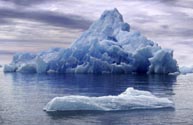
| Above is picture of solid ice in water. The reason that ice floats in water is because it is less dense than the water is. Have you ever put water on a penny and watched it build up and stay on the penny? This is because water has a very high surface tension, which makes it stick together. This is called capillary action. It is because of capillary action that plants are able get water to all branches and stems and flowers. Because water has a high specific heat, it will absorb a large amount of heat before it begins to get any hotter than it already is. |
 |