or in equal force. But by means of our Art, they can be restored to equality in certain respects, as the wise well know; therefore, in our Cross, we make the parts equal and unequal.
Another reason is that we can proclaim either similitude, or diversity, or unity, or plurality in affirming the secret properties of the equilateral Cross, as we have said before.
If we were to expound all the reasons which we know, for the proportions established in this way, or if we were to demonstrate the causes by another method which we have not done, although we have done so sufficiently for the Sages, we should transcend the limits of obscurity which we have prescribed, not without reason, for our discourse.
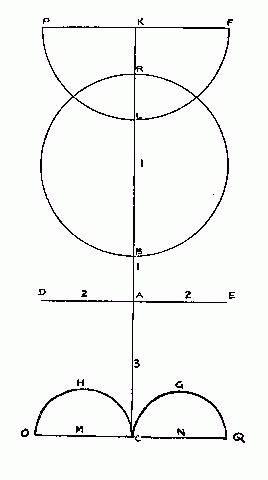
Take any point, as A for example, draw a straight line through it in both directions, as CAK. Divide the line CK at A by a line at right angles, which we will call DAE. Now select a point anywhere on the line AK, let it be B, and one obtains the primary measurement of AB, which will be the common measure of our work. Take three times the length of AB and mark off the central line from A to C, which will be AC. Now take twice the distance between AB and mark it off on the line DAE at E and again at D, in such a way that the distance between D and E is four times the distance between A and B. Thus is formed our Cross of four Elements, that is to say, the Quaternary formed by the lines AB, AC, AD, AE. Now on the line BK take a distance equal to AD up the central line to I. With this point I as a centre, and IB as the radius, describe a circle which cuts the line AK at R: from the point R towards K mark a distance equal to AB, let it be RK. From the point K draw a line at right angles to the central line on both sides, forming an angle on either side of AK, which will be PFK. From the point K measure in the direction of F a distance equal to AD, which will be KF: now with K as centre and KF as radius describe a half-circle FLP, so that FKP is the diameter. Finally, at point C draw a line at right angles to AC sufficiently long in both directions to form OCQ. Now on the line CO we measure from C a distance equal to AB, which is CM, and with hi as a centre and MC as a radius we describe a semicircle CHO. And in the same manner on CQ, from the point C we measure a distance equal to AB which is CN, and from the centre N, with CN as radius, we trace a semicircle CGQ, of which CNQ is the diameter. We now affirm, from this, that all the requisite measurements are found explained and described in our Monad.
It would be well to notice, you who know the distances of our mechanism, that the whole of the line CK is composed of nine parts, of which one is our fundamental, and which in another fashion is able to contribute towards the perfection of our work: then, again, all the diameters and semi-diameters must be designated here by suppositional lines hidden or obscured, as the geometricians say. It is not necessary to leave any centre visible, the exception being the solar centre, which is here marked by the letter I, to which it is unnecessary to add any letter. Meanwhile those who are adept at our mechanism can add something to the solar periphery, by way of ornament and not by virtue of any mystical necessity: for this reason it has not been formerly considered by us. This something is a boundary ring, necessarily a line parallel to the original periphery. The distance between these parallels may be fixed at a quarter or a fifth part of the distance AB. One may also give to the crescent of the Moon a form which this planet frequently assumes in the sky, after her conjunction with the Sun--that is to say, in the form of the Horns, which you will obtain if from the point K in the direction of R you measure the distance just mentioned, i.e. the fourth or fifth part of the line AB, and if from the point thereby obtained, as a centre, you trace with the original lunar radius the second part of the lunar crescent, which joins the extremities at both ends of the first semicircle. You may perform a similar operation in respect of the positions M and N when erecting the perpendicular at each one of these centre points; we can use the sixth part of AB or a little less, from which point, as the centre, we describe two other semicircles, using the radius of the two first, MC and NC.
Lastly, the parallels may be traced at each side of the two lines of our Cross, each side at a distance from the centre line of one-eighth to one-tenth part of the distance AB, in such a way that our Cross be in this manner formed into four superficial lines where the width is the fourth or the fifth part of this same line AB.
I have wished in some way to sketch these ornaments in the figure which each one may reproduce according to his own fancy. It is a condition, however, that you do not commit any fault, however small, against the mystical symmetry for fear of introducing by your negligence a new discipline into these hieroglyphic measurements; for it is very necessary that during the succeeding progression in time they must be neither disturbed nor destroyed. This is much more profound than we are able to indicate, even if we wished to do so, in this small book, for we teach Truth, the daughter of Time, God willing.
We will now expound methodically certain things which you may find on your way by practising the proportions of our Monad. Then we will show by many examples the existence of four lines corresponding to the four lines of our Cross, and which in this consideration we are not able simply to announce, because of the proportions and the particular and mystical results which are produced in another fashion, from the Quaternary of these same lines. And thirdly, we will show that there exist within Nature certain useful functions determined by God by means of numbers, which we have happily obtained and which are explained either in this theorem, or in others, contained in this little book.
Finally, we will insert other things in an opportune place which, if they are conveniently understood, will produce fruits most abundantly.