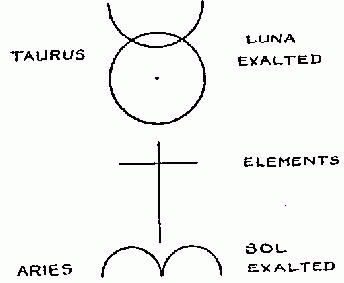
We suggest, therefore, that Philosophers should consider the action of the Sun and the Moon upon the Earth. They will notice that when the light of the Sun enters Aries, then the Moon, when she enters the next sign, that is to say Taurus, receives a new dignity in the light and is exalted in that sign in respect of her natural virtues. The Ancients explained this proximity of the luminaries--the most remarkable of all--by a certain mystic sign under the name of the Bull. It is very certain that it is this exaltation of the Moon to which in their treatises the astronomers from the most ancient times bear witness. This mystery can be understood only by those who have become the Absolute Pontiffs of the Mysteries. For the same reason they have said that Taurus is the house of Venus--that is to say, of conjugal love, chaste and prolific, for nature rejoices in nature, as the great Ostanes concealed in his most secret mysteries. These exaltations are acquired by the Sun, because he himself, after having undergone many eclipses of his light, received the force of Mars, and is said to be exalted in this same house of Mars which is our Ram (Aries).
This most secret mystery is clearly and perfectly shown in our Monad by the hieroglyphic figure of Taurus, which is here represented, and by that of Mars, which we have indicated in Theorem XII and Theorem XIII by the Sun joined to a straight line towards the sign of Aries.
In this theory another kabbalistic analysis of our Monad offers itself, because the true and ingenius explanation is this: the exaltations of the Moon and of the Sun ate made by means of the science of the Elements.
Note.-There are two things which should be particularly observed: first, that the hieroglyphic figure of Taurus is the same as the diphthong of the Greeks (TAURUS SIGN), which was always used in terminating the singular gender; secondly, that by a simple transposition of place we show the letter alpha twice, by a circle and a half-circle, being simply tangents which touch one another as shown.
We must now, in view of our subject, philosophise for a short time upon the Cross. Our Cross may be formed of two straight lines (as we have said) which are equal one to the other-that is to say, we cannot separate the lines except we do it by parting them so that we get equal lengths. But in the mystic distribution of the components of our Cross, we wish to use parts which are both equal and unequal. These parts show that a virtue is hidden under the power of the division of the Equilateral Cross into two parts, because they are of equal grandeur. In general, the Cross must be composed of equal right angles, since the nature of justice demands the perfect equality of the lines used in the decussation. In accordance with this justice, we propose to examine with care that which follows concerning the Equilateral Cross (which is the twenty-first letter of the Latin alphabet).
If, through the common point where the opposite angles meet in our Rectilineal, Rectangular, and Equilateral Cross, we imagine a straight line dividing it into two parts, then on either side of the line thus traversed we find the parts are perfectly equal and similar. And these parts are similar in shape to that letter of the Romans which is regarded as the fifth of the vowels, and which was frequently used by the most ancient Latin philosophers to represent the number five.
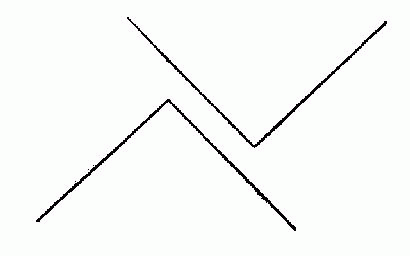
This, I conceive, was not done by them without good reason, because it is in fact the exact half of our Decad. Of these parts of the figure thus duplicated by the hypothetical division of the Cross, we must conclude it to be reasonable that each part represents the quinary, although one is upright and the other reversed in imitation of the multiplication of the square root which comes in here in a marvellous way as the circular number, that is to say, the quinary, from which we find the number twenty-five is produced (because this letter is the twentieth of the alphabet and the fifth of the vowels).
We will now consider another aspect of this same Equilateral Cross--that which follows is based upon the position shown in our Monadic Cross. Let us suppose a similar division of the Cross into two parts be made as in the drawing.
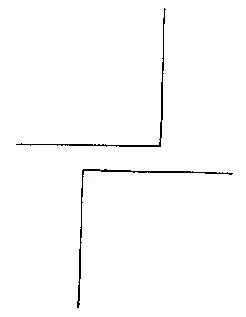
Now we see the germinating shape of another letter of the Latin alphabet--the one upright, the other reversed and opposite. This letter is used (after the ancient custom of the Latins) to represent the number fifty. From this, it seems to me, we establish our Decad of the Cross, for this is placed at the summit of all the mysteries, and it follows that this Cross is the hieroglyphic sign of perfection. Therefore, enclosed within the quinarv force is the power of the Decad, out of which comes the number fifty as its own product.
Oh, my God, how profound are these mysteries! and the name E L is given to this letter! And for this very reason, we see that it responds to the decadal virtue of the Cross, because, starting from the first letter of the alphabet, L is the tenth letter, and counting backwards from the letter X, we find that it falls into the tenth place, and since we show that there are two parts of the Cross, and considering now their numerical virtue, it is quite clear how the number one hundred is produced. And if by the law of squares these two parts be multiplied together, they give a product of 2500. This square compared with the square of the first circular number, and applied to it, gives a difference of one hundred, which is the Cross itself explained by the square of its Decad, and is recognised as one hundred. Therefore, as this is contained within the figure of the Cross, it also represents unity. By the study of these theories of the Cross, the most dignified of all, we are thereby induced to utilise this progression, viz. one--ten-- one hundred, and this is the decadal proportion of the Cross as it appears to us.