| Othello Character List |
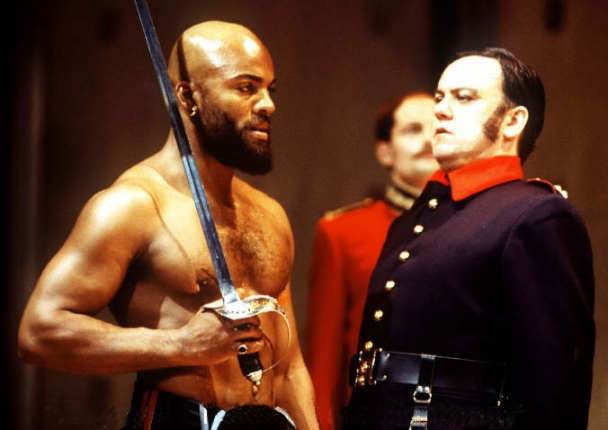
| OTHELLO: Throughout the play, Othello is seen as an outsider, in the aspect that he is not a Venetian. This foreign trait grants Othello a certain power when dealing with Venetians and the way in which they see him. A specific example of Othello's overpowering way of swaying Venetians, or whoever his audience maybe, is his talent and respectable orating skills. It takes a certain kind of person to "win over" a crowd, and Othello is a prime example of this type of persona. Othello's eccentric killing of Desdemona in her wedding sheets is a unique one in terms of symbolism, supplying Othello with many interior secrets the audience may never know of, nor have any part in. Wrapping up Othello's character and the way he his seen by others in the play, this character is a n intricate one, in that there is much underlying detail the audience may never fully examine, to say the least of his peculiar ways. His non-Venetian feature is surely a key in keeping him the audience's constant eye. IAGO: Iago is a very complex and involved individual in Othello. His almost comedic and entertaining ways allow for a certain understanding among the audience. When looking at Iago in a more overview, it is apparent that he gives no real reasoning or justification for his actions. It Iago does possess some or reasons or justifications, they are not shared with the audience, and thus are not evident in the play or to other characters Iago is found interacting with. One thing found certain about Iago's unique ways is the bizarre enjoyment he finds in causing pain or suffering to others in the play. DESDEMONA: Desdemona's young character allows for many distinctive qualities when viewed spectators. Her almost submissive behavior creates innocence. Desdemona's frequency to be very passive permits her to assume responsibility for her own murder. Most visible about Desdemona, is her undeniable independence. She portrays this independent female several time in the play. Such a circumstance is her expressing justification for marrying Othello to her father. Yet another case in which Desdemona illustrates independence is when she protects her own loyalty when facing her husband, Othello, while in question. CASSIO: Cassio is in short a prime example of the clich� "you win some, you lose some." In order for Cassio to achieve such high status in Venetian society, he must face such resentment as from Iago. Such resentment by others, may originate from the fact that Cassio is so young and such an inexperienced soldier. One of Cassio' personal downfalls strives from his own embarrassment, when he finds himself part of a drunken brawl. Overall, Cassio is seen as a threat to some, and to others, solely a juvenile and unproven soldier. RODERIGO: Desdemona's so-called suitor, Roderigo is a young, wealthy and imprudent man, at best. His foolishness is guilty of often finding trouble and taking part in it. Roderigo's young self, is very innocent and often leads him to judge people and think further into the future than others. Such a vision into the future, allows Roderigo to see Cassio as a future opponent, which furthermore incites him to aid Iago in the murder of Cassio. Roderigo is yet another example of Shakespeare, complex character make-up in creating an intense and exciting performance. BRABANTIO: Desdemona' father, the infamous Venetain senator, Brabantio is a strong individual in holding up Venetian society. As many of the other characters in Othello, Brabantio is intricate in his actions and the way he goes about them. A key incident in the play concerning Brabantio is his relationship with Othello. When Othello marries Brabantio's daughter, Desdemona, without his consent or knowledge of such, Brabantio feels a certain betrayal. This wild betrayal by Othello concerns Brabantio enough to feel as though his daughter has perhaps fallen under control of "black magic." Brabantio is viewed as a respectable man, although his downfalls are usually caused by others, and the affect they have on him. DUKE OF VENICE: The Duke's small but, vital role in Othello, provides for an imperative moment in which he conveys to Brabantio that perhaps Othello has not used "black magic" on Desdemona, but she has truly fallen in love with him. Although the small part the Duke plays, does not allow for many audience members to firmly grasp his character, nor complete an opinion of him, the Duke of Venice is viewed respectably. Such respect may derive from his quest for Brabantio to reconcile with the idea of Othello and Desdemona marrying. EMILIA: Iago's wife, Emilia, is in short seen as skeptical, however very experienced. Emilia's own mature ways leads her to be very doubtful of her husband. This unknown doubt and mistrust directedc at her husband, allows Emilia to build up a very strong relationship with her mistress. This relationship is one believed to strive from the lack there of with Iago, this allowing Emilia to have some sort or impact in another life, if it is not going to be her husband's. |
 |