| Shakespeare Biography |
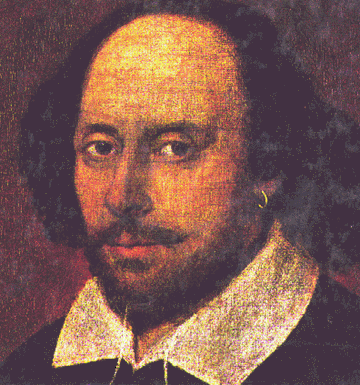
| Shakespeare Shakespeare is perhaps the greatest author the world has ever seen. He perfectly wove the English language into tales of love, war, lust, and death. Shakespeare was born in Stratford-upon-Avon, a town in England. The actual date is not truly known, but he was baptized April 26, 1564 as records indicate, and traditionally baptism occurs 3 days after birth, so it is believe he was born April 23, 1564. April 23 also happens to be the feast of St. George. Born to John and Mary Shakespeare, he was the third of seven children. Shakespeare�s father was a local political figure. He was the Mayor (Bailiff) of the town. Not much is known about his parents or his childhood, the most that people can say and arrest assure of them selves is that he attended some type of grammar school in his child years. He was rudimentary tutored in Latin and English, as well as to be believed a little in French. We know that Shakespeare married Ann Hathaway, who was 8 years his elder. They had a daughter, Susanna, and a set of twins, Hamnet and Judith. We know that Hamnet suffered death at an early age. It is around this time that Shakespeare enters his �lost years,� or the time no one knows much about him. Many people said he became a lawyer, teacher, or soldier, because all of his plays are well versed in all areas that these professions would have knowledge about. It�s believed he lived in London during the lost years, and sent money back to his family in Stratford. As he became well known for his plays, his company the Kings Men gained fame, acting for Queen Elizabeth, and than King James. They performed in the Globe theatre, a theatre Shakespeare had stock in. Shakespeare is believed to have left the scene around 1610 and go back to Stratford to live a laid back life with his family. He is famous for his will, in that he left most of his property to his daughter Susanna, leaving his wife only his 2nd best bed. Elizabethan Age The Elizabethan age was a time of court manners and war, mostly characterized by the state policy and actions of one of England's stronger monarchs, Queen Elizabeth I. Unlike her predecessors, she was able to put matters of state above that of religion, thus creating a strong government and a stronger England. The wars with Spain to dominate the New World and to control trade in the Atlantic crafted greatly the growing patriotism felt by the English. More specifically Shakespeare was one of these great patriots. His plays brought about feelings of national pride and patriotic fervor. Elizabeth being a patron of the arts, fostered the growing theatrical scene in London and especially loved Shakespeare's plays, attending some performances. Without her support, theatre would have probably been shut down, because by a majority of the nobles and aristocrats it was a scene of debauchery no better than a whorehouse. But under her rule it flourished and was able to develop into what we know today as the modern theatre. The Globe Theatre The Globe Theatre was one of many theatres of the time. What makes the Globe so special though is that it was a theatre that was partly owned by Shakespeare him self. The Globe is located on the banks of the Thames River, in London�s Southwark District. The Globe hosted many of Shakespeare�s plays. Cuthbert Burbage, who was a long time friend of Shakespeare, built the Globe in 1599. The most famous actor during the Elizabethan Age was Richard Burbage, who happened to be Cuthbert Burbage�s brother. The ownership of the theatre was 50% by Burbage, with the remaining 50% spilt between various entrepreneurs, the Chamberlain�s (Kings) Men, and Shakespeare. The theatre wasn�t spacious by today�s standards. The pit was were the commoners went, there was no seats and the odor was horrendous. The people who actually had seats in the balconies spent good money on them, and throwing down their own excrement into the pit wasn�t behind them. The theatre was designed to hold around 2,000 � 3,000 spectators. There was no electricity during this age in history; so all plays were conducted in the day. Many people got in trouble for skipping work to come to the theater to spectators. The props and costumes of the time were very limited, that why the crowd dependant on the playwrights to create vivid images of what the actual setting looked like, which Shakespeare did very well. Women were not allowed to act on stage, any female role was acted out by males. The Globe was burned down in 1613 during a performance of Henry VIII, but was reconstructed to be fire proof. It was later torn down in 1642. Today it has been reconstructed as a tribute to the original |
 |