checked July 6th 2003
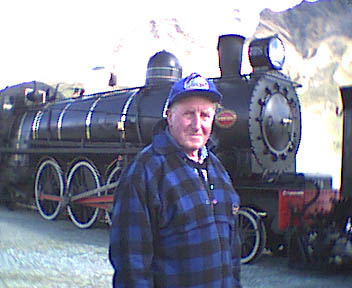
<<< Des Burrow with a Kingston Ab.
THE DES BURROW TAPES
At an engineering group meeting of the Otago Model Rngineering Society in Dunedin New Zealand Des Burrow told of his time spent working on the Kingston Flier. What follows is an abstract of a conversation he had with an obviously sadly ignorant Chatter Marks.
CM There are 2 Abs are there then?
DES Yes, 2 Abs, 778 and 795. 778 is the original AB. 795 is a converted WAB.
CM What’s a WAB?
DES It’s the one that had the side tanks on it, no tender, just a tank engine. They were that big they had trouble with the track. They had trouble with them spreading the track so in the end they took the tanks off them. We’ve been working on 778.
CM Are these the ones beside the Leith down past the old Placemakers?
DES No, these [4-6-2] are at Kingston, at the bottom of Lake Whakatipu. The one down at the Leith is a P class[2-8-0], that’s the one John Rappard is working on.
CM Oh, so you went away for a month to work on it then?
DES Yes, It was only supposed to take a week and a half, but we were away for a month. The right hand cylinder on 778 was cracked, so we took that off and put a new second-hand one on it. The cylinder we took off would have been the original one and it was bolted on with bolts around an inch and a quarter in diameter. You can imagine how hard those bolts were to get out - they were fitted bolts. We managed to get those out. The replacement cylinder was re-bored at Invercargil by Gough’s Engineering and they made a new piston. It weighed 850 kilos with nothing in it. We managed to lift it with a front-end loader, on a tractor. We made a temporary gantry out of box section and put a block and tackle on it to lift it once the tractor had dropped it under the gantry.
We were lucky, the cylinder has a big spigot in the back and it was the same as the one on the cylinder we took off. It fits into the frame. We got the cylinder on then we had to ream the holes out for the fitted bolts. We reamed them out by hand. They made fitted bolts a few thou oversize, and for each hole we reamed, they’ve turned a bolt, they’ve got an old lathe there, they took a skim off them and we fitted each bolt. There was about 24 or 26 bolts right around it. We had a hole in the frame where there was no hole in the replacement cylinder so we had to drill it out. We drilled it out with a hand drill, like one of those old De Souters, one of the big ones.
There were 5 of us pushing this drill, we pushed a 1and 3/8 inch bit through four inches of steel. When we managed to get that through, we put a reamer through and it came up good. We found out when we measured everything up putting the replacement cylinder back that the old cylinder had cracked because the guide bars weren’t aligned with the cylinder. What was happening was that as the piston went up to the front of the cylinder it was going on an angle and hitting the outside edge of the cylinder. That’s why it was cracked and it was cracked right down that side. The guide bars were worn as well. When we put a line through it showed it was about 3/16 to a 1/4of an inch out of plumb.
CM Over what length of stroke would that be?
DES The stroke is about 2 feet, more, maybe 2 foot 6 inches. Once we’d got the guide bars lined up we started to put the valve gear back on it - we broke a ring in the valve, we got the valve in and it jammed, we couldn’t get it out and we broke one of the rings. They were new rings we’d just had made, luckily they made a spare one.
The Ab Class Locomotive
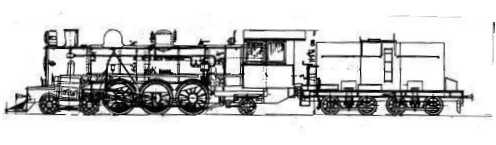
The NZGR class P is a 2-8-0 and was rescued from river protection duties on the Clutha near Belmont.
There are two at Project Steam and a small working party meets Wednesday mornings, weather permitting at Minerva Street, Dunedin.
The Kingston Flyer runs between Kingston [at the bottom of Lake Wakatipu on the map!] and Fairlight 10 km southwards.
Kingston is fifty km south of Queenstown on the bus route to the South and Te Anau and Milford.
Tour buses make a one day return trip from Queenstown to Milford and back.
Travelling to Kingston from the south early in the morning. You find the buses approaching you. Then as I returned from the opening day of the Kingston's 2000/2001 season I saw the same buses hurtling back to Queenstown with nary a moment to stop and admire the magnificent locos and carraiges of the Kingston Flyer.
There are virtually no facilities for maintenance at Kingston with just a couple of old containers. To lift the locos a crane was brought in from Queenstown.
The nearest railway is at Gore, over 100km away to the south-east.
While sometimes the weather is lovely, and the team went fishing on a flat calm Lake Wakatipu in brilliant sunshine, at other times there was snow covering everything with metal being heated on a gas-fired barbecue so it could be worked on.
CM You mentioned a rod that was too long.
DES Yes, when we put the valve rods back on they were a ¼ of an inch too long, so we had to "dump " them - they did them in Invercargil. They clamped them at each end, put one end in a press, put the other end in a portapower, got the middle of it white hot and pushed it with the portapower so they could squeeze the hot part up. The rod was 3 inches by 1 inch section steel - you’ll have to convert all this into metric !
CM Ha Ha Ha ! (see engineering group report) So why did they do that then rather than just chop a bit off the end?
DES You can’t because it’s got a fork on the end and it’s special steel. If you tried welding them they would break. We thought about doing that. But when they push it you’ve also got to remember when they cool they will shrink about another 1/16 of an inch, so it’s more or less hit and miss trying to get it right. They said if it were within a 1/16 of an inch it would be good - better than a ¼ of an inch which stopped us setting the valve timing on it.
CM Is that finished now then?
DES It’ll be done now - they were doing it last Monday..
CM What else were you going up there?
DES We put a new roof on one of the carriages, the old bird cages. The wind caught it one day and lifted half the roof off ( the covering, not the timber) so we renewed that with the heavy plastic that’s put on the trucks on those sliding doors (side curtains). We stapled it on and put aluminium beading round it. Some of the timber was rotten and we renewed a few of the boards. The covering was about 50 or 60 feet long and we had to pull it tight with those big tie downs that trucks use. We put the ratchets on it , pulled it ‘till it was tight then started stapling it and it came up good.
CM So you had to get the loco finished to a deadline did you ?
DES Yes, We had to finish it for the opening which is on the 30th of this month (September 2000).
Enter Stu who Des claims was doing most of the work, which Stu denies, whilst in the background Allan Stevens is heard to cry "He’s not been here for 4 weeks, for God’s sake don’t hold him (Des) up.
DES Tell him about that internal pipe and the stand pipe
STU There’s a ball ended seal on an internal pipe where it attaches to a stand pipe. It’s a ball ended seal to allow a bit of leeway in joining the two pipes together as they may not be quite square with one another when they line up
DES This is the one up in the dome
STU Yes it’s how the steam gets up to the regulator. They have to take them out every year for the engineers to get in to the boiler to look at it but when they used to run for the railways they used to go 4 years between overhauls and half the time you never had to touch them, but of course with upsetting them the steam can leak past the seal and erodes it away, forming a groove. Once that happens when you close the regulator steam leaks past along the groove and she just keeps on blowing steam and she can creep along the track.
DES The steam had cut a big groove half an inch wide and about a 1/16 of an inch deep right through the internal pipe on both the engines so we welded it up with silphos. It was a hell of a job because we couldn’t get inside the thing STU There might be some other way to do it, perhaps you could get a new ball joint and fix it to the dry pipe, but you can’t have a fixture too big because you’ve got to get it out through the tube plate
CM So you were hanging upside down with the oxyacetylene were you Des?
DES Yes, with all the heat coming up and those big studs sticking up in me it wasn’t very comfortable. Did I tell you about those brake blocks ? Hillside sent up some brake blocks and they were far too narrow - they were meant to have gone to Christchurch for the tram. That’s Hillside for you ! What else happened down there?
STU Umm Alan Gough, the engineer who did all the fitting on the cylinder rebuilt over ½ the firegrate while inside the firebox.
DES That was usually done when they took the boiler out, but you can’t do that down there. He was in there for nearly a fortnight cutting bits out and welding new bits in STU The thing we found about AB cylinders is that left and right hand cylinders are all the same, they’re not handed. The only thing that makes them left or right handed is the cut out in the frame itself in which the spigot fits, and it’s this that puts the cylinder at the right angle. The only other difference is where the lubricator pipe comes in at the back which is just a matter of drilling a hole at the right end.
Well, Des tells me that Russell Glendening has since tried the engine now that it has been re-assembled, and that it goes better than it’s ever gone. It is thanks to people like Des and Stu who give their spare time freely and keep the old skills alive that our industrial heritage is itself kept alive and not relegated to the scrap heap.
Chatter Marks apologies for any inaccuracies which may have crept into the transcript.
There is some ribald commentary from time to time between model engineers who remain with imperial and those who use metric
Most use a bastard mixture, like chippies who talk about 4x50's, or 100x2's, for the 4"x2" or 100x50.
Sorry, photo missing at the moment, will be replaced
The 'Birdcage' carriages are fifty/fifty general compartment and smaller first class .The corridor beside the smaller ones in open to the fresh air and passengers have only a mesh to protect them from the elements.
The photo is taken at Pleasant Point Historical Society and Railway. They are some 13km north-west of Timaru. They are the home of the replica rail-motor RM4
RM4 and RM5 were built in 1926 to try and find a viable competition to road buses.
Unlike the English ones they could only haul themselves and didn't have a reverse gear. So were only operated singly between towns with turntables.
By 1931 they had been scrapped.
The Replica was a lengthy job and is built on a Ford T chassis. It does have reverse but Pleasant Point installed a wagon turntable, the only operating one in the country, at the town end of their short line. 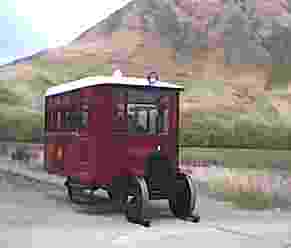
Replica RM4 at Fairlight
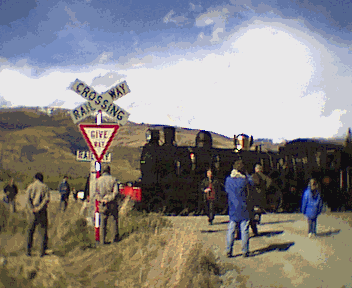
One of the Kingston Ab's at the Fairlight crossing of a farm track. Station and main road are behind the locomotive.
Below. The crowded yard at Kingston with the Ab's and visiting K92. Built by Rogers of Patterson, USA. Plus RM4 about a dozen traction engines and numerous vintage cars …and naturally hundreds of camera wielding visitors
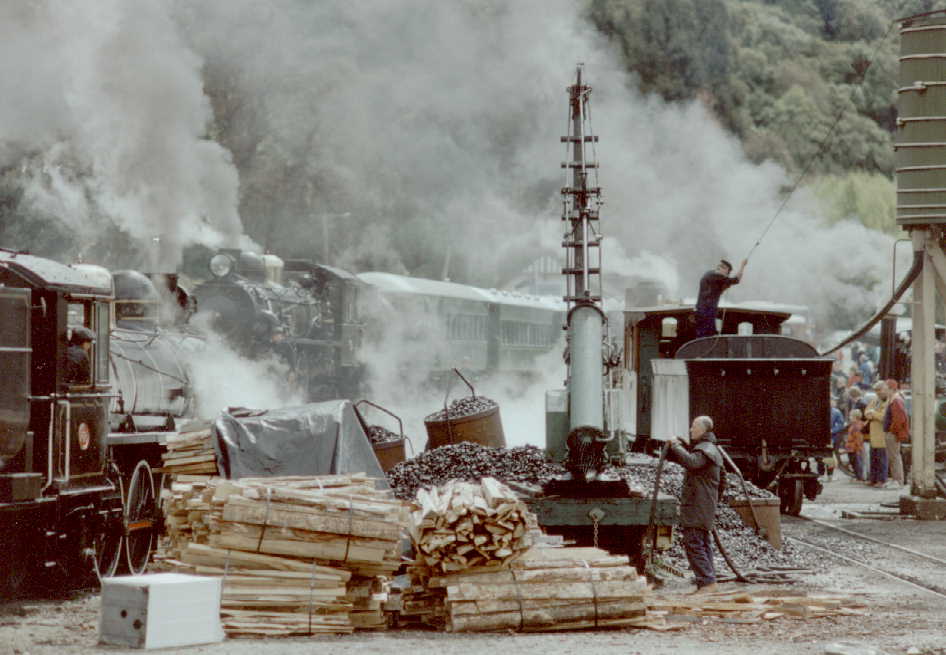
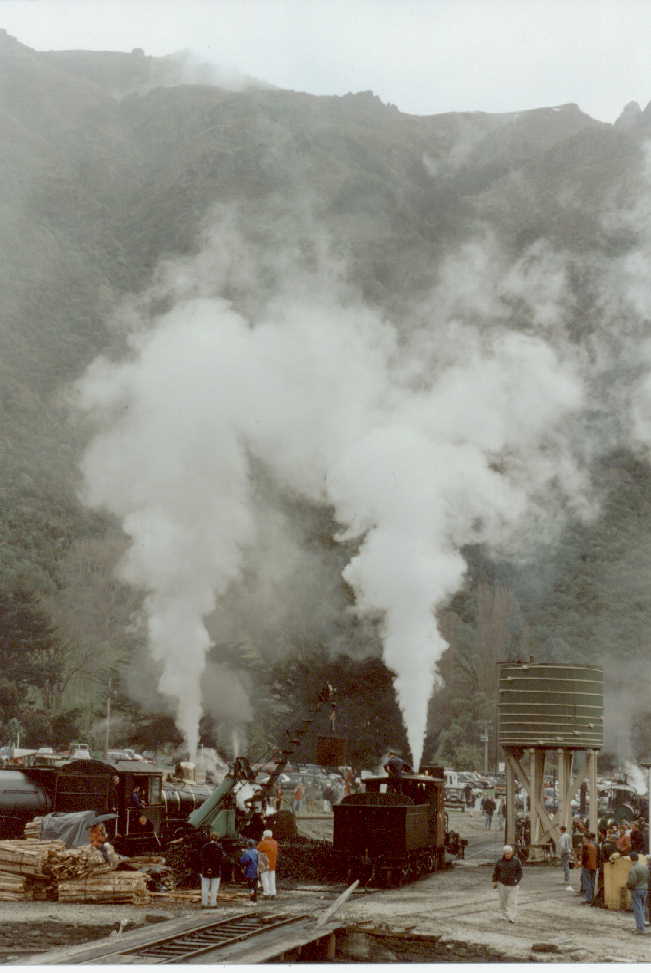
. The crane is powered by steam from the left hand loco. Turntable is an 'armstrong' model and so nicely balanced I saw the RM4 turning without any 'push' by the operator.

Opening Day ended with the triple run of K92 leading the Kingston Ab's with the full seven carriage train