Last Updated: Nov-4-2003
Icelandic is fully supported in any application in MacOS X that is built using the Unicode standard. The problem is that several key applications still use the older MacRoman standard to handle languages. To use these applications you either have to buy a localized version of MacOS X from the Icelandic Apple IMC dealer or localize it yourself.
This page contains information on the issue of Icelandic localization on the Macintosh platform. Please do not use the information for illegal purposes.
In order to use Icelandic in non-Unicode applications as well as the Unicode ones in MacOS 10.3 (slightly different in older versions), you have to do the following:
Each step will now be explained in details.
Note: Most people prefer to work with duplicates, rather than the original files. Also, active system files cannot be changed, while the system is running. They can be replaced afterwards by booting up in MacOS 9 or by accessing the files from another computer through target mode.Apple provides information on how to create your own keyboard layout on it's website.
If you are upgrading from a localized version of MacOS 10.2 you may find it useful to know that MacOS 10.3 uses the same keyboard layouts.
Keyboard layouts are stored in:
Library/Keyboard Layouts
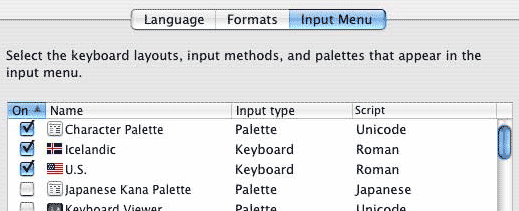
To activate a keyboard layout you check in the checkbox in front of it in the Input Menu in System Preferences/International:
If you want to avoid having to choose the Icelandic keyboard layout each time you open an application, you should remove the Unicode.bundle file from the System/Library/Keyboard Layouts folder and store it elsewhere
Note: This folder is not to be confused with Library/Keyboard Layouts, where you store your own layouts.Not every font is configured properly for Icelandic. This includes all fonts, installed by Microsoft Office. It is not a bad idea to keep a backup of fonts, that you know are configured properly, to replace ones that aren't. The following is a list of fonts that usually need to be configured properly:
/Library/Fonts/Arial
/Library/Fonts/Arial Black
/Library/Fonts/Arial Narrow
/Library/Fonts/Arial Rounded Bold
/Library/Fonts/Baskerville.dfont
/Library/Fonts/BigCaslon.dfont
/Library/Fonts/Comic Sans MS
/Library/Fonts/Copperplate.dfont
/Library/Fonts/Courier New
/Library/Fonts/Didot.dfont
/Library/Fonts/Futura.dfont
/Library/Fonts/Georgia
/Library/Fonts/GillSans.dfont
/Library/Fonts/HelveticaNeue.dfont
/Library/Fonts/Herculanum.dfont
/Library/Fonts/Optima.dfont
/Library/Fonts/Times New Roman
/Library/Fonts/Trebuchet MS
/Library/Fonts/Verdana
/Library/Fonts/Zapfino.dfont
It can be done, using an application such as TransType:
This is what is needed to fix several fonts for compability with MS Office and other software:
1. Open the TransType application.
2. Drag the misconfigured fonts into the "Source fonts" window.
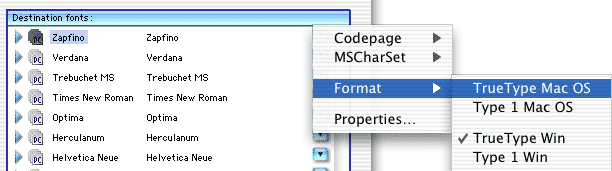
3. From the pop-up menu to the right of each font select "Format -> TrueType MacOS" like this:
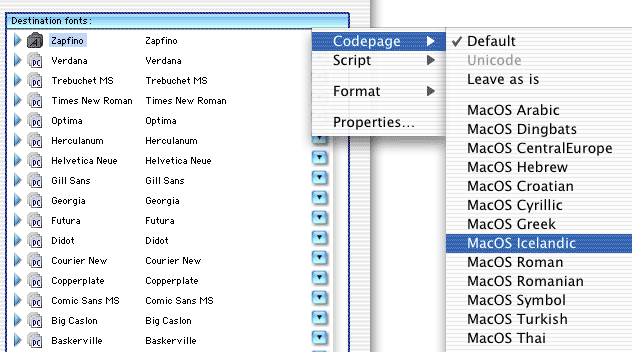
4. Then select from the same pop-up menu "Codepage -> MacOS Icelandic" like this:
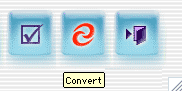
5. After you have selected the TrueType format and Icelandic codepage for each font you simply press the convert button and it will process all the fonts for you:
This step requires the use of a resource editor, such as Resorcerer.
Note: You can get the same result by using the freeware ResEdit and ToggleFork.1. Open the Resorcerer application.
2. Drag the following file onto Resorcerer:
/System/Library/Frameworks/Carbon.framework/Versions/A/Frameworks/HIToolbox.framework/Versions/A/Resources/English.lproj/Localized.rsrc
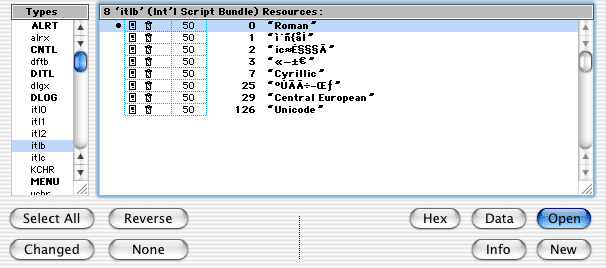
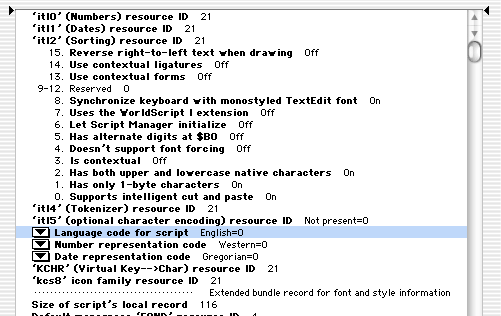
3. From the "Types" field to the left select the "itlb" resource and double-click the "Roman" resource which appears in the large field to the right.
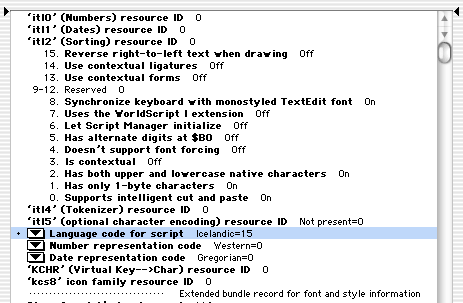
4. In the window that appears, change "Language code for script" to "Icelandic=15":
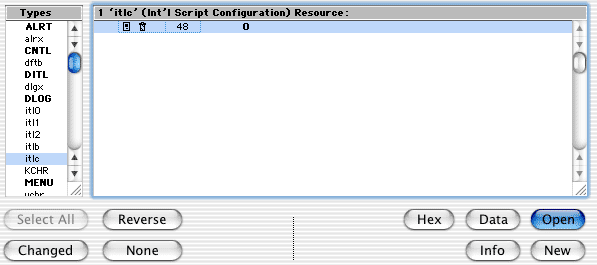
5. Next you select the "itlc" resource from the "Types" field and double-click the only resource that appears in the large field to the right:
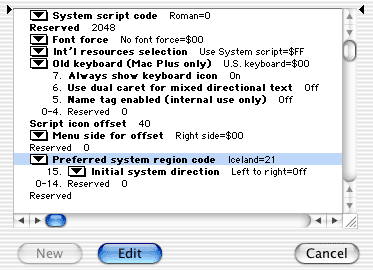
6. In the window that appears change "Preferred system region code" to "Icelandic=21":
7. Then close and save.
Note: This replaces the standard way of handling date and time in Microsoft Office X with the Icelandic one so it should not be done if you are going to use Icelandic as a secondary language.
Again this requires the use of a resource editor, such as Resorcerer.
Note: You can get the same result by using the freeware ResEdit and ToggleFork.
1. Open the Resorcerer application.
2. Drag the following file unto Resorcerer:
/System/Library/Frameworks/Carbon.framework/Versions/A/Frameworks/HIToolbox.framework/Versions/A/Resources/English.lproj/Localized.rsrc
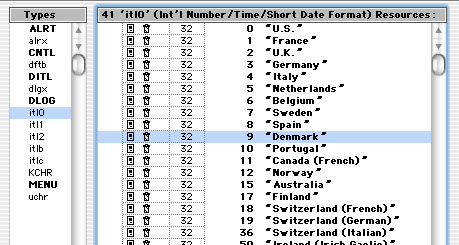
3. From the "Types" field to the left select the "itl0" resource.
4. Select the "Denmark" resource in the field to the right (do not double click)
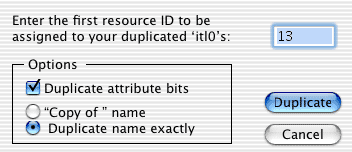
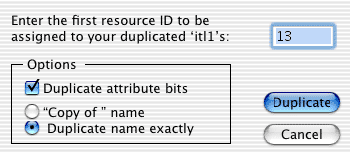
5. From the "Edit" menu select "Duplicate Selection" - you should get this window:
6. Change the number "13" to "21" and press the "Duplicate" button.
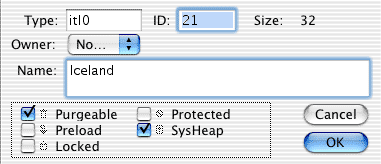
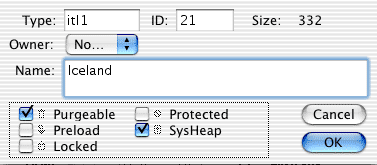
7. Now highlight your newly created itl0 21 "Denmark" resource and press the "Info" button.
8. Change the name from "Denmark" to "Iceland" - it should look like this:
9. Press "OK"
10. Double-click your newly created 21 "Iceland" resource.
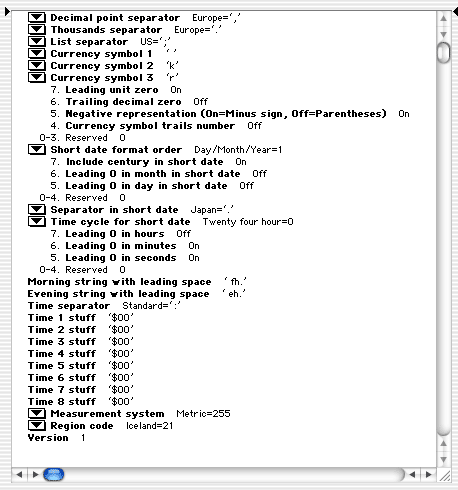
11. These are the items that need to be changed (double-click to edit item):
Currency symbol 1 - from 'k' to ' '
Currency symbol 2 - from 'r' (France) to 'k'
Currency symbol 3 - from '.' (Italy or Germany) to 'r'
6. Trailing decimal zero - from On to Off
4. Currency symbol trails number - from On to Off
Short date format order
7. Include century in short date - from Off to On
6. Leading 0 in month in short date - from On to Off
5. Leading 0 in day in short date - from On to Off
Seperator in short date - from '/' (US) to '.' (Japan)
Morning string with leading space - from '' to ' fh.' (note: leading space)
Evening string with leading space - from '' to ' eh.' (note: leading space)
Region code - from 9 (Denmark) to 21 (Iceland)
After the editing it should look like this:
12. Close the itl0 21 "Iceland" window and save changes.
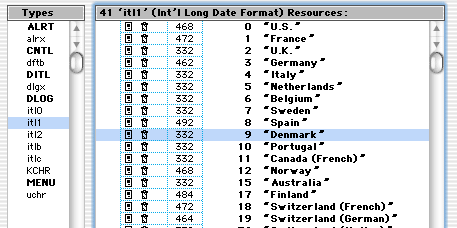
13. Now, from the "Types" field to the left select the "itl1" resource.
14. Select the "Denmark" resource in the field to the right (do not double click)
15. From the "Edit" menu select "Duplicate Selection" - you should get this window:
16. Change the number "13" to "21" and press the "Duplicate" button.
17. Now highlight your newly created itl1 21 "Denmark" resource and press the "Info" button.
18. Change the name from "Denmark" to "Iceland" - it should look like this:
19. Change the name from "Denmark" to "Iceland" and press "OK".
20. Double-click your newly created 21 "Iceland" resource.
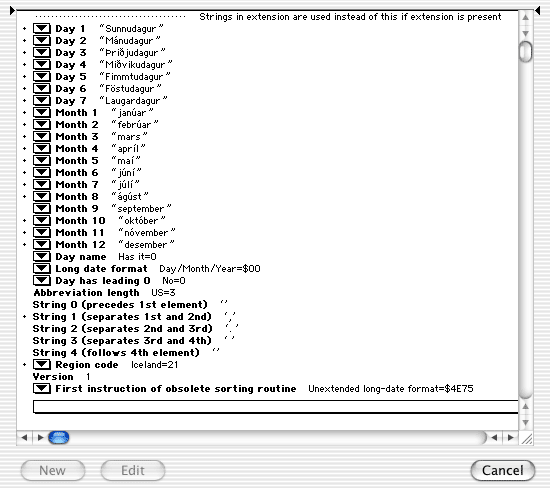
21. These are the items that need to be changed (double-click to edit item):
Day 1 - from "søndag" to "Sunnudagur"
Day 2 - from "mandag" to "Mánudagur"
Day 3 - from "tirsdag" to "Þriðjudagur"
Day 4 - from "onsdag" to "Miðvikudagur"
Day 5 - from "torsdag" to "Fimmtudagur"
Day 6 - from "fredag" to "Föstudagur"
Day 7 - from "lørdag" to "Laugardagur"
Month 1 - from "januar" to "janúar"
Month 2 - from "februar" to "febrúar"
Month 3 - from "marts" to "mars"
Month 4 - from "april" to "apríl"
Month 5 - from "maj" to "maí"
Month 6 - from "juni" to "júní"
Month 7 - from "juli" to "júlí"
Month 8 - from "august" to "ágúst"
Month 9 - unchanged (after all Danish is pretty close to Icelandic!)
Month 10 - from "oktober" to "október"
Month 11 - from "november" to "nóvember"
Month 12 - from "december" to "desember"
String 1 (seperates 1st and 3rd) - from ' ' to ','
Region code - from 9 (Denmark) to 21 (Iceland)
After the editing it should look like this:
22. Then close and save.
This step requires the use of a resource editor, such as Resorcerer.
Note: You can get the same result by using the freeware ResEdit (ToggleFork is not needed here, since you are working with MacOS 9 files).
1. Open Resorcerer
2. Drag the following file unto Resorcerer:
System Folder/System
3. From the "Types" field to the left select the "itlb" resource and double-click the "Roman" resource which appears in the large field to the right.
4. In the window that appears change "Language code for script" to "English=0"
5. Then close and save.