A New Calling
Download
Microsoft Word File
A
New Calling – The Beginning of the 2nd Missions
Trip
Acts 16:6-10, 11-15
Some
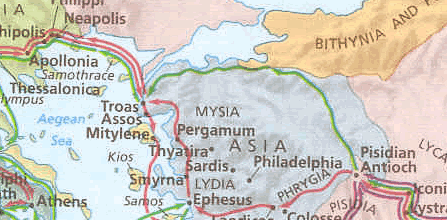
Background Info: Paul and Silas, now going separate ways from
Barnabas and John travel by land along the eastern coast,
checking up on the progress of the churches started in the
first missionary trip. He goes through
Antioch
and his hometown
Tarsus
to make a quick stop at
Tarsus
to pick up Timothy and our study
begins…
©1992 Zondervan Publishing House
Some
questions to ponder upon:
·
How
can the Spirit prevent something from happening?
·
How
willing are to take heed to the Spirit’s command?
·
How
can we communicate with God?
·
How
can God communicate with us?
·
How
quickly can we respond to God’s calling – in other words, what
is our spiritual reaction time?
In
the first group of verses we encounter, Paul is near the
northern portion of what is present-day
Turkey
(see
green line on map). With his troupe, they wanted to enter
into
Bithynia
,
“but the Spirit of Jesus would not allow them to.” Hmm, the
Spirit not allowing a group of apostles and evangelists into a
place that could use the gospel? Doesn’t that strike you as
strange? How in the world can something prevent you from
entering another region (besides the border patrol)?
Something that Paul had though was the right path to go, God
didn’t – He had other plans in mind.
So
Paul and his group, after flirting with the border for about
half a day decide to travel to
Troas
(known to ancient Greeks as
Troy
).
That very night, notice the timing here, Paul dreams and has a
vision of a man of
Macedonia
begging (beseeching) him to come and help them in
Macedonia
.
Immediately, the next morning Paul, Silas, Timothy, and now
Luke take off for
Macedonia
.
Also notice the timing there.
So
some topics come to mind – Isaiah wrote that “the wisdom of
the wise will perish, the intelligence of the intelligent will
vanish” (29:14). Why does Isaiah write about this and how
does it relate to Paul’s situation with
Bithynia
?
Secondly, take a look at the timing of
the situations. Paul wants to enter
Bithynia
, but God says no and delivers a
vision in the form of a dream that very night. What does Paul
do? He gets up and goes towards his new mission. How willing
are we to “get up and go” when God asks us to?
Now the second set of verses
puts the group in
Europe
, the first time the Bible
mentions ministry in the continent. And where do Paul and his
friends go to? They went straight to
Philippi
, “the leading city of that
district of Macedonia” (
16:12
). In order to make a change in
lives or to be effective in the missions field (notice
effective and not efficient), sometimes we must be
willing to risk going to the centers of power, the central
area of influence. Just think – while you could evangelize to
a group of say,
5
to 10 people
in your dorm, your classes, etc., imagine how many more you
could reach if you could evangelize to the leaders of your
school, your community, your city, the nations?!! And how
many more lives could they touch!
Now
in verses 13 through 15, Paul and friends went in search of a
place for prayer, to have a time to talk to God. Their minds
were focused on Christ at this point and see what happens to
them. Instead God led them to speak to women gathered near
where they had chosen to pray. God opened up the heart of
Lydia
, a
dealer of purple cloth, and opened up the door for her and her
entire family (her entire family too!) to be baptized.
Now two things arise from this situation – why does God change
up Paul’s plans again? And what is so special about purple
cloth? God knew what Paul was capable of and because of
Paul’s continual focus on God, he was used to preach to and
baptize an entire family. Now purple cloth during these days
was a signature of nobility, of royalty. Most often, only the
wealthy and powerful have access to purple cloth – meaning
Lydia
was
a wealthy businesswoman of her time.
So
to recap and to apply this study to our own lives:
·
Are
we willing to get up and go when God calls us to service like
Paul? Are we willing to listen to His word and His will for
us?
·
What
is the difference between efficiency and effectiveness?
(Efficiency is getting something done while effectiveness is
getting something done well and having an impact.) How can you
make your own personal ministry more effective?
·
What
is your main focus in life – family, friends, yourself,
certain goals, or God? How can you more effectively focus on
God? (With Paul, his “reward” for focusing on God was ability
to speak to and baptize
Lydia
’s
family.)
·
Do
you trust God and have the faith that He can move families,
college campuses, even nations? What can you learn from Paul
and his faith in these 10 verses? What can you learn about
ministry in these 10 verses?
Sources Used:
John Darby’s Synopsis of the New Testament
John Wesley’s Explanatory Notes on the Whole Bible
Scofield’s Reference Notes
The
Student Bible: NIV Version
|