Firm Foundations
Download
Microsoft Word File
Firm
Foundations
Romans 1:1-17
As
we read in the last Bible study, Paul shifted his focus of
missions to the Gentiles. While he never really gives up on
Jews, his target is now towards the Gentiles in the eastern
Mediterranean
,
primarily between present-day
Israel
to
present-day
Turkey
.
However, when he begins the book of Romans, Paul has a bigger
audience in mind.
Say
the word Romans. What images come to mind? Images of
a powerful empire, of a mighty army flash across our
imaginations. The leader of the world to all who lived during
that time period,
Rome
was
the center of government, law, culture, power, strength, and
learning. Paul had a big dream, he had a higher calling, he
wanted to, even longed to bring the news of the most
powerful empire known to humankind. What an interesting life
goal for a man who had never seen a Roman in his life when he
wrote this.
What
foundations does Paul lay down right away in the first seven
verses of Romans? He makes it very clear that his calling is
because of Christ and God’s mercy. He also identifies the
entire Trinity and how each works and manifests itself. In
essence, these are the fundamentals of Christianity that Paul
lays claim to immediately. Take a look at your own faith. Do
you make exceptions to the rule or do you stand firm on the
fundamentals?
Key
in on verse 9 “God, who I serve with whole heart in preaching
the gospel of his Son…” Does Paul go out and half-heartedly
say a few words about how great God is then retreat back into
his group of Christians? Do great generals go into battle to
barely poke the enemy and then retreat back to the
stronghold? This is a nice reminder for when we are in the
ministry field.
Now
let’s take it further a step. Not only should we serve with
our whole heart, Paul tells us to be “not ashamed of the
gospel, because it is the power of God for the salvation of
everyone…” (verse 16). Can a person serve God with their
whole heart and still be ashamed of the gospel? This leads to
another question: can a person who’s ashamed of what they
believe in serve God with their whole heart? Notice that Paul
talks about the power of God again in this verse. How often
do we see God’s power at work in today’s world? Is it a
matter of the God not revealing it, our own spiritual
blindness to it, or a matter of faith? Do we believe that God
can still perform miracles in today’s world?
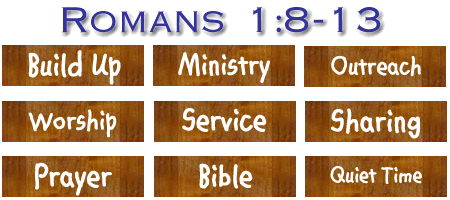
Now
backtrack to verses 8-13. Paul lists the integral parts of
living the Christian life. In verse 8 there is praise and
worship, in verse 9 Paul talks about serving God and
foundation in the Word, in 10 he touches upon prayer, in 11
sharing, in 12 Paul writes of encouragement through meeting
with other Christians, and in 13 team evangelism. So how does
one connect all of these (remember in a previous lesson how we
did a foundational
hierarchy with knowledge coming before wisdom before
power?)? Well, we start with the basics of Christian living –
prayer, reading the Word, and quiet time with God. From there
we understand praise and worship, serving God, and sharing our
faith. And beyond that, as we mature in faith, we learn to
encourage and build up one another, team outreach, and
personal ministry. (Each aspect will be covered in future
lessons.)
Finally, we finish this foundational building lesson with
verse 17. What does it mean by “the righteous will live by
faith”? And why does Paul quote the rarely used book of
Habakkuk? To give you a hint, Martin Luther and the
Reformists used this verse as their rallying cry for the
Protestant Reformation. Ladies and gentlemen, men and women
of God, are we the ones who will live by faith from first to
last and everlasting to everlasting?
Sources Used:
John Darby’s Synopsis of the New Testament
John Wesley’s Explanatory Notes on the Whole Bible
Scofield’s Reference Notes
Geneva
Study Bible
The
Student Bible: NIV Version
|