Week of May 13, 2001
Hello all,
The devil is in the details. Not long ago I was visiting another medical school about this time of year and every first year medical student I talked to told me that they had no idea why anyone would put themselves through the "hell of medical school." Hellfire and brimstone often seems preferable to the endless competition to learn various biochemical, anatomical, and physiological minutiae. Here is an example. Last block in biochemistry we studied the citric acid cycle and were responsible for the biochemical structures and names of intermediates, names and actions of enzymes, coenzymes, reaction mechanisms, substrates, products, cellular location, regulation, and amount of energy equivalents produced to name a few. Detailed knowledge on this level was also expected glycolysis, gluconeogenesis, glycogenolysis, glycogen synthesis, the pentose phosphate pathway, pathways for the interconversion of sugars, and the electron transport chain. Those were the topics covered on just the first half of the four hour biochemistry test last block. Is it any wonder some would prefer physical agony to this mental anguish?
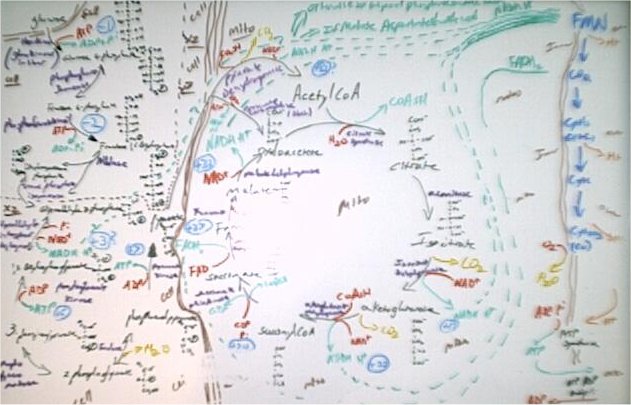
My study board for the citric acid cycle and some other pathways.
Yet, there are those who seem to enjoy medical school and most medical students probably find themselves in this category at one time or another however fleeting it may be. For me the difference lies in my perspective. Rather than becoming bogged down in the intricacies of life, if I can mentally step back to notice the bigger picture I get a feeling expressed by Shakespeare's Hamlet in a quote that begins, "What a piece of work is man!" . Here is another example. This block we are studying respiratory physiology, the lungs. In a lecture last week our professor could not help but use the words design and miraculous engineering to describe the initial 0.3 seconds of a newborn infants first breath. In just that short amount of time the lungs convert from a fluid filled solid mass to an air filled collection of 300 million bubbles called alveoli. At the same time the newborn's circulatory system goes through some radical changes in order to switch gas exchange from the old placenta to the newly functional lungs. In order to accomplish this task the baby's body must be well prepared. Surfactant (like dishwashing soap) must be produced to overcome surface tension so that the lungs can expand, but not so much that the alveoli remain distended (surface tension is required for proper exhalation of air). The fatty substance dipalmitoyl phosphatidylcholine that makes up about 80% of the surfactant has exactly the right chemical makeup to maintain the surface tension at the necessary level. I could go on about the neural pathways necessary to stimulate the first breath, the muscular tone developed so that the diaphragm contracts with sufficient force, the carefully balanced osmotic pressure so that the fluid is efficiently moved into the vascular system, and the marvelous design of the valves, shunts, and pressure differences that causes blood flow to convert nearly instantaneously to an adult flow. . . . But, the important thing is this, the more I learn about the daunting detail in just the human body the more certain I am in a divine engineer who gave us the breath of life. God is in the details.
I hope you enjoyed this little philosophical foray, and had a Happy Mothers Day! Have a great week.
Brenton Reading