October 24,2001
Name—Warren & Gwen Darling, Wil, & Ben
Location Bethany, Ontario
Farm Name—Little Darling’s
E-mail address—[email protected]
Flock Size, -- Currently 230 ewes, 7 rams, and 4 llamas, 2 LGDs
Breeds in Flock Commercial Rideau X Dorset ewes, Charollais rams
Acreage, -- 139 acres purchased in 1996. First sheep purchased in November 1996.
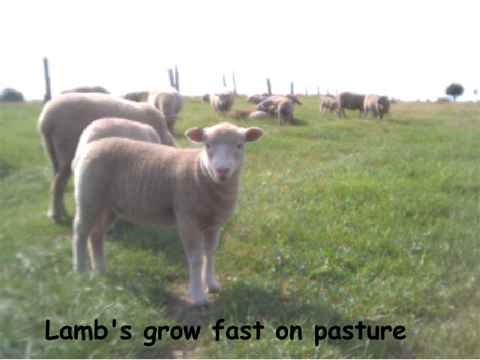
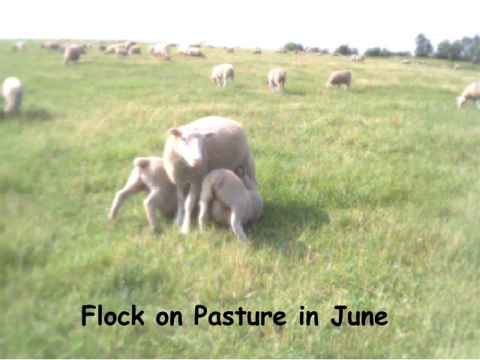
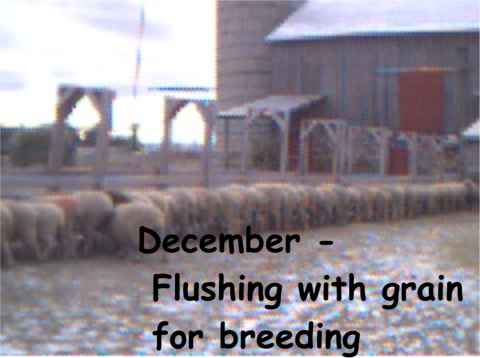
Production practices and information— Ewes flushed for breeding in December & January; Rams introduced December 25. The flock is sheared and pregnancy tested via ultrasound in March, and vaccinated in first week of May. Lambs arrive the last 2 weeks of May & the first week of June - some are born on pasture, all are on pasture at 2 days of age. They are weaned in August.
Marketing Strategy—65-80 lb lambs in summer are sold at Cookstown. The biggest lambs are marketed straight off grass. The rest are weaned and fed free choice hay with limited commercial lamb grower mix.
Ewes feed on grass in summer (rotational grazing) and free choice hay in winter. Labor is at a premium so hay is fed as round bales in feeders - set out once a week. Grain is only fed in December and January during breeding, or in exceptional cases like year 2000 when the quality of hay was poor. Ewes lose a lot of condition during lactation, but since they only lamb once a year, they have time to gain the weight back.
Lambs get grass and ewes milk. Some are finished on a commercial lamb grower and hay. In exceptional years like 2001, the pasture was supplemented with round bales of hay.
solutions
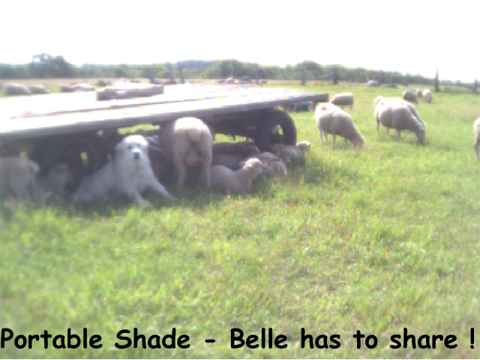
Coyotes are constantly testing the pasture. I have miles of high tensile electric fence, llamas, and 2 LGDs. I got the second dog this spring, and now when the coyotes howl at night, I can sleep peacefully. The fence, although effective, is not enough. Llamas are very effective against 1 or 2 coyotes, but cannot handle the ones that hunt in bigger packs. A single LGD is effective, but the coyotes seem to be able to sense that there is only one and test the dog constantly. With a second dog, the coyotes respect the dogs’ territory and keep their distance.
Flock Health Program—All animals are vaccinated annually for clostridial diseases, and treated for internal parasites as required. Only Rams from flocks with known health status are introduced. Visitors from farms are asked to wear clean coveralls and boot covers are supplied.
Breeding Strategy—Charollais rams are used on Rideau X Dorset Ewes to produce market lambs. This is the target breeding strategy.
Also, Rideau rams are used on Dorset ewes to produce breeding replacement Rideau X Dorset females
And finally, Dorset rams are used on my original Charollais X Dorset ewes to produce market lambs and a few Dorset replacement females.
In the future, I am considering simplifying this process. If I could purchase quality replacement Rideau X Dorset ewe lambs from a flock with a good health status and at a reasonable price, I would not need Dorset or Rideau rams.
sale.—Breeding Stock—We now have more replacement ewe lambs than we need. These are sold in late August – those not sold are shipped to Cookstown.
I’m pretty new to this business, so my comments would be directed at newcomers. You can avoid a lot of pitfalls and learn a lot in a short time by attending classes, farm tours, joining the local sheep club, etc… The OSMA sheep reps are very knowledgeable – often they have more experience than the local vet.