|
ARTE Y
ESPIRITUALIDAD
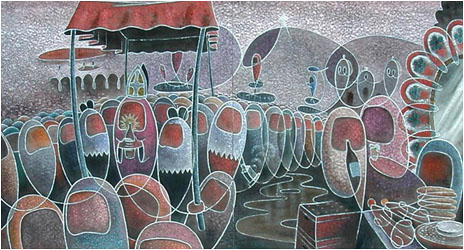
El tema de la serie 'HABITANTES DEL TIEMPO' es definitivamente de un contenido
extraido desde las mas hondas interioridades del ser, aquellas
en que mora la esencia misma de su existencia: el Espíritu,
habitante de la intemporalidad del tiempo y la infinitud del
espacio, parte fundamental de esa trilogía que complementada
con nuestra estructura física e intelectual (cuerpo y alma)
constituye nuestra humanidad.
Es aquí donde la
temática de cada cuadro evoca, en tono de denuncia, una nueva
religiosidad supuestamente sincrética, que unas veces es una
mezcla (¿mestizaje?) de ritualidad andina y paganismos traidos
de ultramar y otras, expresiones puras de cultos idolátricos
ancestrales nuestros o sustituciones también idolátricas de
estos ('Sustitución Idolátrica').
La masificación de estas
prácticas crea la necesidad de utilizar los medios más
accesibles al artista, su pintura, para mostrar la disyuntiva en
que cada quien debe, reflexivamente, ubicarse.
Insta pues esta pintura,
a tomar una actitud vivencial correcta, una senda: la Luz de la
verdad ('Habitantes de la Luz') y desechar la oscuridad, el
engaño en que nuestra sociedad se va sumiendo cada vez más con
la connivencia oficial ('Deut 5:6-10').
Volviendo al tema del
'Sincretismo', el termino alude a una fusión de costumbres
rituales y sociales en torno a un asunto de fe. Esto implica el
mestizaje de los aspectos formales y aún ideológicos del
fenómeno, es decir, lo material y lo intelectual (otra vez:
cuerpo y alma) mas no llega al estamento primordial: el
Espíritu. Y es que en estos niveles tal fusión es imposible,
pues hablamos de agua y aceite; eso es lo que son las fuerzas
que gobiernan los reinos de la Luz (la verdad) y las Tinieblas
(la mentira) en cuanto a integrarse, algo que la casta eclesial
conoce y retiene.
Ese es el mensaje que
estas obras intentan regalar a quienes entreguen su sensibilidad
y receptividad.
Oskar Olazo |
 |
ART
AND SPIRITUALITY
The subject matter of the series INHABITANTS OF THE TIME' is
definitely that of the content extracted from the deepest interiors of the
human being, where dwells the very essence of the existence: the Spirit,
inhabitant of the intemporality of the time and the infinity of the space,
the fundamental part of the trilogy that, complemented with our physical and
intellectual structure (body and soul), constitutes our human entity.
It is here where the subject of each painting
evokes in a tone of accusation a new religiousness, supposedly syncretic,
which at times is a mixture of the Andean rituals and the paganisms brought
from the other side of the ocean and others, the pure expressions of our
idolatrous ancestral cults or their substitutes, also idolatrous
('Idolatrous Substitution').
The mass diffusion of these practices creates the
necessity for the artist to use his most accessible medium, his
painting, to show this dilemma, in which everyone should reflexively find
his place.
Thus, the paintings make us choose the right
position in life, the path: the Light of the truth ('Inhabitants of the
Light') and reject the darkness, the deceit in which our society is sinking
deeper and deeper thanks to the official connivance ('Deut
5:6-10').
If we turn again to the concept of the
'Syncretism', the term alludes to the fusion of the social and ritual
customs around the matter of the faith. This implicates the mixture of
formal and even ideological aspects of the phenomenon, i. e., the material
and the intellectual sides (again, body and soul), however it does not reach
the essencial level: the Spirit. And the problem is that on this level the
fusion is impossible, because we are talking of water and oil; these are the
forces that govern the realms of the Light (the truth) and the Darkness (the
lie) when it comes to the integration, the fact that the clergy knows and
retains.
This is the message that the paintings try to
reveal to those who contribute with their sensitivity and receptivity.
Oskar Olazo
|