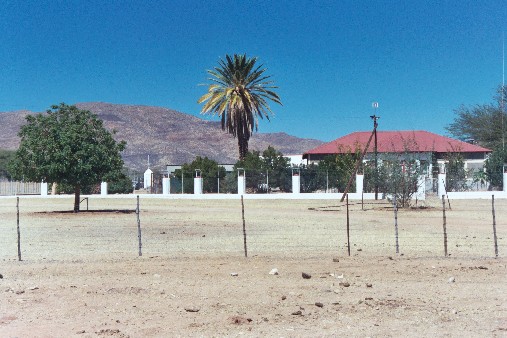
Typical farm house in Erongo mountains
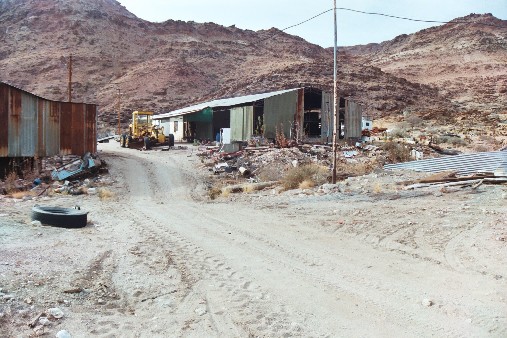
Junkyard at Pofadder farm house
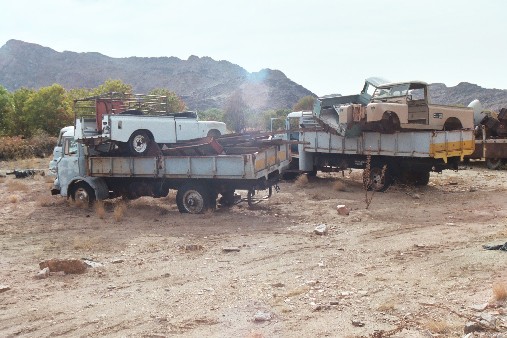
Junkyard at Pofadder farm house
Before we headed down to Uis in order to climb Brandberg from there, we first toured around extensively in the Erongo mountains. That was a very beautiful area with interesting rock formations with farm houses in between. The farm houses themselves were nicely built, which contrasted well with the environment. Behind them, there was usually a kind of junk-yard for old cars. The land is kind of tough on cars sometimes: On August 12, we went to some hear-say camping to spend the night there. The road toward it was tricky because the Nissan had a rather low ground clearance. We continuously heard the bottom of the car scrape the road. In Etosha, Russell had already torn off the bumper, so we tried to spare the car a bit.
|
Typical farm house in Erongo mountains |
Junkyard at Pofadder farm house |
Junkyard at Pofadder farm house |
When we reached the camping, there seemed to be no-one there at first, and then your typical native African suddenly came out of the bushes. We tried to talk to him in various languages (Afrikaans, German, and English) but he kept on walking and just smiled. We he reached a small stone cottage, he took out a green map and started to give each of us a piece of paper, which said: "His name is Israel and he cannot read or write. He speaks very little Afrikaans and is still learning English. He will arrange everything for you. Enjoy your stay." Though nearly unbelievable, everything was arranged beautifully, even providing hot showers. At candle light though (also provided), because electricity was not there. This meant we could not splash too much, otherwise the light would go out.
|
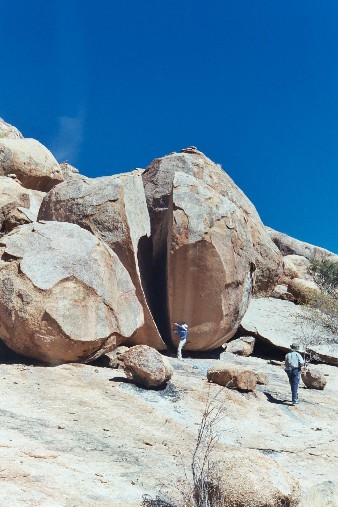
Split boulder in Erongo mountains |
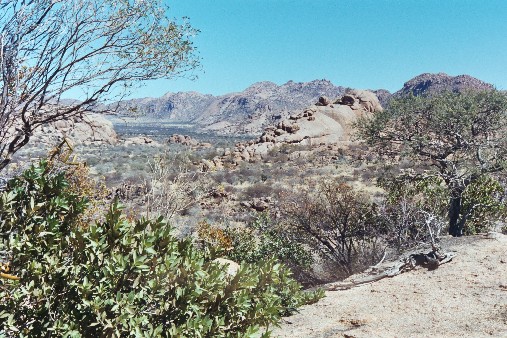
Erongo mountains |
We thought this luxury could only improve once we would hit a real town: Uis. What a mistake that was. When we arrived in Uis, we heard that water was only available from 6 to 8 in the morning and in the evening, and for an hour during lunch. That is logical, we thought, because there was a severe drought in Namibia, so people had to use water thriftily. However, the guys that ran an internet cafe told me a different story: Although the citizens dutifully paid their taxes, the county could only pay the water company 12 % of what they owed them. The rest of the money had mysteriously disappeared. Oh well, I guess that suits Africa too.
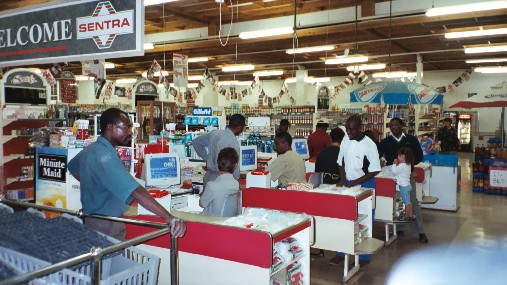
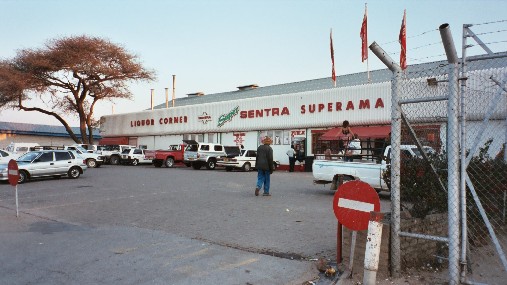
What surprised me everytime I saw it, was the modern look of the cities. There are no cottages like I had seen in Kenia and Tanzania, but decent houses. And instead of bartering over exotic foods on local markets, I could get nearly everything I was used to in the local supermarkets, varying from bread to chocolate. wend was, van brood tot chocola.
|
Supermarket in Tsumeb |
Supermarket in Tsumeb |
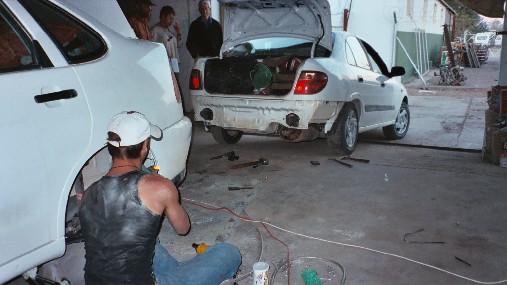
Our cars did not always held up that well on the Namibian roads. Both vehicles started to rattle strangely beneath our feet. Russell had already torn off the rear bumber in Etosha (which was his own fault though), and the VW Polo got two flat tires. The first flat tire was on the road to Solitaire, before Naukluft. It was changed quickly, and the flat tire was repaired in Solitaire and put on the car again. However, there were only non-licensed mechanics in Solitaire, which we noticed later on. After a week and a half, the tire exploded, blowing a hole in the wheel case and causing the bumper of the VW to hang loose too. Therefore, we had to have both cars repaired in Mariental (for a laughable � 46,-).
|
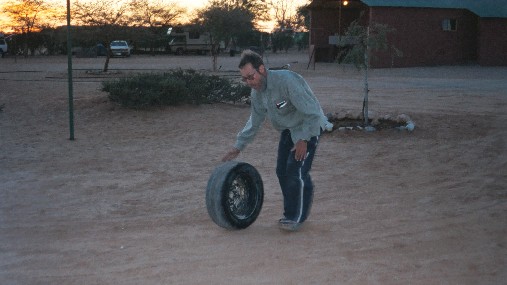
Russell with repaired flat tire in Solitaire |
Repairing both cars in Mariental |