75 cm freshwater crocodile in water
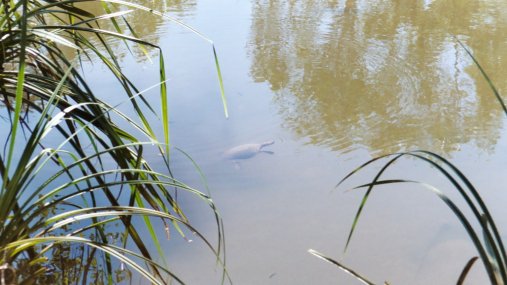
Turtle in Palmondoora creek
A long bushwalk of 4 weeks, only interrupted by a food-drop by helicopter after the first 2 weeks. That is what Daan and I had intended to do, and that is what we did. And of course, Willis's Walkabouts was again the only organisation that was able to realise that. Two of Russell Willis's guides led our walk: Peter (Tommo) Tomlin during the first 2 weeks, and Bruce Swain during the last 2 weeks. Apart from Daan and me, Colin Johnstone was the only other customer that was doing the full 4 weeks. All the other walkers only did the first or only the last 2 weeks. Halfway, 2 helicopters would take care of flying in and out the food and the people. The first 2 weeks, there were 8 of us: Daan, Colin, Tommo, Dorothee, Ingrid, Ray, Dennis, and me. The second 2 weeks, we were with nine: Daan, Colin, Bruce, Jenny, Patricia, Neill, Ronda, John, and me.
The first 2 weeks did not start out well: The day before, Daan and I had suffered a genuine food poisoning. The day before that, we both had done a sunset cruise where the only thing that we had both eaten had been a salmon dip-sauce during the sunset. The day on which we left for the walk, we were still sick from a restless night and weak from hardly eating for the past couple of days. In the morning, we flew by airplane (6 seater, 1 propellor aircraft) to Kalumburu, an Aboriginal community. From there, we were driven by car to the Drysdale river. Although we were still quite weak, that is when the 28-day walk started there for us.
The first day was very tough for us. Instead of making camp as quickly as possible, the guide decided to move on for a couple of kilometers more, even though we had told him about our situation the night before. As the terrain got tougher, Daan and I simply could not continue anymore. "I want to make camp soon, I don't feel too well." says Daan at that point to the guide. "Are you drinking enough?" is his response. Instead of answering, Daan throws up behind a rock. That convinced the guide that we really had to stop. Finally. That evening, we could eat something at last, and after a good night's rest, we could keep up just fine the next day.
When the food poisoning had subsided, things were improving quickly. That is until the skin of my feet started to come off. There were no blisters, but the skin just came off when I rubbed it. After a week, the guide lent me a pair of his socks, which started a definite improvement of my feet. Until then, I had been walking on thin socks. The borrowed socks were thicker and whooly to the touch, which was far better.
After that, the soles of my shoes started to come off, which is scarier, because without shoes you don't get very far in the bush. Two glueing actions later, my soles came off completely after the third week, while we were still walking towards a good camping spot. An emergency repair with superglue made my sole stuck back to my shoe again, and my shoe to my knee. With a swift action I managed to un-glue my knee again, at the cost of some hair and a tiny piece of skin. And after that, all went a bit better.
At the end of the 4 weeks, my shoes had been worn out so much on both the inside and the outside, that I left them in Australia in a rubbish bin. After my holiday in 2001, I had had my shoes re-soled at the outdoor shop where I had bought them. During the walk, my fellow companions told me that re-soling gives very unreliable results. It was a well-known problem that re-soled shoes tend to reject the new soles.
In addition, Australia is a very harsh country for shoes. Bruce told me that he had been walking in Patagonia for 9 weeks without so much as a scratch on his shoes, and during this walk, they had been half worn. The problem is that Australia consists of so much lose lumps of sandstone, varying in size from pebbles to houses. It is sharp and raw material (but also brittle) which works on shoes as sandpaper on wood.
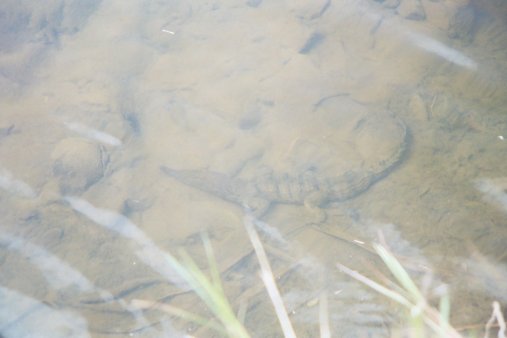
During the walk, we passed along 4 large rivers, Drysdale, Carson, Palmondoora Creek, and Morgan. In there, we often saw fresh-water crocodiles, and we even swam with them, but not too close of course. Although they are not dangerous to humans, they sometimes started to show territorial behaviour toward us.
At a certain point, we had found a nice spot next to the water for lunch. As usual, we sat ourselves down and prepared for a swim. Neill was first in the water and was splashing about when we suddenly heard a vague growling sound. It became stronger and eventually we saw a crocodile of little more than a meter swimming toward us. With each splash, it curled itself upward half out of the water while uttering a low growl.
I realised my chance for a nice swim was disappearing, so I jumped in quickly before the crocodile got any closer. With a big jump I plunged into the water. When I surfaced again, Daan yelled from the shore: "It has gone under now." Two seconds later I was ashore again (and Neill as well), but we never saw that crocodile again.
|
75 cm freshwater crocodile in water |
Turtle in Palmondoora creek |
Furthermore, we saw some wallabies here and there (maybe half a dozen in total), about 2 or 3 snakes (1 was not poisonous, but the others probably were), and many spiders and snapping turtles.
What I won't be missing are the thousands of flies that bugged us with their presence. There were a lot of cows in the Drysdale park, which resulted in lots and lots of flies and cow dung. You get used to the flies sitting on you body (an average back of an average bushwalker would always carry about 40 of them), but you do not get used to them crawling into your ears, eyes and nose. They were always looking for moisture and simply left our food alone. With 30 to 35 degrees in the shade, and way over 40 in the sun, we were sweating beads while carrying our 25 kg backpacks. As soon as we had taken our packs off, many hundreds of flies landed on us to suck up the (sweat-)moisture.
Contrary to the cattle in the Dutch meadows, the cattle in Drysdale moved with grace and with deceptive ease over the most difficult of terrains. These were no animals that you could outrun, let alone while carrying 25 kg on your back. Usually, the animals fled from us, but not always.
On one occasion, all 8 of us were standing in front of a very big bull with a really well-shaped set of horns. At a distance of about 15 to 20 meters, we were looking eachother straight in the eyes. Making noise with water bottles and cutlery and by means of shouting didn't change anything. The bull remained motionless. Jokes were being made like "That tree is mine", and in my mind I was going over the motions needed to untie my backpack so I could run faster. When I looked back, I saw Dennis standing at a very respectable distance from us; half turned back and ready to run.
|
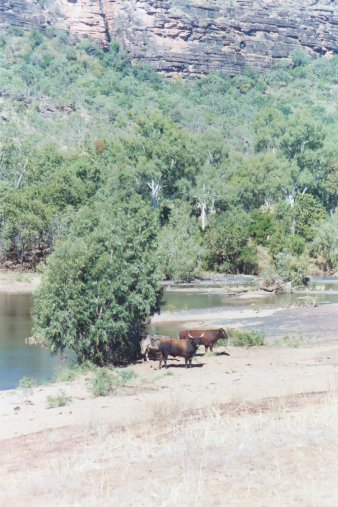
Cattle watching us along Carson river |
After what seemed to have been an eternity, but it couldn't have been more than a short minute, the bull turned his right side toward us. Spontaneously, we started cheering, which we should not have done. As if it had felt insulted with the idea of having lost, the bull turned to face us again. The game started anew. The guide (Tommo) and Colin took several steps closer, but the bull did not move, and the tension in my throat reached a new climax.
Once again, the bull turned his right side toward us, and, even though we should have known better by now, we burst out into cheering again. Again the bull turned back to face us. It was just like a bad movie, but rather one I would have preferred to see in a cinema. The trees around us were not really solid; a slightly angry bull would go right through them. I did not like this at all anymore and had almost decided to walk around the bull and his cows by myself in a very big semicircle.
Suddenly, we saw the bull's cows starting to move between the trees. Were they running away? No, they were coming straight toward us, the bull got re-inforcements. This settled the stare-down in our disadvantage and everyone turned around and started to walk away as quickly as possible, trying to avoid running in blind panic. After having gone a couple of paces, we turned around to look at the bull. We saw nothing. He had run off with his cows as soon as we had turned away ourselves, and far to our left they were running among the trees. We could move on at last, but I can't say that I felt omnipotent. On the contrary, I had obtained a new healthy respect for nature which I would not quickly forget.
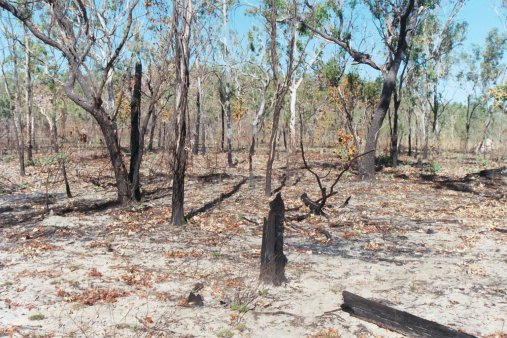
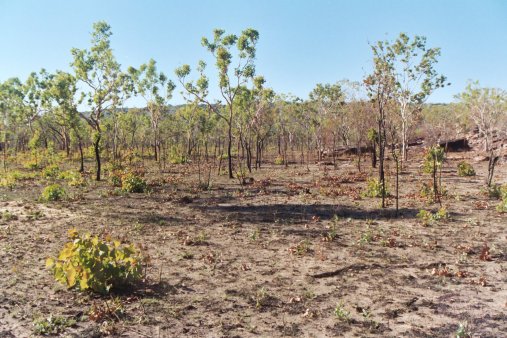
A not so nice property of the Drysdale park is that about 50 % of it has been burned. Since long ago, Aboriginals have been burning their environment. Nature had adapted itself and there was a good symbiosis of Aboriginals and nature. However, because of all the misery that white man poured out over the Aboriginals, that tradition has largely disappeared. White man now realises this, and they try to re-establish the old way of nature management again.
Sadly, the Aboriginals themselves do not know anymore how the burning has to be done. The chairman of the Kalumburu community continuously complained about his fellow tribesmen, because they were "messing around" as he put it. The facts sadly seem to agree with him. In many places, the environment has been burned incorrectly, which means that everyhing there is dead. Where it has been done correctly, new growth can soon be seen shooting up again. For the main part however, Drysdale gives a depressing impression with all the burned trees. Furthermore, the ashes on the ground create very fine dust that whirls up during walking, which is not very pleasant (let alone healthy).
|
Result of early burning this year (renewing) |
Result of late burning this year (depressing) |