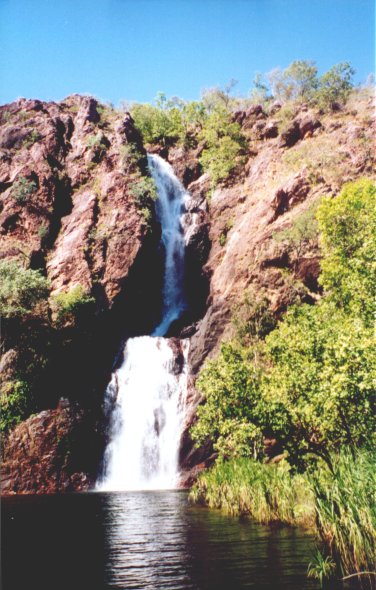
Waterfall in Litchfield National Park
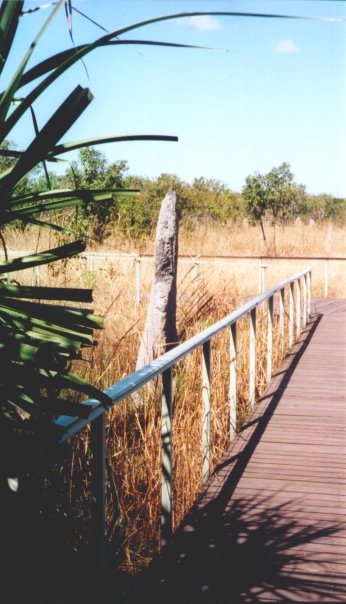
Magnetic (northward facing) termite mounds
Northern Territory Wildlife tour
The flight to Darwin (from Schiphol) was very very long. First to London (flying 1 hour 20 min + waiting 50 min), then to Singapore (flying 12 hours 55 min + waiting 4 hours 35 min), and finally to Darwin (flying 4 hous 30 min). The total flight time was therfore 24 hours and 10 min. Added to that, we were required to check in 2 hours in advance, and Daan and I had to take a 2 hour train ride from Enschede to Schiphol as well. Because of the reputation of Dutch Railways with respect to schedule keeping, we left an hour earlier than necessary. We can pride ourselves in the fact that we almost fully used up that extra hour, because the carriage in which we sat broke down. It had to be pushed further by another train going in the same direction. The train ride took us 3 hours instead of 2, which brought the total trip time to over 29 hours.
In Darwin, it appeared that my luggage had not arrived (Daan's had), for which we spent a long time filling out forms. We also had to wait our turn because we were certainly not the only ones. Qantas gave me a small pack with toiletries and something to sleep in so I could survive the local hotels while waiting for my luggage, which would take 2.5 days. We had landed wednesday morning at half past 4, and finally, at friday 5 in afternoon, I got my own stuff back. Thankfully, I had been prepared for this hassle by filling my daypack with the most essential items, so I was't completely at a loss.
Being a tourist, you are put in the touristic centre of Darwin. And tourism has been made into such an art by the Australians that they even have a special word for the typically Australian souvenirs: Australiana. Shops with Australiana were packed with T-shirts and signs with very comical (for once) lines. The crocodile with its row of fangs was present on many a T-shirt. It was interesting though, that I did not see anyone actually wearing them. Neither did I see the kangaroo- or the koala-dolls outside the shops. But I should also mention that Darwin's centre was full with souvenir shops, so I guess there must be a market for these items.
On our homeward journey, we arrived in Darwin with a regular domestic flight from Alice Springs, and were taken to the centre with a bus. This was a normal public transport bus in which also people sat that lived in Darwin and were returning home. However, for the sake of the tourists, the bus ride was turned into a small sightseeing trip in which the driver happily provided the commentary. I was amazed, especially because I was used to the downright rude tone at which Dutch bus drivers speak to you (if they speak to you at all). Being tourists, we liked the sightseeing, but just image being a Darwin citizen returning home after a long and tiring journey. Wouldn't you rather have a rude driver that shuts his mouth and simply drives you home along the most direct route possible?
Daan and I spent the night in backpacker's hotels: cheap accomodations for tourists with backpacks. At 22 dollars a night, you can get a bed in a room for 4 people. You do not know who the others are, you do not get breakfast, and showers and toilets are shared with the entire corridor. Still, this was not as bad as it may seem. We were in the "Melaleuca", a building with about 100 rooms. There are clean sheets, the beds are reasonable, and the whole place is cleaned thoroughly every day. At night it is reasonably quiet: there is to be no talking after 10 o'clock in the evening, and the people obey that rule. In addition, there is a very nice etiquette not to disturb your roommates when they are sleeping, even if they do that in the middle of the day. This etiquette was very much appreciated by us when we arrived at 7 in the morning after our 29 hour journey with no sleep but with a jetlag.
Most guests of backpacker's hotels were young people travelling through Australia for a couple of months or even a year. The English (which made up about half of them) usually could find a job because English was their first language. For the others (also a lot of Dutch people) there was usually no work left. They were second choice in hotel and catering (English were preferred) and wages for jobs on fruitfarms consisted of food and a bed only. All this made travelling in Australia quite expensive. Although backpacker's hotels were cheap, it still cost about 600 dollars a month. And then you still had to eat.
We booked this trip at AAT Kings in Darwin at about 100 dollars a person. They picked us up at half past 7 in the morning with a big touringcar, with which we were driven from one beautiful spot in Litchfield National Park to another. The tour seemed to have been tailored to Japanese: at each spot we got a certain time to look around (not long enough), then the bus moved on. In a lot of places (at the waterfalls and the magnetic termite mounds), a boarded pathway led you up to the most photogenic spot. There, we took turns in leaning forward to shoot a great picture, and then we moved on again, This tour brought us to really beautiful spots, but for me personnally, there was no real satisfaction. I only get that when I have to make something of an effort to get there. This tour however, is very relaxing.
|
Waterfall in Litchfield National Park |
Magnetic (northward facing) termite mounds |
This day trip (also about 100 dollars a person) was also booked at AAT Kings in Darwin. The trip itself however, was run by NTAT (Northern Territory Adventure Tours). The start was again at half past 7 in the morning, and the morning was spent in the Northern Territory Wildlife Park: a zoo with only those animals that live in the Northern Territory. We really needed a full day to look at everything in the park, but we got only a half one. Interesting fact was that almost all marsupials, except for kangaroes, were in nocturnal houses. Outside were mostly large animals like cows, pigs and camels: foreign species (feral species).
The tour led us on toward a crododile farm, which bred these animals for their hides and meat. The eggs for breeding were to a large extend taken from the wild. Apparently, the crocodiles did not really suffer from this, because their numbers were still increasing each year. We were also taken on a riverboot, from which we could see crocodiles swimming high up from the water to get a piece of meat hanging from a stick. It was nice to see these 4 to 6 meter long creatures do something else but lying lazily in the sun. The tour ended with a visit to Fogg-dam: a failed experiment to grow rice in the Northern Territory at a large scale. After that, the area has remained a wetland. I must conclude by saying that this tour was well worth its money.