Animals
Aggregate
Anemone
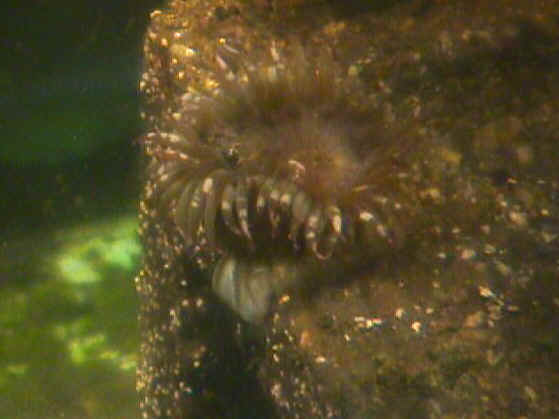 The aggregate anemone or Anthopleura
elegantissima is very common to the Puget Sound, especially near Seahurst
Beach. The anemone is of light yellowish-green color with purple tipped
tentacles. The base of the anemone is usually covered with small objects
such a s shell fragments to protect it while it is out of the water.
The aggregate anemone or Anthopleura
elegantissima is very common to the Puget Sound, especially near Seahurst
Beach. The anemone is of light yellowish-green color with purple tipped
tentacles. The base of the anemone is usually covered with small objects
such a s shell fragments to protect it while it is out of the water.
When the aggregate anemone is under water it
waves its tentacles to catch its pray. Special cells called nematocysts
assist by stinging pray.
The common form of reproduction among anemones is
called budding. Budding is asexual and is most easily described as
cloning.
Back to the Top
Bat Star
The bat star or Patiria miniata is a unique sea
star. It has a very rough dorsal surface. The bat star can be
identified by the webbing between its arms. It will feed on other sea
stars.
The Patiria miniata is used by scientists because
it can reproduce throughout the year. Most stars con only reproduce in
spring or summer.
Humans are the greatest enemy to the sea
stars. They are collected for science and decoration purposes.
Oyster farmers kill the stars found in their oyster beds. Oil spills and
other forms of pollution kill many organisms including sea stars.
Back to Top
Blue Mussel or
Bay Mussel
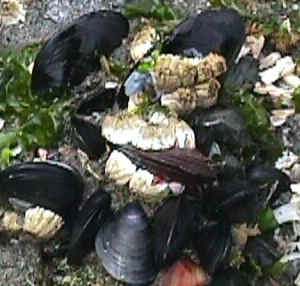 Mytilus edulis is better known as the blue or bay
mussel. It is about four inches long and two inches wide. It is a
very deep bluish purple color. Mussels will attach themselves with
their byssal threads to almost any surface including other mussels.
Mytilus edulis is better known as the blue or bay
mussel. It is about four inches long and two inches wide. It is a
very deep bluish purple color. Mussels will attach themselves with
their byssal threads to almost any surface including other mussels.
Blue mussels are filter feeders. Their main
predator is the starfish who use their arms to pry shells open . Humans
use muscles as food.
Muscles will reproduce to the point where they
take over the whole beach if predators are removed. If this happens the
marine ecosystem will be thrown out of balance.
Back to Top
Common
Barnacle
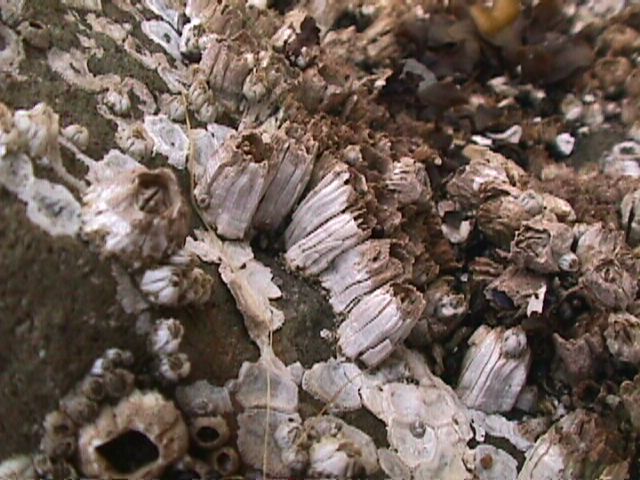 Common barnacles are one of the most abundant
organisms on many beaches including Seahurst. Their scientific name is
Balanus glandula. They live attached to rocks in the mid and low tide
zones. Their shells are strong and usually sharp.
Common barnacles are one of the most abundant
organisms on many beaches including Seahurst. Their scientific name is
Balanus glandula. They live attached to rocks in the mid and low tide
zones. Their shells are strong and usually sharp.
Barnacles are hermaphroditic. They cross
fertilize eggs and then release them into the ocean. The eggs form into
cyprid larva which attach to a rock where they will stay for the rest of their
lives. Common barnacles tend to grow tall opposed to wide because of
crowding problems. They filter feed for plankton.
Back to Top
Dungeness Crab
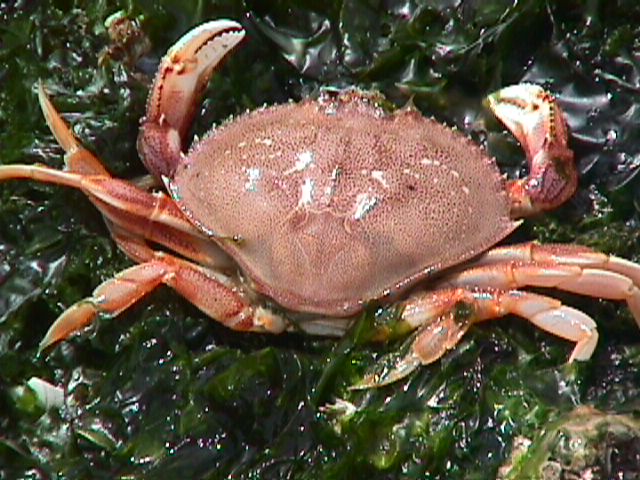 Cancer Magister is a crab commonly known as the
dungeness crab. It is between seven and nine inches wide and four to five
inches long. The top of this crab is reddish brown and the bottom is a
yellowish color. It lives all along the Pacific coast.
Cancer Magister is a crab commonly known as the
dungeness crab. It is between seven and nine inches wide and four to five
inches long. The top of this crab is reddish brown and the bottom is a
yellowish color. It lives all along the Pacific coast.
Dungeness crabs are very important commercial
crabs, as are its close relatives C. irroratus, C. borealis, C. productus, and
C. antennarius.
Dungeness crabs must shed their shells every time
they grow. When they regrow their shells they have the ability to regrow
lost body parts.
Back to Top
Heart Cockle
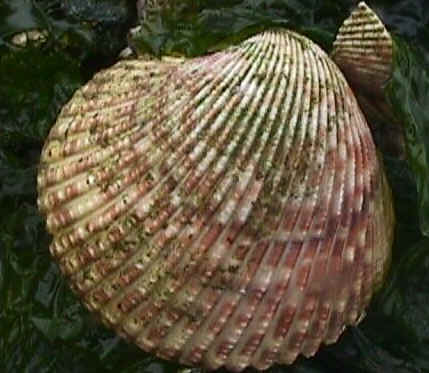 Heart cockles are in the family cardiidae.
They are much like both clams and scallops. The heart cockle or
Clinocardium nuttallii was commonly found on Seahusrt Beach in the summer of
1999, but not as commonly in the summer of 2000.
Heart cockles are in the family cardiidae.
They are much like both clams and scallops. The heart cockle or
Clinocardium nuttallii was commonly found on Seahusrt Beach in the summer of
1999, but not as commonly in the summer of 2000.
Cockles are edible, but presently are not
abundant enough for a large commercial market.
The heart cockle's shell coloring is a mixture of
reds, oranges, and whites. It is very strong. Cockles have short
siphons. It usually buries itself in the sand below the low tide mark.
Back to Top
Hermit Crab
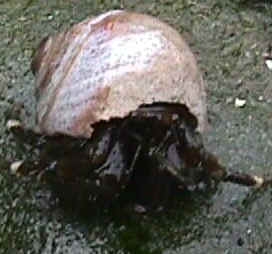
Pagurus samuelis is the scientific name for the
hermit crab. They are found along the Pacific Coast from British Columbia
to Mexico. They are about two cm wide and live in shells that have been
deserted by other animals, usually Turban snails.
Hermit Crabs usually live on rocky beaches.
They like kelp beds, tide pools, and rocks. When threatened they can pull
into their shell. The females store their eggs inside their shells to
protect them.
Hermit crabs are another misunderstood
species. While many people say they are crabs, they are more closely
related to shrimp.
Click here for
More Pictures
Back to Top
Jellyfish
Jellyfish are very unique animals. They are
amoung the simplest animals on earth. They have no bones, no brain, no
gills, no lungs, and no heart.
Jellyfish reproduce sexually and
asexually. When the egg and sperm meet they grow into a larva which forms
into a polyp which buds off new medusae. The medusae will grow until they
are up to eight feet across.
Jellyfish drift through the water feeding on
whatever they come across. Their most common food sources are plankton and
small animals, but one has been found with a seal skeleton in its stomach.
Jellyfish usually die within a year of their birth.
Back to Top
Kelp Crab
Pugettia producta or shield-back kelp crabs are
very common in the Puget Sound. They can be found everywhere in the water
between Alaska and Baja California. Adults live in kelp beds in the
ocean. Immature kelp crabs live closer to the shore near the low tide
mark, sometimes in brown algae.
The kelp crab can be identified by its long narrow
body. It has a very smooth looking appearance, but the back is often
covered in barnacles. Its legs are long and skinny and made for grasping
seaweed such as the kelp it lives in. The crab's claws are small in
relation to its body, but are very powerful.
Back to Top
Moon Snail
The world's largest moon snails are found in the
Puget Sound. Moon Snails or Polinices lewisii live in round spiral
shells. They live on sandy and muddy beaches. They are usually in
the ocean in shallow areas, but sometimes they burry themselves in the sand.
Moon snails feed mostly on clams. They are
known to destroy oyster beds while looking for them. When they find a clam
they drill a hole into its shell and suck it out.
The main enemy of the moon snail is the
twenty-rayed starfish. Many humans collect moon snails for their shells.
Click here to see
More Pictures
Back to Top
Ochre Star
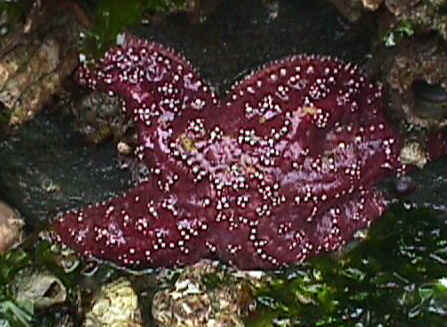 Pisaster ochraceous is a sea star better known as
the Ochre Star or purple star. This sea star is one of the most popular
sea stars because it is fairly common and easy to collect. One thing many
people don't realise is that the purple star is sometimes orange.
Pisaster ochraceous is a sea star better known as
the Ochre Star or purple star. This sea star is one of the most popular
sea stars because it is fairly common and easy to collect. One thing many
people don't realise is that the purple star is sometimes orange.
The Pisaster ochraceous has a network of spines
on its dorsal side which create many groves. This sea star along with a
few others possess the talent to turn their stomachs inside out and indert them
into a bi-valve shell. The Pisaster ochraceous can insert its stomach into
a bi-valve shell open only .1mm.
Back to Top
Sea
Cucumbers
Sea Cucumbers are strange looking animals.
They have a tough, leathery, orange or red skin. It appears to have no
skeleton, but it has a trace of one in its skin. The sea cucumber
has the ability to expell its organs and then regrow them later.
Sea Cucumbers reproduce sexually. Most
species release eggs and sperm into the ocean, but not all. The females of
some species carry their eggs. In one species the young develop inside the
mother.
On Seahurst Beach sea cucumbers can be found in
crevices of the larger rocks.
Back to Top
Sea Pen
The sea pen, or Ptilosarcus gurneyi, is only
found sub tidally. It is orange and up to 50 cm long, but only half of
which is above the sea bottom. The top half of the sea pen looks like a
feather, which is how it got its name. The barbules are actually used for
feeding; they contain polyps that capture small animals for food.
When the sea pen is disturbed, it pulls itself
into the bottom of the ocean, forcing out all of the water inside of it.
The sea pen is eaten by Armina californica.
Back to Top
Six Rayed Star
The Leptasterias hexactis or six rayed star is a
very small, dull colored sea star. It is typically under two inches
across, but has been found up to three inches. This star's colorings are
usually either lead gray, olive green, blackish, or dull pink. The easiest
way to differentiate this star from others is the six arms.
The Leptasterias hexactis is unique because the
females of this species broods her eggs until her young are old enough to live
on their own unlike other species who release their eggs and sperm into the
ocean.
Back to Top
Sun Star
The sun star or Solaster stimpsoni can be easily
identified by the blue-gray stripe on its arms. It is also different from
common sea stars because it has ten to twelve arms instead of the common five.
The sun star is in the Puget Sound, but is not
commonly found by beachcombers because it is usually below the low tide
mark.
The sun star reproduces sexually and the larva is
free- swimming. The larva will eventually either be eaten by a fish or
grow into a sea star up to fifteen inches across.
Back to Top
Vermillion
Star or Equal
Arm Starfish
Mediaster aequalis is the scientific name for the
sea star commonly known as the equal arm starfish or the vermillion star.
The name "equal arm starfish" comes from the fact that all of the
star's arms are exactly equal. The name "vermillion star" comes
from the star's dorsal side color. The star's ventral side is a pale
orange.
Mediaster aequalis is one of the smaller sea
stars ranging in size from three to seven inches. It is found on many
types of beaches at very low tides. This species' range is from Alaska to
southern California.
Back to Top
Back To Homepage