
The Man (George O'Brien), a farmer by trade, is having an affair with The Woman from the city (Margaret Livingston). The man leaves home whenever The Woman from the city calls him, even if it is minutes before dinner.
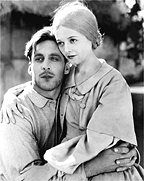
The Man's wife, The Wife (Janet Gaynor), notices that he is gone one night (she had just seen him), and sits down in dispare, crying her eyes out. With a hot bowl of soup in her lap that she slaved to make for The Man, she feels used and abused.
The Woman from the city tells The Man that she loves him and wants to marry him. The Man asks, "what about my wife?" she replies by telling him to kill his wife by taking her out for a boat ride. There, he would throw her over the edge of the boat so that she drowns. He would make it look like the boat capsized.
The Man is in love with The Woman from the city, but he also loves his wife and daughter, too. He is torn. Eventually he takes The Wife for a boat ride. The Wife figures out what is going on (she knew all along that he was having an affair). She knows The Man is trying to kill her, and he does try to kill her... but he can't bring himself to do the dirty deed. The Man realises that he loves his wife more than The Woman from the city. But can he win back The Wife before it's too late?
F.W. Murnau's Sunrise is a wonderfully simple movie in that it tells a simple story very well. It details the passion between a man and a woman using gestures and movements rather than voices or even title cards. Voices would have ruined the performances; you can get a lot more from silent performance than a talking one.
Sunrise won the very first Oscar - Best Picture, most unique and artistic production - and was well deserving of the honor. (It's sad to note that it isn't considered a best Pciture winner though.) It won three Oscars including Cinematography and a leading actress Oscar for Gaynor, which she won for Seventh Heaven but was also for Sunrise and Street Angel. Totally convincing as The Wife, Janet Gaynor gives us such a wonderful performance and you can see her plight and sorrow from her eyes alone.
Plot: 
The story revolves around a man trying to reclaim his wife. It is told through exceptional acting and, on the plus side, few titles that would bog it down.
Visual Effects: 
Cinematography is exceptional; F.W. Murnau used many varied styles of angles and techniques to create many wonderful and uique shots.
The film is very dark; not in content but in piture quality (the film is 78 years old). It is hard to see some of the action in some scenes but this only a small slight on the film. It dosen't affect the story but does affect the presentation.
Sound:
The score is OK but feels out of sync and place in different parts of the film. The score doesn't feel "suited" to the picture.
A nice touch to the picture was the inclusion of yelling and clapping during several scenes in the film. You can here people yell "Hey!" and/or clap when needed (but not actually speak.) Again, a nice touch.
Character Development:
The Man really wants to kill his wife but has an incredible change of heart. We see The Man go through this change which is well documented through out the film.
Atmosphere:
Realism:
Warren�s Rating: 
Movies it was nominated with for Best Picture (Unique and Artistic production):
Chang: A Drama of the Wilderness (1927); The Crowd, (1928)
 8.43/10
 Is the movie worth your time to watch?

25-02-05
Age at win: 23
Nominated for: Best Actress in a Leading Role, The Wife, Sunrise: A song of two humans [Also for Seventh Heaven (1927) and Street Angel (1928).]
Nomination: 1/2 (acting), 1/2 (total); Win: Only
Janet's performance is subtle, yet powerfull. You can see the raw emotion comming from her in every scene, but mostly in her eyes. They are haunting eyes that just give away so much emotion that she carries the film with subtle acting. Had there been voice to the characters, the performances would have been ruined.
25-02-05
