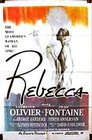
It has been a year since the the first Mrs. de Winter, Rebecca, died under mysterious circumstances.
The handsome George Fortescu Maximillian 'Maxim' de Winter (Laurence Olivier) is in Monte Carlo to supposedly escape the pain of his wife's death, all this time later.
It is in Monte Carlo that Maxim meets a lovely young woman who will soon become the Second Mrs. de Winter (Joan Fontaine). When they arrive at Manderley, Maxim's grand English Estate, she is coldly received by everyone, including Mrs. Danvers (Judith Anderson), the head "housekeeper" if you will.
But as the Second Mrs. de Winter tries to become aquainted with Manderly and the staff, she realises that Maxim, the staff, and Manderley itself are still seduced and haunted by the memories of... Rebecca...
"Last night, I dreamt I went to manderlly again." This opening line haunts the picture right from the get-go and it sets the tone for the entire film. We know instantly from this line that the film will not end on a pleasent note, and that something terrible is bound to happen.
Throughout the film we are given glimpses into the relationships between Rebecca and Maxim, her family, and even housekeeper Mrs. Danvers. All views paint a different picture of life at Manderley.
It is not clear what the relationship between Mrs. Danvers and Rebecca was, but there are hints of unnatural goings on.
We also don't know how Rebecca died, but again, there are hints. Was she murdered? Was there an accident? We don't know, but this another one of the haunting aspects of the film.
Director Alfred Hitchcock (while still constantly fighting with producer David Selznick) allows the answers we crave to slip out slowly, building the suspense up to the final scenes where we do indeed learn the truth. Hitchock lures us deep into a world of death, lies, and illusions, thrilling us at every turn.
Plot: 
The story is very developed. A Man, Maxim de Winter, is distraugh over his wife's death, but we don't know why. And yet he marries again, brining his new wife into his world, ever-haunted by the memories of his dead wife.
The story is intriguing and suspensefull, as only Alfred Hitchcock could do. Combined with the attention to detail and sticking-to-the-original-material of David Selznick, Rebecca is a taught thriller that never lets up.
Visual Effects: 
There is a great fire scene that is very well done, and most of the miniature models of Manderley look great too. However, there is one model of Manderley that looks phoney, and detracts from the establishing shot that it is intended to be.
Sound: 
The score of the picture is haunting and exciting at the same time. The score works very well in the suspensefull atnosphere of Rebecca.
Some voices were looped and redubbed, creating a "hollow" sound at different (but few) points in the film, most notably comming from Florence Bates during the opening scenes in Monte Carlo.
Character Development:
We learn something new about every character all the time; in one scene important informations may be given about Maxim or maybe about his dead wife. Whatever the case, the details are given out slowly, and at just the right moments untill the plot unfolds at the climax.
Atmosphere:
Alfred Hitchcock knows how to get someone's attention in a movie, and he did so well in Rebecca. Hitchcock lures you into Maxim's world, and keeps you on the edge of your seat right up untill the very end.
Realism:
Warren�s Rating:
Movies it Beat out for Best Picture:
All This, and Heaven Too; Foreign Correspondent; The Grapes of Wrath; The Great Dictator; Kitty Foyle: The Natural History of a Woman; The Letter; The
Long Voyage Home; Our Town; The Philadelphia Story
 9.43/10
 Is the movie worth your time to watch?

16-03-05
