|
|
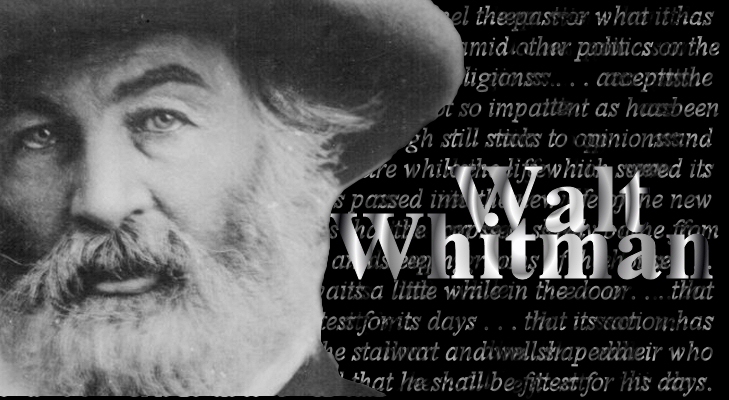
Criticisms - Home The following Literary Criticism is presented by Meena Alexander called "In Whitman's Country"
I cannot imagine myself in America without Whitman.
Sometimes, in times of difficulty, when reinvention of the self is a fierce necessity-a time such as now-I think of myself as having been wafted here by Walt, a creature with a tumbling grey beard, cap askew, bony wings sprouting out of his corduroy jacket.
There are bits of grass in his mouth, and when I am about to pass out, with all the air gushing through-we make a curious kind of airplane together-he pushes a few stalks into my mouth. The grass is filled with moisture, rather cold and glittery, and the bits of ice on the blades help moisten my tongue. I totter a little with the unsteadiness of it all. Am I on a "trottoir," as he called it? Am I really in Mannahatta?
I could not have come to America without Whitman. Now that would be an odd statement to make to an officer at the other end of the table when one is taking a citizenship test-How many stars, how many stripes, how many states? etc. What should I say? Whitman drew me here, and now I am a woman who must cast herself on the kindness of others:
I resist anything better than my own diversity,
Breathe the air but leave plenty after me,
And am not stuck up, and am in my place. ("Song of Myself," sec. 16)
How did I get to Whitman's country? November 2, 2004. It's a moist fall day, and I put on a light coat and go to take my place in the line at the polling booth near Fort Tryon Park. I have come from India, the world's most populous democracy, and in India, returning after my studies in England, I read Whitman again. In me are the memories of voting lines in Hyderabad, where I used to live, old people who had trudged in from villages miles away, mothers with infants hoisted to their hips, laborers, teachers, and everywhere the dust rising in the dryness that grips the city before the rains fall.
Now in the dampness of a New York November I step into the sunlight, and my fingers close around the pages I have slipped into my pocket. The pages are dry and light, and they feel as if a current of air were still passing through them. When I first came to America, I bought a book. I see from the date on the front page, December 1979, that I purchased it a little over a month after I arrived in Manhattan. Books were a luxury then, but this was one book I did not want to be without. Even now, the pencil markings I made so long ago are vivid, new to me, just as the book is, though the glue is resolutely unstuck in that green-backed Norton edition of Leaves of Grass, and I can tear out hunks and carry pages with me without hurting the boundaries of poems. So it is that "Song of Myself" struck loose of the book has come to take up residence in my coat pocket. And I have recourse to the poem as I stand waiting for the old man in glasses to check out my signature, neatly xeroxed in the pad of voters' names in front of him. I am all ready for a hitch, but it seems to work, the tally of name and signature as I point out my address, the very last apartment building on Fort Washington Avenue, just before the park.
How far north can one go on this island and not fall into water? Just a few more miles towards Spuyten Duyvil and one can see the foam lapping at the grey rocks.
Every few years in my life I go through a blaze of reading Whitman, and there are always poems I return to, in some driven way: "Song of Myself," "Crossing Brooklyn Ferry," and from time to time "Out of the Cradle." So it was before I left India in late 1979, so it is now. Why?
I try to spell it out. It has to do with identity, identity, that overused, much maligned word. In a very recent book of that title Zygmunt Bauman speaks of the "spectre of exclusion" that haunts us now, in this age of fluid, coursing borders. And it is precisely to that anxious reality that Whitman speaks. Reading the poet when I was a young woman in India, I was gripped by an excitement that is still in me when I open his pages.
Who else has conceived of the self as a cluster of jutting, jostling identities and dared to make an epic out of that chaos, cutting and clipping it into a paysage �tat d'�me that is pronounced to be coextensive with a great continent? Who else has made such music out of self-division and then imagined a new, internally embattled nation as coequal to that self?...
Where else could I have come to from a country where the weight of centuries threatened to overwhelm? It seemed to me then that there was an odd fit between the burden of time that I was born to and the promise of space that I had chosen. But what sort of life could I make for myself here, what sort of poetry? Those are questions that only time will slowly answer.
Whitman did not abandon me. Last year, in March 2003, when I was working on a poem I eventually called "Triptych in a Time of War," I felt that pulse of anxiety that had sometimes hit me when writing, the sense that I was entering utterly uncharted territory. I was writing in a time of war. It was then I felt the presence of Whitman, the feeling that it was all right to go ahead and write in the strum and throb of a violent present, make a long line for the breath to weave through, try to make sense of multiple worlds, one layering over the other, make an American poem, whatever in God's name that might be.
And what of "The old knot of contrariety" evoked in "Crossing Brooklyn Ferry" and reappearing throughout Whitman's poetry, a tug of discordant elements, the dark, the hidden, the silenced, braided through the clear and sweet and light. There was a way in which Whitman spoke directly to the knotted, secretive life I had led. I was raised in a world of tradition and decorum where being born a girl meant that even if one were to receive an education and excel in that realm of thought and learning, the core sexual self was already mortgaged, bound into a shadowy zone of indebtedness. Hence the self-division that I learnt to live with, depending on the mind to free me, if only provisionally. For after all, who could lose her body? I will never forget the frisson that ran down my spine when I read the line: "Through me many long dumb voices" ("Song of Myself," sec. 24).
Elsewhere in my writing I have called this a "back against the wall aesthetic," a recourse to the most primitive ground: the body as the site of first and last resort. And it is precisely here I see her holding hands with Walt Whitman. In her sleep she speaks to him, and he, a gay man, shares with her the evidence of the senses, a vision of "the caresser of life wherever moving" ("Song of Myself," sec. 13).
I have no evidence that Lalithambika read Whitman. In fact, it is eminently possible that she didn't. But Whitman certainly has been translated into my mother tongue, Malayalam, an ancient coastal language of India, whose literature has been fed, as all great literatures have been, by streams of translation. Kerala has a long socialist tradition, and Pushkin, Tolstoy, Lorca, Neruda, and Whitman have all been translated into Malayalam. When I was a child in Kerala I used to hear cousins who went to school reciting bits of Whitman that they had "byhearted" in Malayalam, part of a long mnemonic tradition.
In a recent e-mail communication I asked the poet Ayyappa Paniker about Whitman. He sent me his poem "Yesterday I Saw Whitman" in an English translation he himself had made. The poem has a poignant opening:
Yesterday, or was it the day before, I saw Whitman.
Talking loudly about the multitudes,
In loneliness I saw Whitman.
Stretching his long shadow across the Long Island, the islander poet was counting the waves of the sea.
The e-mail he sent with the poem was eloquent. Ayyappa Paniker, one of the most important 20th-century poets of Malayalam, told me that in his own imagination he connected Whitman with another great epic poet, Vyasa, the author of the Mahabharata. Each poet was born on an island. Turning to the other great Indian epic, news of which might well have reached Whitman, he reflects on Whitman's "Out of the Cradle": "the remaining or solitary bird perhaps echoes the survivor bird in the story of Valmiki, the author of the Ramayana"-alluding to how Valmiki was driven to write by the piteous cries of a bird calling out to his dead mate. Ayyappa Paniker closes by speaking of the "invisible threads" that surely bind us all our lives, reminiscing about an old man he knew who once lived in the city of Thirvananthapuram. That man so loved Emerson, that everyone knew him quite simply by that name-Emerson. Dr. Paniker concludes his e-mail by saying: "In the metreless metre of recent Malayalam poetry we may see the influence of Whitman, Neruda, Lorca etc." But the worlds that Whitman wanted to draw together sometimes threaten to split him apart, lay him waste, body and soul: "Is this then a touch? quivering me to a new identity?" ("Song of Myself," sec. 28).
Was this the price to be paid for living in the American present, in a world that Emerson felt had no need of memory, where "history is an impertinence and an injury" (Emerson, "Self-Reliance"), where autobigraphy had to be inscribed "in colossal cipher"? Studying Whitman when I was a student in England, then writing about him in my dissertation, it was precisely the way in which he used his body to achieve, sometimes at painful cost, a flowing, liquid poetics, a life in letters, where the edge was courted, where breakdown was close, even necessary to free the quick of the desiring self-all this haunted me. I titled the chapter on Whitman that I drafted at the age of nineteen "Identity by My Body," little realizing that this was to be the theme that would stitch itself through my work, even though Whitman's own name and presence might lie buried in the seams of my consciousness, the world he had drawn me to more than three-quarters of a century after his death, filling me up, tumbling me over.
Tomorrow morning, if the weather is fine, I will put on my boots and walk north to the edge of the island, to Spuyten Duyvil. The northern side of the creek was called Shorakapok by the Lenape people who inhabited it. The word is translated as "space between the ridges" or "sitting down place." I will sit between the rocks and gaze at the waters of the river Hudson. My grandmother was born in Kozhikode, an ancient city where Vasco da Gama landed. I imagine Whitman, his beard speckled with salt spray, strolling where the Arabian Sea meets the land of Kerala. Lifetimes later, I am here at the Hudson's edge, haunted by what the poet in "Out of the Cradle" called "the unknown want."
I search for something that lies just beyond the reach of words.
In Whitman's country.
(Alexander)
MY OWN INTERPRETATION
When reading Alexander's Literary Criticism on Walt Whitman, she sees that she lives in a world where everything she sees is influenced under Walt Whitman, such as the city, writings of Emerson, etc. She expresses that there are bits of grass in Whitman's mouth, and when she is about to pass out, with all the air gushing through, Whitman pushes a few stalks into her mouth and the grass is filled with moisture, rather cold and glittery, and the bits of ice on the blades help moisten her tongue.
|