|
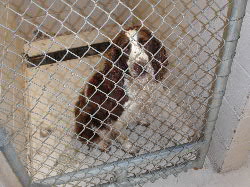
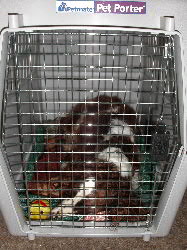
On Tuesday, May 4, I received an email from Millie, the ESRA (English Springer Rescue America) Alabama state coordinator, asking me to check out a Springer at the Lee County Humane Society. She said that the Humane Society contacted ESRA asking them to take the Springer. Millie said I could foster the dog if want. At first I was a little hesitant, because it was less than a month ago that Penelope died, and I wasn�t planning or emotionally prepared to get another dog until Christmas. So the thought of caring for a foster dog for six months sounded kind of scary. But Millie said the Humane Society told her that the dog�s only 1-3 years old and very sweet and heartworm negative (about half of rescued dogs in this area are heartworm positive). She said a dog like that would only need to be fostered for six weeks before getting adopted. And even if it doesn�t work out somehow, like if the dog isn�t suited for apartment living, or is vicious toward cats, then there are two ESRA members who are close to me who can foster also. That�s when I agreed to foster the dog. So Millie called them first thing the next day, and told me that I could go in anytime I want to check out the dog. So I went there at 9 AM and met Courtney. She said that they�ve had the dog for a week. They were out investigating a cruelty case, when two stray dogs came running toward them from the streets, and one of them was this Springer. She said that the dog seems like to have been well taken care of and not to be abused, so they were waiting for the owner to call to pick up the dog, but nobody called. The Humane Society named him �Montana�. I had my shelter dog evaluation sheet from ESRA out, examining Montana. Before I was afraid that the strange shelter dog would bite me, but Millie had told me that if the dog growls when I touch him, then just leave him there. But when I felt and touched him all over, grabbing his paws off the floor, trying to make him lie down so I can rub his tummy, he just stood there looking out of the glass door next to the reception desk. Also he was coughing a lot, about every five seconds. Because I was not told that the dog had any diseases, even though it sounded a lot like kennel cough, I just thought maybe I was wrong. Then Courtney and I walked Montana around outside. I asked her if Montana misses the other dog that came with him, she said that the other dog was a terrier and had been transported to a terrier rescue the day before. But they had been in separate cages for a week, and it didn�t seem like they missed each other. And then she told me that Montana has kennel cough. Later she put Montana back in his cage, so I could call Millie to ask her if I should pull the dog. I told Millie that the dog is indeed very sweet, but he has kennel cough. She thought it might�ve been just a reaction from the bordetella vaccine that they gave him at the Humane Society, and she said I can pull Montana. So I went inside to talk to Courtney again. She gave me all his records. They had given him the combination vaccine at the Humane Society, but not the rabies vaccine because they don�t have a vet on staff. They also gave him heartworm and flea and tick preventatives. Then I went over the rest of the shelter dog evaluation sheet with Courtney. She said Montana�s probably neutered, but she�s not sure. And I couldn�t tell if he�s neutered or not, because I�ve never seen a dog that�s not neutered before. She said that Montana is probably housetrained because he always urinates when they let him exercise outside, but she�s not sure because they don�t take the dogs out regularly because they have so many dogs. I then asked her if Montana�s okay with cats (if he was not, I would have to keep them in separate rooms, or have him fostered by another ESRA member). She said he probably is, because he�s so sweet, then she went to take Montana out of his cage. The picture is him in the Humane Society cage. I put him on harness and leash (didn�t want him to slip out of a collar and accidentally run away), and Courtney walked him to their cat room. There he met a cat that was loose walking around on the floor. Courtney said that cat is their resident cat and is dog friendly. Montana went up to sniff the cat, but he lost interest after a few seconds. Then I took him outside and I called my vet to set up an appointment to have him checked out. They said there�s appointment in thirty minutes available. So Montana and I walked around the outside of the Humane Society, then I decided to just drive to the vet clinic, hoping that the previous appointment would end early. We walked around outside of the clinic for a few minutes, then I thought, Montana smelled so much of urine, I might just spend the money to have him bathed at the vet�s. Millie had told me that if the dog needed medicated baths, then ESRA would pay for it (ESRA automatically pays for medical bills under $200 for all their foster dogs; but if over that, then we would have to ask the board of directors first to see if dog that sick should be rescued at all, if approved, then we would get more money), but if it�s just a regular bath, then I would have to take care of it. So we went inside so I could ask how much the bath would be. Jerri the receptionist knows me pretty well, and after I told her that I would like the dog to have a bath also, she took the dog to the back and told me I could pick him up in the afternoon. |
|
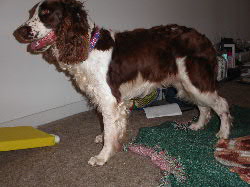
At around noon, I got a call from the vet, telling me to pick up Montana right away. He said that Montana had a pretty bad (kennel) cough, and because they don�t have any isolation unit, he didn�t want him to infect any other dogs. The vet said he probably got the cough at the Humane Society, because he sees a lot of dogs adopted there, and Montana is the third dog adopted from there in 24 hours that came in with kennel cough. Kennel cough is like the dog�s version of cold or flu. Good thing the vet said it�s very unlikely it can be passed to cats, so I didn�t have to worry about him making my own cat sick. The vet gave me some antibiotics for the cough, and steroid to suppress the cough. He also had yeast infection on his right ear (ear infection very common among Springers), but the vet said his left ear canal looks clear all the way to the ear drum. He also had hookworm, so we got medicine for that too. Millie said he had all the regular shelter dog diseases, so it�s not a surprise to her. The total of the bill, without the bath, came down to $198. Good thing we didn�t have to ask the board of directors for extra money. Then I took out the shelter dog evaluation form to finish the rest of the questions. The vet�s groomer said Montana was a very good dog while being groomed. The vet showed me a quarter-size scar that was on the back side on Montana�s left ear. I hadn�t noticed the scar when I was at the shelter, and the vet said he has no idea what caused the scar. The vet said that because Montana had kennel cough and worms and is a little underweight at 50 lbs, I should make sure he gets lots of good quality food (like when humans get colds, lots of sleep and warm chicken soup can just do the trick to help toward cure). When I was examining Montana at the Humane Society, I could easily feel his ribs. I think he's normal weight when he's filled out will be around 60 lbs. I didn't know they "make" Springers this big anymore. When Penelope and I went to see Springer Specialty dog show in Atlanta in 2003, she was the biggest Springer there at slightly overweight 55 lbs. Most of the show dogs there were 40 lbs and what I thought Cocker-Spaniel-sized. And the vet said he�s a very pretty dog, and then we went home. The vet also said he�s two to three years old and confirmed that he�s neutered and gave him his rabies shot. |
|
|
|
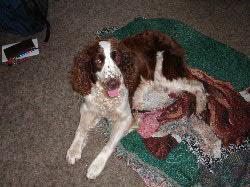
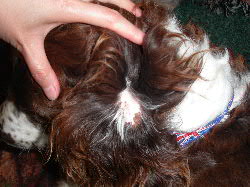
Later that afternoon, I decided to comb him (didn�t have a brush because Penelope didn�t need to be brushed because her fur was always clipped so short) with the comb that came with the electric clipper. But I found out that there were several mats on his body. There were mats between his every toe, and there was a big mat behind his left ear. There was no mat behind his right ear, I think it�s because the vet�s groomer shaved it out, but he also left a clipper burn on that area. So I spent the next three hours bending over him to carefully remove all the mats. But we were lucky that he didn�t have any mats in the arm-pits area like Penelope did when I first got her. Millie called later to ask about Montana, and when she heard that Montana still smells after the bath at the vet�s, she said he would smell a lot better after all the mats were removed, and I told her that I just did that. But I still make him lie on the blanket whenever he's outside of the crate because he still smells a little. He's friendly to all humans, but he wouldn't roll over the first time I met him at the Humane Society. But he rolled over and let me touch his belly when I was grooming him. Millie also asked me if he would fetch or play with toys. I told her I hadn�t let him fetch because the vet said absolutely no exercise to minimize the coughing. Before getting him, I was worried that a dog this young would need a lot of exercise to prevent him getting bored and starting destroying my apartment, but now I have a dog that can�t have any exercise at all. Millie said I could change his name if I wanted. But I didn�t want to change his name because to me only new parents give their kids new names, and even though I knew I would get a little attached to him, I didn�t want to adopt him, unless somehow he doesn�t get adopted until Christmas, then I would probably adopt him. |
|
|
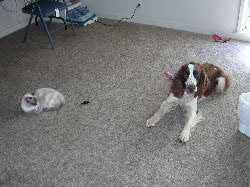
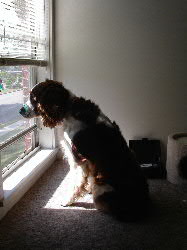
He's not food motivated (unlike most Springers, who would do anything for food). So to train him, I couldn't just use his dry food like I did with Penelope. For the first three days, I had to use cheese to lure him into the crate and to start teaching him basic commands. He already knew how to �Sit�, and he automatically sits when he sees a piece of cheese on my hand. But he's willing to please and can probably be trained mostly by praise. Courtney at the Humane Society said he didn't eat a lot there (they only give dry food) and lost weight there. But he likes the canned food (high quality ones left over from Penelope, $2 per can that Virginia said she would have no problem eating it too) that I give him. I gave him half can every three hours. I didn�t want to give him too much at a time because I knew he hadn�t had a lot of food in a while, and I didn�t want him to throw up if he ate too fast. I also mixed a few kibbles of Buddy Biscuits in his canned food, because I would like to slowly wean him from wet food, and eats dry food only by the time he gets adopted (not everybody has the money to give their dog canned food everyday). He knows what a fridge is, so he probably spent at least part of the time indoors. I put out water for Montana, but he hadn�t drunken any by night time. So to prevent dehydration, I thought about going to Walmart to buy a can of puppy milk like I did with Anastasia (I made Anastasia drink kitten milk when she wouldn�t drink or eat the first day I adopted her). But I really didn�t want to leave him by himself the first day, and coincidentally I found an unopened bottle of Pedialyte that I bought for Penelope two months earlier. And I used a dropper to make him drink half of the bottle that night. By the time we were getting ready to sleep the first night, I put him in his crate, and Anastasia and I slept on my bed in the living room. But I was worried that he would get bored and start whining and barking when I was sleeping for seven hours, so I put the crate next to the bedroom window, and Anastasia and I slept on the floor next to the crate. His biggest entertainment right now is looking out of the bedroom window and watching the cars roll by. When he's in the crate when I'm not at home, if I place the crate in the living room, then he would whine. But if I leave the crate right next to the bedroom window, he would look at the cars all day. Whenever he�s in the crate, I put a chew bone (Greenie) and a toy inside to keep him company, even though he doesn�t chew the bone. |
|