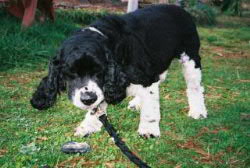
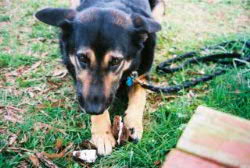
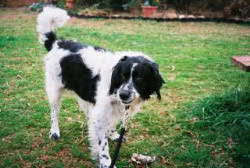
Keely slept very well in the car on the drive back home. After we got home, I only gave Keely half of her usual dinner because she had a lot of treats earlier that day. I don�t want her to become overweight through the training process. Keely was so tired after we got home, that she slept the rest of the night and the next day. It was deep sleep, she didn�t even wake up like she usually does, when I walk around in the apartment. And usually she wakes up about half an hour earlier than I do in the mornings, but on Sunday morning, she slept until I got up to take her out potty. Who knew it would take 7 miles of walk, one obedience test, AND a socialization event to make a six-year-old dog tired. Keely certainly has a lot of energy for an older dog, just like Penelope.
Thursday, March 16, 2006
I'm trying to feed Keely the Fromm Chicken and Brown Rice formula. I mixed 1/4 cup Fromm with 3/4 cup Wellness Chicken for two days. Like when she had Nutro Ultra, she was okay the first day and half, then 48 hours after first feeding of Fromm, she started having loose stool. So I've put her back on Wellness only again. Fromm Chicken does not contain beef or lamb, so I don't know why she's having GI upset. Anyhow I just can�t have her on one brand only, so I�ve reduced the Fromm to 2 tablespoons per meal and see how that works.
Keely has been progressing well with her behavior training also. When Keely first came, she would growl at Anastasia when the cat got near her food, me, or my food. I tried three times the first two days after she came to live with me, to yell at Keely �Hey!� when she started growling at Anastasia, but every time she would continue to growl. Later, Keely started to growl at me when I moved around in the kitchen when she�s eating, tell her to get off the livingroom chair, or hug her while she�s sleeping. When I correct her for those things, I could tell Keely was getting redirected aggression, because even though she would growl at what I did, she would also look around the room for Anastasia, and occasionally even take her frustration out on the cat by chasing the cat while she�s growling at me. Because of her redirected aggression tendencies, I can�t train her the way I did with my previous fosters. Heather did mention that Keely had redirected aggression toward her Chloe, but I can�t just let it go like Heather did, because Chloe is bigger than Keely, but I don�t think Anastasia could stand up to Keely�s attacks, even though Keely�s a small for a Springer. So usually I try to correct Keely only when Anastasia�s not in sight. However, to get Keely stop growling at Anastasia for getting near her food, me, or my food, I still used the counterconditioning and desensitization method. I feed Keely in the kitchen, but her food bowl is kept on the kitchen counter when she�s not eating, because I don�t want her to develop possessiveness over the bowl. When I feed her, if she doesn�t eat it immediately, I pick up the bowl and put it on the kitchen counter, and offer it to her again in an hour or so. I figured out that if I just keep the food bowl with food out when Keely doesn�t feel like eating it, this actually promoted her possessiveness of her food against both me and Anastasia, because Keely would increase her growling when Anastasia got near her food when she finally decided to eat, in addition to low growling at me when I moved around in the kitchen when she was eating. To train Keely out of growling at Anastasia for the food, I would stand in the kitchen while Keely�s eating, and if Anastasia decides to come into the kitchen also, I would refocus Keely by showing her a treat, and then drop treats every five seconds or so, as long as the cat�s in the kitchen. Within the last month, I think there�s definitely improvement, because Keely used to growl at Anastasia if she sees her anywhere while she�s eating her meals, but now she only growls if Anastasia gets within two feet of the dog while she�s eating.
About training Keely out of growling at Anastasia for her possessiveness of me and my food, I took a slight variation from Heather�s recommendation also. Heather said when Keely growled at her dogs for trying to get attention from Heather, Heather would push Keely away, telling her that if she growls, she won�t get what she wants. I tried this with Keely and Anastasia, but it just ended up Keely getting even madder at Anastasia, and she growled louder. So what I did was when Keely growled for Anastasia getting near me, �I� would leave. Sometimes while I�m walking away, I would pick up the cat and take the cat with me. So essentially �I� am the good thing that is taken away if Keely provides an undesirable behavior. When I walk away, Keely would get confused and immediately stop growling. Now she allows Anastasia to get pretty close to me when I�m petting the dog, but she would still growl at the cat if the cat butts her head on my arm to get me to pet her, when I�m already petting the dog first. However, Keely would not growl if I�m already petting the cat first then she comes along, just like before. I do the same training for Keely�s possessiveness toward my food against the cat. When she growled at Anastasia when the cat got near my food (I�ve never fed Keely human food before, so I don�t know why she thinks my food belongs to her also), I would pick up my dinner tray and leave. This would stop Keely from growling immediately also. Now two months later, Keely has only growled once in the last three weeks at Anastasia for getting near my food, whereas it used to be once a day or so.
Keely did not growl at me at all the first week after I got her. But just like Heather predicted, once Keely felt more comfortable in her new situation, she started growling at me also. Usually it would be pretty easy to correct this type of behavior, pretty much just to let the dog know that the human is the alpha, the dog�s not. But with Keely, again I have to be very careful when correcting her, because I don�t want her to take her frustration out on Anastasia (they can get a little frustrated when they are learning that they are not the boss anymore). To train Keely out of growling at me for getting near her food while she�s eating her breakfast and dinner, when she starts growling, I make sure Anastasia�s no where in sight, then I pick up the food bowl, and take it away. This is to tell Keely that I�m the one in control of the food, not her, and that if she misbehaves, I can decide not to let her continue eating (this is one reason why it�s good not to free feed your dog, because when they are free fed, i.e. food always in the bowl, then they might start to think that food falls from the sky, not from the human). Again Keely would stop growling at me immediately when I take away the entire bowl (I don�t worry about her biting me when I take away the food because I know her history, but if you think your dog might bite you when you do this, you have to be extra careful). Then I wait 15 seconds or so, then show her the bowl, tell her to Sit and Down and Stay, then leave the bowl on the feeder again. Usually she would not growl again at me for the rest of the meal, even when I move around in the kitchen. Also I do a lot of maintenance training with this issue. I always tell her to Sit-Down-Stay before I give her meals, this is to reinforce the idea to Keely that I�m the one in control of her food, she�s not (Heather did this with her also). At the beginning of training about a month ago, when I decided to do something about her growling at me for her food, I would keep some treats with me, and I would always stay in the kitchen while she�s eating, so she would be used to my presence while she�s eating. I would move around in the kitchen, when I got close to her, I would show her a treat and drop a treat into her bowl every time. So she learned that if she lets me get close to her food while she�s eating, she would get a treat. So overtime, she would actually look at me for treats when I got close to her food, and when I didn�t give her a treat for it, THEN she would growl at me. To train her out of this new issue, I just picked up her food when she growls, and also decreased the frequency I gave her treats slowly. I need to train her to the point that she won�t need to be treated at all when I get near her food, so her adopters won�t need to always have treats ready when they decide to get near her food. Also occasionally I would take up her bowl while she�s eating, and then put a treat inside (the treat I�m using is small, about fingernail size, but Keely appears to like it more than her food, because she would always eat the treat first when she gets her bowl back), then return the bowl to her. So she would get used to having her bowl with food in it being taken away, because that means she would get an extra treat in there when it comes back. Right now I�m giving her treats about 50% of the time when I get near her food while she�s eating, not every time, and she seems to be okay with it. Also, occasionally I would intentionally bump into her while she�s eating, or petting her while she�s eating, but I have to show her a treat immediately afterward, or else she would still growl at me for that. But when she does, again I take away her bowl to make her sit-down-stay before I give her back her bowl (without treats inside, because I want her to know I�m not rewarding her for growling at me in the first place, or else she might learn that the way to get a treat is to growl at nothing).
Keely likes to sleep on my moon chair in the livingroom. Sometimes I would tell her to get off and she would growl at me. At first I had to drag her off by her collar, but now I just need to tell her off and she would, but she still does not like it and would growl at me sometimes for it. I make sure Anastasia�s not around when I tell her to get off though, because Keely would start redirected aggression with her when she is forced to get off.
Keely would also growl at me when I hug her while she�s sleeping. I think a very small part of it is she might have arthritis already and is physically hurt when I do that to her (I give her glucosamine powder mixed in water once a day in the morning, and she does not have diarrhea with it). For the psychological part, I try to train her out of it by counterconditioning and desensitization again. Before I decide to hug her, sometimes I would have a treat in hand, and when I hug her, even before she had the chance to start growling, I would show her a treat. Another method I�ve used for this is to hold her in my arms. If she growls, I keep holding her, when she stops, even for a couple seconds, I would pet her. Keely loves to be petted, so within about 30 seconds each time, she would stop growling, so I would continue to pet her, and not just restraining her (when she growls).
Keely�s issues isn�t as dramatic as Brenna�s was, but personally I feel actually Keely�s harder to figure out if we�re on the right path to train her out of them or not. I think part of it is her age, it�s probably been this way for the past six years and it would take longer to train her out of, but in some ways I think it�s more complex, especially it�s associated with redirected aggression. I do feel sometimes we�ve taken a step back here and there, but overall I think Keely is doing better with her behavior training.
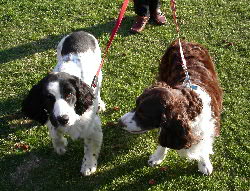
Yesterday afternoon we went to visit Jake and his family. Keely did pretty well with Jake. However she did growl at him twice indoors when he sniffed the doggie Oreo cookies I was feeding them, and also Keely growled once at Jake, again indoors, when I was petting her and he came for some petting too. But overall they did pretty well together, just like I had predicted (Brenna and Jake get along pretty well, and since Brenna and Keely�s personalities are very similar, I thought Keely and Jake would get along too). Pictures taken during the visit are on Jake�s webpages 30-34.
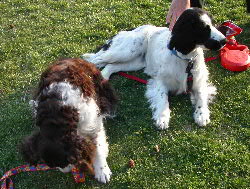
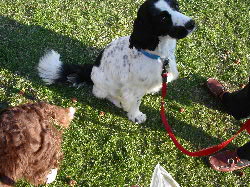
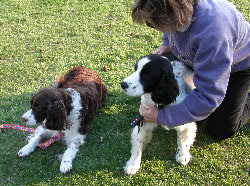
After we went to see Jake in Birmingham, we drove to meet Millie and Dede before we went back to Auburn. Dede is Millie�s new foster dog. Millie�s own dogs and foster dogs in the last few years have been senior or dogs with terminal illness, whereas Dede is only about two years old. By the way, Janet, Ben�s foster mom, was the one who went to the animal shelter to evaluate Dede in GA; and Mickey, who helped out with Jackson, was also the one who pulled Dede out of the shelter and transported her to a boarding kennel before Millie got her. About a month ago, Millie emailed Heather asking her about dog training, because Dede was exhibiting dog-dog aggressive behavior, and Heather referred her to me. So Millie and I have been emailing back and forth about positive reinforcement obedience training and counterconditioning and desensitization training for Dede. Millie said Dede was fine meeting Freckles, her senior male Springer. However, when Millie took Dede to meet another Springer foster in Birmingham, Dede growled and barked and snapped at that dog. At first Millie suspected dominance aggression, but I was very skeptical of that, and I told Millie to do the �Down� test with Dede the next time they meet another dog. The �Down� test requires the dog to learn the Down command first, at home without distractions, then the handler will tell the dog to �Down� in front of another dog, treats can be used. Since Down is a submissive posture, it would be hard for a real dominance aggressive dog to �Down� on command in front of another dog. Dominance aggression is often mistaken by fear aggression, which is way more common. Besides, I think fear aggression is much easier to train out of than dominance aggression, because most of fear is learned, whereas dominance has more to do with genetics than environment. Therefore, since fear was learned, it can be �un-learned�. Janet in Knoxville also got a new foster dog, a seven year old female Springer called Cookie, whom they suspect is a puppy mill breeder dog. Cookie pretty much exhibited the same issue, dog-dog aggression, the only difference is Cookie has actually bitten two dogs when Janet took her to see her friends� dogs, whereas Dede hasn�t. So for a while I was emailing both Millie and Janet similar emails, with some slight variations tailored to Dede and Cookie�s unique symptoms, and also slight variations in training techniques between Millie and Janet (Millie lives with her husband and her own Springer; Janet lives with her husband and three older kids and a Shih-Tzu puppy and several guinea pigs; Janet finished a positive method obedience class recently with Muffin the Shih-Tzu, whereas Millie hadn�t gone to an obedience class in a while). The training needed for fear aggression is counterconditioning and desensitization. So even though both dogs, like Brenna and Keely, all female dogs have/had dog-dog aggression issues stemmed from fear aggression but all four love to be around people, their age and circumstances and level of aggression are different, I do recommend a slightly different technique from person to person, and from dog to dog, according to the ability of the dog, and the ability of the handler. With Cookie, I recommended Janet to be extra careful when introducing her to another dog, because she had bitten and drawn blood before. So I recommended her to use a muzzle if needed. I know a lot of dog-loving people abhor the idea of a muzzle, but I think it�s a great training tool if used correctly, just like crate training. Also I recommended her to be very careful when feeding treats to Cookie in front of another dog, just to be aware of Cookie accidentally bite her hand when her target is another dog. One upside is that both Cookie and Dede, as well as Brenna and Keely, appear to be very smart and love food, which makes them so much easier to train.