Table Of Contents
Science | Technology | Music | Ballet | Philosophy | Literature | Cinema/TV | Sport | Art
Georgy Gamov Gamov attended Leningrad (now
St. Petersburg) University, where he studied briefly with
A.A. Friedmann, a mathematician and cosmologist who
suggested that the universe should be
expanding. At that time Gamov did not
pursue Friedmann's suggestion, preferring instead to
delve into quantum theory. After graduating in 1928, he
traveled to Göttingen, where he developed his
quantum theory of radioactivity, the first successful
explanation of the behaviour of radioactive elements;
some of which decay in seconds while others decay over
thousands of years. His achievement earned him a
fellowship at the Copenhagen Institute of Theoretical
Physics (1928-29), where he continued his investigations
in theoretical nuclear physics. There he proposed his
"liquid drop" model of atomic nuclei, which served as the
basis for the modern theories of nuclear fission and
fusion. He also collaborated with F. Houtermans and R.
Atkinson in developing a theory of the rates of
thermonuclear reactions inside stars." University of Maryland, College
Park East
West Space Science Center Argonne National Laboratory
University of South Carolina
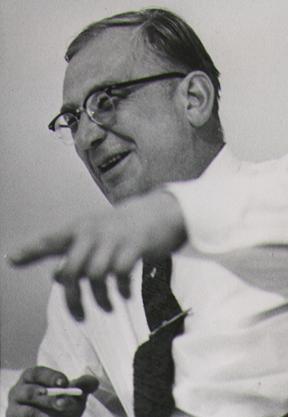
"GEORGY ANTONOVICH
GAMOV (b. March 4, 1904, Odessa, Russia [now in
Ukraine]--d. Aug. 19, 1968, Boulder, Colo., U.S.),
Russian-born American nuclear physicist and cosmologist
who was one of the foremost advocates of the big-bang
theory, according to which the universe was formed in a
colossal explosion, billions of years ago. In addition,
his work on deoxyribonucleic acid (DNA) made a basic
contribution to modern genetic theory.

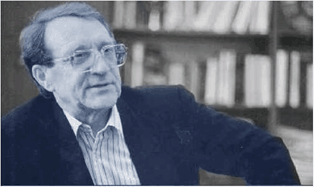
"Sagdeev has made
fundamental contributions to a broad range of fields
ranging from plasma physics to planetary science,
astrophysics, and arms control. He is responsible for the
Soviet space missions to Venus and Comet Halley and is a
strong promoter of international cooperation in space
research."
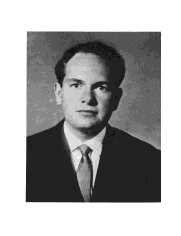
"Abrikosov proposed the
type-II superconductors concept and the lattice
describing their magnetic behavior. He predicted gapless
superconductivity. His semimetals theory explains lattice
and electronic features, infrared transparency, and
excitonic phase transitions. He invented finite
temperature field-theoretical methods and contributed
substantially to plasma kinetics, compressed matter,
quantum fluids, spin glasses, and
semiconductors."
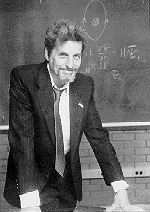
"Aharonov is known for
monumental contributions to theoretical physics:
specifically, for the Aharonov-Bohm and Aharonov-Casher
effects, for pioneering work in measurement theory, the
nature of quantum correlations, superselection rules, and
geometric phases, and for his deep insights into the
covariant description of quantum mechanics."
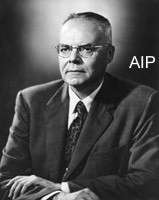
Biography
"Chemist, born in Moscow. An officer in the
Russian army, he was professor of chemistry at the
Artillery Academy in St Petersburg (1898--1906). He
synthesized isoprene, the basic unit of natural rubber,
and made contributions to the catalytic chemistry of
unsaturated carbons, of great value to the petrochemical
industry. During World War 1 he directed Russia's
chemical industry. He emigrated to the USA in 1930, and
became professor at Northwestern University (1931--5),
where he developed a process for making high-octane
petrol."

|
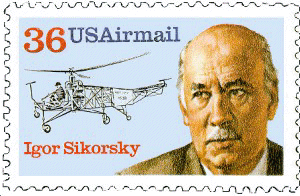
TECHNOLOGY Igor Sikorsky
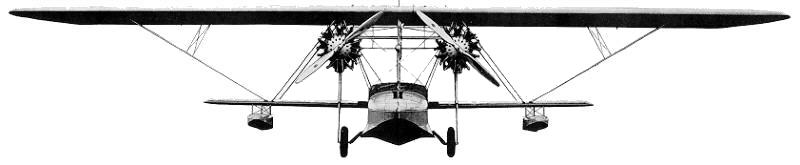
"The success in the field of rotary-wing aviation was due almost entirely to a man living in America named Igor Sikorsky. Sikorsky was a Russian who had fled from the Bolshevik Revolution in 1917 to France (Sadler 2). After years of private development, he encouraged the United States Government to agree to a considerable budget of two million dollars for rotary-wing research in 1938 (Sadler 2). The government ended up choosing a joint Sikorsky-Vought effort to be funded, and the project evolved into the VS-300 model helicopter. It formed the most tangible link between the early design concept of rotary-wing aviation and the practical aircraft that is capable of military operation (Sadler 2). The machine was indeed quite different from earlier models. It was an incredible advancement in helicopters, but others soon followed."
One of Sikorsky's earlier models. Courtesy of "History of Helicopters".
|
|
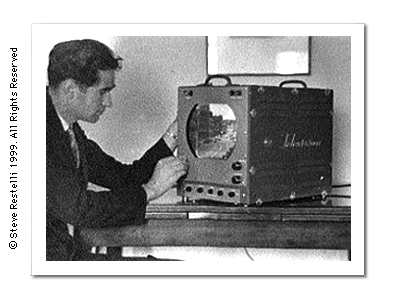
Vladimir Zworykin
"Zworykin, Vladimir Kosma (1889-1982), American physicist and electronic engineer, known for his developmental work in television. Zworykin was born in Murom, Russia, and educated at the Institute of Technology in Saint Petersburg, the Collège de France, and, after his immigration to the United States in 1919, at the University of Pittsburgh, Pennsylvania. He became an American citizen in 1924. In 1929 he became director of the Electronic Research Laboratory of the Radio Corporation of America (RCA) at Princeton, New Jersey. Important contributions were made by Zworykin to both the transmission and the reception of television. He was largely responsible for the development, during the 1920s and '30s, of the television camera and picture tube. He also directed the group that in 1939 successfully produced a powerful electron microscope."
|
|
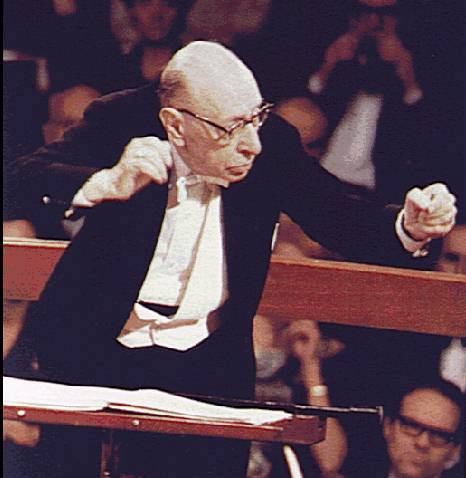
MUSIC Igor Stravinsky
"In 1939, following the deaths of his eldest daughter, wife, and mother, Stravinsky left France for the United States, where he became a citizen in 1945. He delivered lectures at Harvard University and sought comfort in a longtime acquaintance, Vera de Bosset. The couple married in 1940 and moved to Hollywood, California, where Stravinsky found calm respite in the warm climate and a strictly regimented schedule. He continued to produce neoclassical works through World War II but succumbed to a major creative depression when he realized that the music world was moving beyond neoclassicism to more avant-garde forms. With the help of Roger Craft, a young composer who joined Stravinsky's household in 1948, Stravinsky reemerged as a new force in modern composition, experimenting with Serialism in works such as Cantata (1952), Septet (1953), and In Memoriam Dylan Thomas (1954). His later works of the 1950s and 1960s melded both his earlier influences with the new style, and he created pieces of unrivaled density and complexity before his death in 1971."
|
|
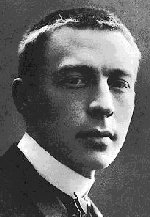
Sergey Rachmaninov
"In the wake of the October Revolution and the end of World War I, the Rachmaninoff family moved first to Stockholm, then to Copenhagen, and then, with the possibility of major financial gain on the horizon, to New York City. The man once known for his composing became an instant success on the concert circuit, giving 40 performances in four months throughout the United States and signing a recording contract with the Victor Talking Machine Company (soon to become RCA-Victor). Having secured his position as one of the premier performers in the U.S., Rachmaninoff and his family moved to Los Angeles and built a house mimicking the best of Russian culture, entertaining Russian guests, employing Russian servants, and observing Russian customs. It was as though the great composer of the East needed his muse transplanted in the West. This was 1921. |
|
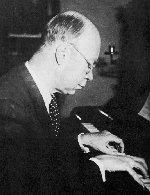
Sergey Prokofiev
"With the onset of the cataclysmic 1917 Russian Revolution, Prokofiev moved to the United States, where he was quickly indoctrinated into the capitalist-driven market of classical music. Reeling in enthusiasm, he was quickly contracted to write a new opera, The Love for Three Oranges (1919). For the first time in his life, however, the prolific composer was struck with writer's block. After dropping all other obligations to focus on The Love for Three Oranges, finances grew tight and, "with a thousand dollars in my pocket and an aching head," Prokofiev returned to Paris to re-find his muse. There, he completed his Piano Concerto No. 3 in C Major (1921). He left shortly thereafter, though, for Southern Germany, where he spent over a year and a half in the Bavarian Alps." |
|
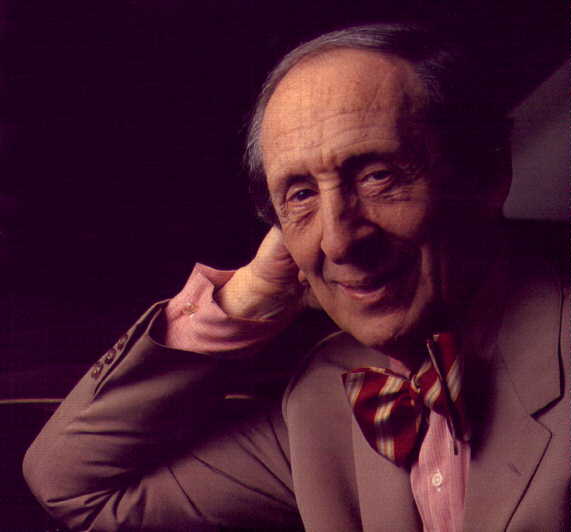
(Oct 1, 1903 - Nov 5, 1989) "He was probably the most famous pianist of the 20th century. His teachers included Sergei Tarnowsky (1882-1976) and Felix Blumenfeld (1863-1931). He left Russia and went to the United States in 1925. He never returned to Russia until 1986, when he gave two sensational recitals there."
|
|
|
|
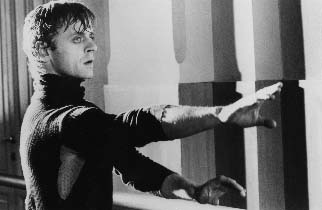
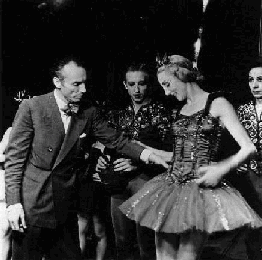
George Balanchine
"George Balanchine, (1904-1983), the Russian-born American choreographer, is one of the foremost choreographers in the history of ballet, particularly in the neoclassical style. The son of a composer, Balanchine was born Georgy Melitonovich Balanchivadze in Saint Petersburg, Russia. He was trained at the Imperial Ballet Academy and studied composition at the Saint Petersburg Conservatory. His early works, for the 1922 series Evenings of Young Ballet, were criticized as too avant-garde. In 1925, while touring in Europe with his small company, he joined the Diaghilev Company in Paris as a choreographer. After the impresario Sergei Diaghilev died in 1929, Balanchine choreographed for several companies, and in 1933 he organized his own group, Les Ballets. At the invitation of American ballet patron Lincoln Kirstein, Balanchine moved to New York City and together they founded the School of American Ballet in 1933 and the American Ballet Company in 1935." |
|
LITERATURE Vladimir Nabokov
"Nabokov, Vladimir (1899-1977), Russian American novelist, poet, and critic, whose highly inventive writings earned him critical acclaim as a major 20th-century literary figure. Nabokov's novels demonstrate great stylistic and compositional virtuosity, and his astonishing imagination often took a morbid or grotesque turn. He is best known for his novel Lolita (1955). |
|
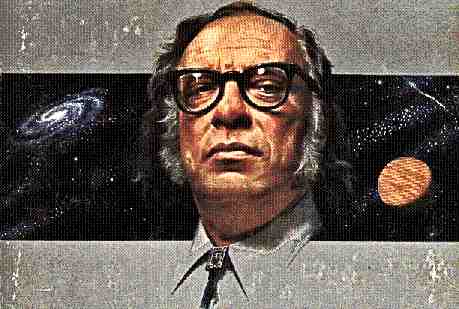
Isaac (Ajzek) Azimov
"For more than 45 years, Isaac Asimov has been a professional writer ofrenowned versatility. The Russian-born scientist and author, who hasbeen called a genius and "the nearest thing to a human writingmachine," is perhaps best known as one of today's major sciencefiction writers. His broad range of works includes histories,childrens' books, collections of articles, mysteries, and booksconcerning the Bible, literature, geography, and nonfiction sciencematerial.
|
|
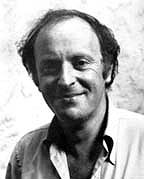
"Joseph Brodsky (1940-1996): Russian-American poet, Nobel Prize Winner: Author of half a dozen volumes of poetry in Russian and English (with many self-translations). Essayist, Professor of Literature at the Five Colleges. Was briefly a member of the editorial board of METAMORPHOSES before his death." |
|
Ayn Rand
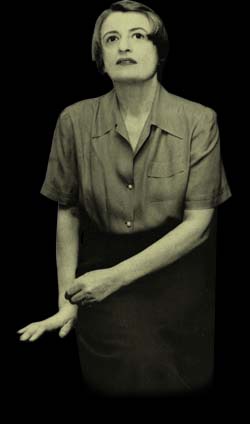
"Ayn Rand was born in St. Petersburg, Russia on February 2, 1905. At age six, she taught herself to read and two years later discovered her first fictional hero in a French magazine for children, thus capturing the heroic vision which sustained her throughout her life. At the age of nine, she decided to make fiction-writing her career. Thoroughly opposed to the mysticism and collectivism of Russian culture, she thought of herself as a European writer, especially after encountering authors such as Walter Scott and &emdash; in 1918 &emdash; Victor Hugo, the writer she most admired." |
|
CINEMA AND TELEVISION Louis B. Mayer
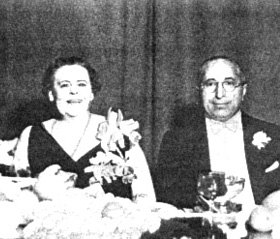
"Former junkman Louis B. Mayer rose to become one of the most influential and powerful men in Hollywood during the '30s and '40s, when he was the head of Metro-Goldwyn-Mayer, once considered the grandest of Hollywood studios that claimed to have "more stars than there are in the heavens." He was born Eliezer Mayer in Minsk, Russia. The son of a laborer, he emigrated with his family to New York during his childhood." |
|
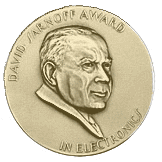
"Russian-born David Sarnoff (1891-1971) first made his name as a telegraph operator who happened to be on duty in New York on April 14, 1912, when a faint signal came in: "SS Titanic ran into iceberg. Sinking fast." Sarnoff informed the nation of developments through his reports to the New York American. In the years that followed, Sarnoff saw beyond Morse Code. He sold Radio Corporation of America on his vision of a "radio music box" that would bring entertainment and enlightenment into people's living rooms. In 1926 the National Broadcasting Co. was incorporated, and NBC's Red and Blue networks went on the air, offering programing that linked town and city simultaneously." |
|
Anna Kozlova
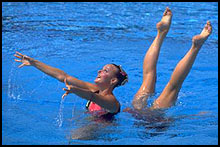
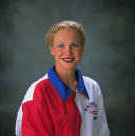
"Anna Kozlova is one of the most accomplished synchronized swimmers in American history Kozlova came to the U.S. to train in 1993 and did not return to her native Russia. She has won a total of 17 national titles, including nine in the Olympic events (team and duet). She will return to the Olympics after an eight-year absence this year at Sydney. Anna ended up in Santa Clara, California when she and her duet partner went there from Russia to train for two months." |
|
|
|
|
Questions or comments? Contact Galina Sergushenkova-Wladyka