
|
Diet |
Reproduction |
Physical |
Habitat |
Links |
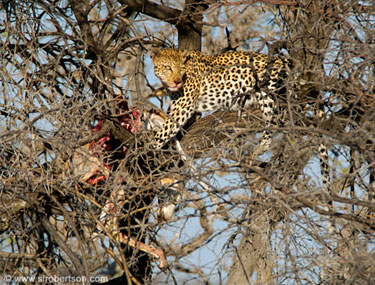
Diet Leopards are opportunistic hunters. Although mid-sized animals are preferred, the leopard will eat anything from dung beetles to 900 kg male giant elands . Their diet consists mostly of ungulates and monkeys , but rodents , reptiles , amphibians , birds and fish are also eaten. In fact, they hunt about 90 different species of animals. A solitary dog is a potential prey for leopards, although a pack of dogs can tree or drive off a leopard. In Africa, mid-sized antelopes provide a majority of the leopard's prey, especially impala and Thomson's gazelles . In Asia the leopard preys on deer such as chitals and muntjacs as well as various Asian antelopes and Ibex . |
 |
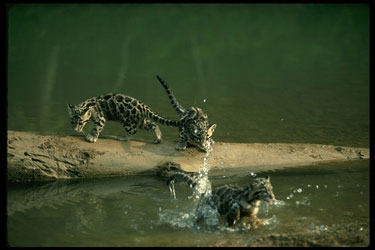 |
Reproduction A male may follow a female who catches his attention. Eventually fighting for reproductive rights can take place. Depending on the region, leopards may mate all year round (India and Africa) or seasonally during January to February (Manchuria and Siberia). The estrous cycle lasts about 46 days and the female usually is in heat for 6–7 days.Cubs are usually born in a litter of 2–3, but infant mortality is high and mothers are not commonly seen with more than 1–2 cubs. The pregnant females find a cave, crevice among boulders, hollow tree, or thicket to give birth and make a den. Cubs open their eyes after a period of 10 days. The fur of the young tends to be longer and thicker than that of adults. Their pelage is also more gray in color with less defined spots. Around three months the infants begin to follow the mother out on hunts. At one year of age leopard young can probably fend for themselves but they remain with the mother for 18–24 months. |
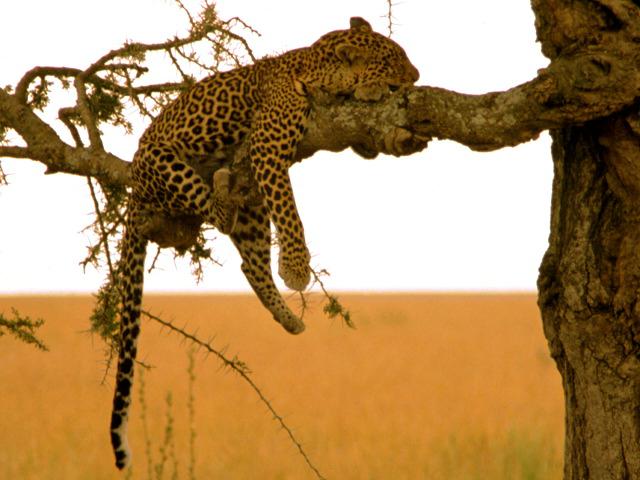
Physical The leopard is an agile and graceful predator. Although smaller than the other members of Panthera , the leopard is still able to take large prey given a massive skull that well utilizes powerful jaw muscles. Its body is comparatively long for a cat and its legs are short. Head and body length is between 90 and 190 cm, the tail reaches 60 to 110cm. Shoulder height is 45 to 80 cm. Males are considerably larger than females and weigh 37 to 90 kg compared to 28 to 60 kg for females.One of many spotted cats, a leopard may be mistaken for a cheetah or a jaguar. The leopard has rather than cheetah 's simple spots, but they lack internal spots, unlike the jaguar. The leopard is larger and less lanky than the cheetah but smaller than the jaguar. The leopard's black, irregular rosettes serve as camouflage. They are circular in East Africa but tend to be square in southern Africa.Leopards have been reported to reach 21 years of age in captivity. |
 |
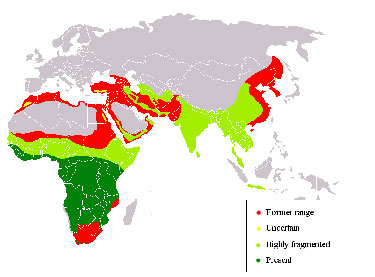 |
Habitat As of 1996, the leopard had the largest distribution of any wild cat, although populations before and since have shown a declining trend and are fragmented outside of subsaharan Africa. The IUCN notes that within subsaharan Africa the species is "still numerous and even thriving in marginal habitats" where other large cats have disappeared, but that populations in North Africa may be extinct. In Asia, data on distribution are mixed: populations in Southwest and Central Asia are small and fragmented; in the northeast portion of the range, they are critically endangered; and in Indian, Southeast Asia, and China, the cat is still relatively abundant. Leopards also like to live in grasslands, woodlands and riverside forests. |
Top