Assignment 2
I have selected the lecture “ proteomic ” from the set of lecture series that S-star has offered to download and study . This topic had delivered by Dr. Marc Wilkins .

Proteomic
Nowadays we know that genome define the information content of organism and genome sequence has changes biology forever. However genome sequence does not tell how an organism works but it can tell by study protein, the functional molecules. The protein complement that expressed by genome or tissue is called Proteome. The word is derived from PROTEins and by genOME, since proteins are expressed by the genome. Proteomes are dynamic that change as a function of time, development, extracellular or intracellular condition. The proteome is larger than the genome, especially in eukaryotes, in the sense that there are more proteins than genes. This is due to alternative splicing of genes and post-translational modifications like glycosylation or phosphorylation.
Proteomic is the study of proteome that aim to separate, identify and characterize proteins on a large scale to define levels of protein in cells and tissues and how these change. Proteomic need to investigate protein complex because protein can operate by themselves or associate with other protein and need to elucidate protein function, pathways and the interrelationships of protein.
Protein separation Traditional protein chemistry use column chromatography, such as ion exchange or reversed phase chromatography, which can separate only one protein at a time and purification for a long time (month).The best tool available for separation of many proteins at once is 2–dimensional polyacyramide gel electrophoresis.
Proteomic will define the proteome of a cell or tissue meaning what protein are express at what time and what condition, provide means of comparing proteomes to explain phenotype, provide clue to protein function by define co-stimulate and co-regulation protein and is potential in combination with other technology, but proteomic will not replace genome sequencing and can not be ease as genome sequence.

|
Expianation
2–dimensional polyacyramide gel electrophoresis
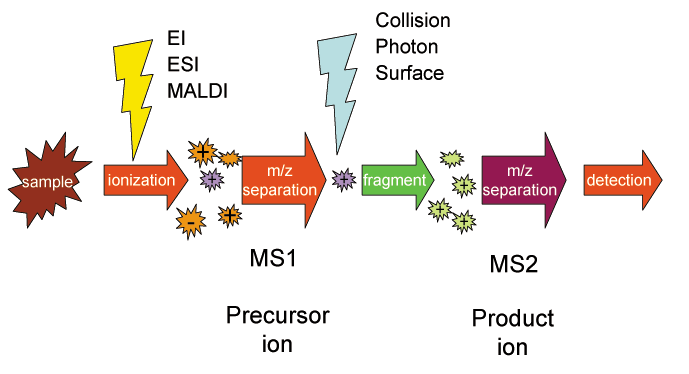
Mass spectrometry (MS) precisely measure the mass of molecule that have 2 part,ion source and measuring apparatus. In ion source for protein analysis are electrospray ionization (ESI) and matrix assisted laser desorption/ionization (MALDI). The measuring apparatus these are teamed with are quadrupoles, time of fight (TOF) detectors, ion traps and combination all of them. (Common platforms are MALDI-TOF, ESI-TOF, ESI/ion trap, triple or quadrupole TOF)
Automate Mass spectrometry
|
|---|