Faculty
of Humanities
Department of Curriculum Development
Media and Computers in Education
The
MOO Environment in General and the Educational MOO in Particular
User
Profile
Abridged
Version
Thesis submitted for the M.A. degree
By
Orly
Yankelevsky
This thesis was carried out under the guidance of
Dr. Avigail
Oren and Dr. David Mioduser
October 1999
Copyright: Yankelevsky, O. (1999). The MOO Environment in General and the Educational MOO in
Particular: User Profile. Unpublished thesis paper,
Acknowledgements
I wish to thank all the people who made this
thesis possible: First and foremost, my supervisors, Dr. Avigail
Oren, for showing me the MOO world and for her guidance, support and
encouragement and Dr. David Mioduser for his
constructive remarks. Secondly, I would like to thank Elon
Noiman for his professional and devoted assistance
with the statistic analysis. Last but not least, I should like to thank all my
friends on the MOO who encouraged me and the anonymous MOO users who were
willing to spare their time and participate in my research.
This paper attempts to investigate the
social and educational potential of the MOO, with emphasis on the educational
MOO. This is accomplished through a close examination of the profile of MOO
users. 161 MOO users of both social and educational MOO environments completed
an anonymous on-line survey on MOO experience which examined their demographic
characteristics, motivation for frequenting the MOO, use of the MOO, perception
of the MOO and the way they view their membership there. Findings regarding the
demographic characteristics of users are consistent with the literature.
Respondents were mainly native English speakers, computer competent with high
education. They grasp the environment as both social and educational and use it
mainly for sharing ideas and professional tips. The elements found favorite by
most users were the sense of community and the cross- cultural contact. A
typological classification of MOO users revealed three prototypes: The highly
academic teacher, the student seeking company and the young programmer. In
light of these findings, this paper suggests that the MOO be viewed as a
learning environment that encourages learning in a social setting and can
enhance the development of real professional communities based on communal
interest for collaborative work.
The rapid development of the Internet
network brought many changes to our daily life and presented new challenges to
the education. The new channels of communication also offer an alternative to
the place-based community - a virtual community, based on mutual interest.
Virtual communities, formed in cyberspace,
vary from asynchronous, like newsgroups and discussion forms, to synchronous,
like Chat, IRC and the MOO. This research will concentrate on the MOO
environment, since of all synchronous environments,
the MOO provides the strongest resemblance to the traditional community (Falk,
1995). The MOO environment provides various activities in addition to chat and,
unlike chat and IRC environments, does not cease to exist once all users log
out. Users revisiting the MOO will find the same rooms and objects they
remember from prior visits. This gives the MOO a sense of permanence so
important to the development of a long lasting community (Rheingold, 1994;
Reid, 1994).
The MOO - Multi User Dimension Object
Oriented environment is an Internet based textual virtual world in which
people from all over the world meet in real time to converse, interact with
textually described objects and with each other in synchronous and asynchronous
ways. MOO visitors, expand the environment by building textually described
rooms and objects and thus become contributors and not just passive recipients.
MOOs divide into Social and Educational. Social MOOs serve as a gathering place for friendly, social
interaction. Educational MOOs are usually centered on
an academic theme and enable teacher-student and student-student communication
during and after school hours.
The social potential of the MOO
The MOO environment fits Oldenburg's (1991)
definition of "third place". According to Oldenberg
the first place is where we live, the second place is where we work and the
third place exists on neutral ground and guarantees all members social
equality. People come to third places on a voluntary basis and the main
activity there is conversation among the regular clientele. The MOO
environment, which is open to everyone and offers equality, may serve as a
third place for people with shared interest.
The educational potential of the MOO
A literary review of current pedagogical
theories reveals that all share some common features. All emphasize the
importance of collaborative learning and learning in a social setting, the
inseparable bond between intellectual learning and the learner's emotional
world and the need to combine the learning process with the community life in
which it takes place (Oren, 1997). Vygotsky (1978)
claims that learning is best done in a social setting and that a “care-taker”
is needed to help the learner into the zone of proximal development - the area
of new knowledge. New pedagogical theories also emphasize the importance of
autonomous learning - students' responsibility to the content and pace of their
learning and active learning - constructing knowledge through active learning (Papert, 1991).
The MOO environment offers the opportunity for
collaborative learning for the students as well as collaborative instruction
and collaborative professional development for the teachers. The variety of
interactive tools offers a wide range of opportunities to students and teachers
with different styles of learning and teaching and make it impossible for users
to stay passive (Backer, 1998).
Research Rationale
In an age where virtual communities are
created daily, and act as an addition or substitute for the place-based
communities, it is worth examining the social potential of such environments.
Since learning is also a social process and should take place in a social
setting, there is room to study the educational potential of such environments
as well.
Sarason (1997) claims that in order for learning to be
meaningful, one must focus on the learner: his interests, attitude and
motivation, and design instruction to enhance them. In light of this approach,
this research aims to examine the potential of the MOO by focusing on the MOO
users for whom the environment is designed.
Curtis (1992) argues that despite the
availability of personal computers and free access to the Internet to all
university students and the easy access to MOO environments not all are
attracted to it. Serpentelli (1991) admits that not all find interest in the MOO not even those who could have
benefited from it.
This research, hence, aims to describe the
profile of those users attracted to the MOO. Such information will allow MOO
administrators to design MOOs that suit users' needs and
interest.
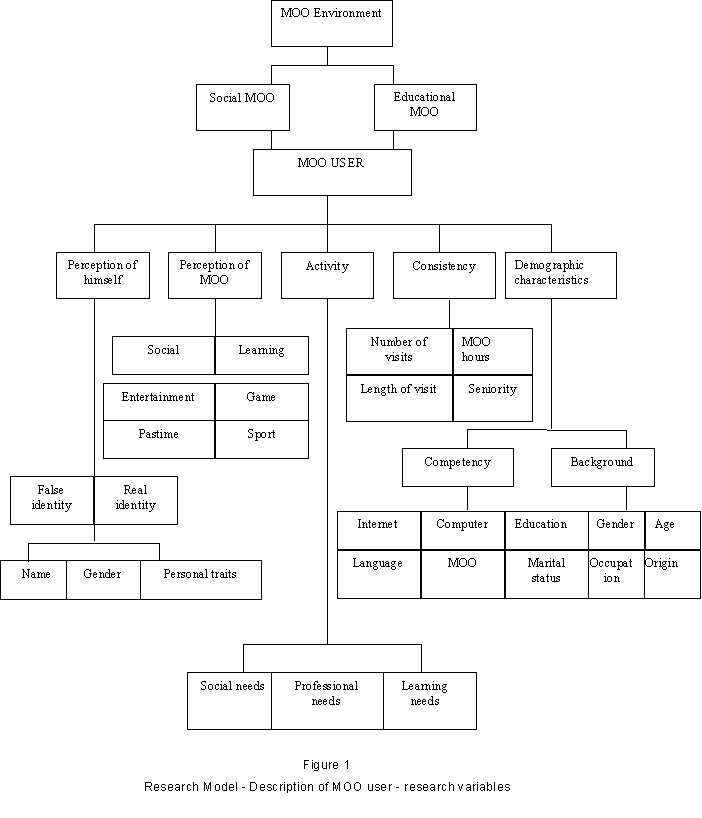
The questions raised in this research are
as follows:
u What are the demographic characteristics of the MOO
user?
u What characterizes the MOO user's consistency in the
environment?
u For what purposes does the MOO user use the
environment?
u How does the MOO user view the environment and what
does it mean to him?
u What elements of the environment attract the MOO
user?
u How does the MOO user view his identity in the MOO
environment?
u Do MOO users from Social MOOs
and Educational MOOs differ in the above respects?
u Do MOO users with different background variables
(gender, mother tongue, occupation and age) differ in the above respects?
Figure 1 the research model - Description of
MOO users - diagram of variables.
Background back
MOO Population
Earlier studies provide data on the
demographics of people who use the MOO. According to these studies MOO population
is portrayed as an "Elite group". Moo users are most often above the norm in terms of educational
background and socioeconomic status. They are people with passable proficiency
of English who have access to the Internet. (Luke, 1993; Fernback & Thompson, 1995; Curtis, 1992;
Serpentelli, 1991; Roberts, Smith & Pollock, 1996; Sempsey, 1997). Serpentelli
explains that the reason the MOO population is more exclusive than that of
other virtual environments lies in the fact that the MOO environment is more
complex to handle (Serpentelli, 1991).
Roberts, Smith and Pollock (1996)
interviewed 54 MOO users. The picture emerging is of a predominantly male,
young, highly educated group of North Americans. Out of the 54 interviewees 69%
were male, 23% female and 3% described their gender as indeterminate. 64%
of interviewees resided in the
Curtis who observed the population of Lambda
MOO claims that 90% of the MOO population are college
undergraduate students. Bruckman who surveyed the
population of MediaMOO found that 84% were man. Serpentelli, predicted, though, that the communicative
aspect of the MOO may contribute to breaking this gender gap by attracting more
woman (Serpentelli, 1991).
Perception of the MOO
The MOO may be grasped in many ways. Curtis
(1992) calls the MOO environment a "social outlet" and compares the
random encounters occurring on the MOO to those taking place on a shipboard. Suler (1996) describes the MOO as an "ongoing
party" and Bruckman and Resnick
(1993) as an "endless conference reception".
Reid (1994) explains that the MOO user is
simultaneously in two worlds: real and virtual and sometimes the boundaries are
not clear. Cherny (1995) distinguishes between two
perspectives: viewing the MOO as an extension of real life and viewing the MOO
as an escape from it. Cherny explains that users who
belong to the first group tend to choose their own name for their persona and
initiate off-line meetings with friends from the MOO community. Members who
view the MOO as a whole new world will prefer a false name and engage more in
role play games and gender swapping.
Elements of the MOO
Different researches view different aspects
of the MOO as its main attraction. Many consider the social contact and the
close friendships formed on the MOO as its best reward (Turbee,
1997; Roberts, Smith and Pollock, 1996; Rheingold, 1994). Bruckman
and Resnick (1993) studied the population of MediaMOO and found out that the most meaningful interaction
is that among regulars who by their constant presence give the MOO its sense of
consistency. This is why it is considered important for users to frequent the
MOO on a daily basis (Suler, 1996; Turkle, 1995). Since the population of the MOO is
international MOO users have a chance to meet other users from different
cultures. This sense of "global village" is one more reward the MOO
(Roberts, Smith and Pollock, 1996).
Another important element is the ability to
expand the environment. Turbee (1997) claims that the ability to build objects and own them gives
users a feeling of consistency and encourages users to revisit the MOO.
Building objects and thus helping develop the MOO also strengthens the user's
sense of belonging (Bruckman,1997; Roberts, Smith and
Pollock, 1996). Programming skills help users climb up the hierarchy level.
Status and influence are, then, another element (Bruckman,
1997; Reid, 1994).
In addition to the realistic elements, the
MOO has also some unrealistic features: anonymity and the ability to maintain
more than one identity. Turkle explains that the MOO
is a laboratory where the user can test various aspects of his personality,
free himself from physical limitations and
psychological inhibitions and be anything he wants to. This freedom leads to
gender swapping. Gender swapping may result from the wish to undergo new
experiences or avoid unpleasant ones (Serpentelli,
1991; Curtis, 1992; Rheingold, 1994). Finally, since users may appear under
different titles the MOO population is egalitarian. Real life status does not
exist in the MOO. Status in the MOO results from users' contribution.
Suler's taxonomy
Suler explains people's addiction to virtual worlds such
as Palace and MOO based on Maslow's hierarchy of
human needs. Suler claims that people become
preoccupied with an activity if that activity satisfies their needs. Suler explains how the MOO environment satisfies human
needs starting at the bottom.
The most basic human needs are the
biological ones. The MOO is emotionally safe due to the anonymity it allows and
therefore users feel more open, bold and experimental. By biological Suler includes not only the phenomenon of Cybersex but also the playful flirting. Next comes the need for interpersonal contact, social recognition
and a sense of belonging - the need for a place where everybody knows your
name. The fact that all MOO users have something in common -
their interest in computer technology enhances the feeling of belonging.
The third need is "the need for learning, accomplishment, mastery of the
environment and the self esteem that arises from such achievement." The
MOO is not a static environment and the process of mastering its technical and
social structure is a never-ending process. The forth need is the need for
"self-actualization - fulfilling one's intellectual and artistic needs.
Bartle's typology
Trying to found out what people want out of
a MUD, Bartle (1996) conducted discussions on
bulletin boards. Out of the hundred postings he came up with four things people
typically enjoyed about MUDs and inferred four types
of MUD users: The achiever - who is interested in doing things to the
game - setting goals, achieving them and climbing up the level hierarchy. The
explorer - who likes to explore the virtual world and learn as much as
possible about it. The Socialiser - who is
interested in socializing with other users, found out about them and get to
know them. The Killer - interested in doing things to other players and demonstrate his superiority over them. Most users drift
between all four depending on the situation.
According to Bartle
the Achiver views the MOO as a game, the Explorer as
a pastime, the Socialiser as
an entertainment and the Killer as a sport. Bartle
notes that these types are not typical only to the MUD environment and that we
can encounter such types also on educational MOOs.
Research population
161 respondents, from 49 different MOO
environments, took part in this research. 88 of them were from Educational MOOs and 78 from Social ones. Probability sampling was not
possible since no updated list of all MOO environments is yet available and the
exact number of MOOs is unknown. Moreover, MOO
administrators keep users' real name and e-mail addresses confidential.
Therefore, participants were sampled by way of convenience and quota sampling.
Sampling took place via three channels:
News board and discussion lists within
the MOO - A few popular
public-access MOOs were selected and an invitation to
take part in it was posted on their internal news board and their *general
discussion list, with approval of the MOO administrators. In this way an appeal
could be made to a large audience.
External Discussion lists - an announcement about the research and a call to
take part in it was also posted in some discussion lists outside the MOO.
Personal appeal - Since recruiting participants through MOO news
board and external discussion lists could cause biases, participants were also
recruited randomly from within the selected MOOs by
personal address.
Materials
A questionnaire consisting of two parts was developed for this research. The first part
contained demographic items and the second related to MOO experience. Since MOO
users tend to frequent more than one MOO and their attand
behavior may vary from MOO to MOO, participants were asked to relate to the MOO
that they call their Home MOO - the place most significant to them.
Variables
Demographic measures: Out of the 11 demographic measures 7 referred to
background: gender, age, origin, mother tongue, education and marital status
and 4 to computer competence: time spent on computers and on the Internet and
the applications mastered.
Consistency: The consistency variable was measured by 4 measures:
the way the respondent learnt about the MOO, his command of the MOO, his plans
for the future and the nature of his visits - in terms of length, number of
visits per-day and seniority in the environment.
Activity: In order to assess respondents' use of the
environment a 5 point Likert scale consisting of 24
items was designed. Each item described a possible activity based on the
literature, personal experience and initial interviews with random MOO
participants. Items related to both social activities and
educational/professional ones. Respondents were asked to rate how often they
are engaged in the activities on a scale ranging from Never to Always.
Perception of the MOO: The way respondents view the MOO was measured by two
5 point Likert scales. Respondents were asked to
assess how true each given statement describes the way they feel. The first
rating scale referred to the way the MOO is viewed and contained items such as;
a game, a pastime, a sport, entertainment, a social environment or learning
environment. The second scale concentrated on the realistic and unrealistic
elements of the MOO and the extent to which they may attract participants to
the MOO. Respondents were asked to state how much they like elements such as;
sense of community, anonymity, equality, cross-cultural relationships etc.
Player's perception of himself: The way participants view themselves in the MOO was
measured by three items. Participants were asked whether or not their MOO name,
gender and personal traits are identical with those they have in reality.
Procedures
The questionnaire was written in a format
that allowed respondents to fill it out via a Java-enabled browser and submit
it anonymously. Yet, respondents were given the option to mention their e-mail
address in case they wish to be informed about the results of the research. The
idea behind this option was to encourage participants by intriguing their
interest and rewarding them for their trouble. Confidentiality was promised to
those choosing this option.
Data collection in the three sampling
fashions mentioned earlier lasted about two months. In the course of this
period a total of 166 valid forms was gathered. About
12-15 hours per week were devoted to wandering around MOO environments and
randomly addressing MOO users.
Descriptive statistics was used to analyze
the data obtained. In order to examine differences among respondents who vary
on the independent variables three tests were used. Chi square test of
independence (c 2)
and Spearman correlation coefficient were used to test statistical correlation
between variables. T-test was used to compare mean scores of two separate
groups of one variable.
Results
back
In principle, the picture of educational MOO
users resembles that of MOO users in general. Bearing in mind that the
potential of the educational MOO is of more interest to the educational filed,
findings described here will concentrate on the users of educational MOOs. However, an attempt to compare data obtained about
MOO users of educational MOOs with data obtained
about MOO users of social MOOs will be included.
Users of Educational MOOs
Out of the 161 respondents, a total of 88
(54.7%) respondents regard an Educational MOO as their home MOO. The vast
majority of respondents are male (64.8%), the averaged age is 31.8 and 63.6%
are over the age of 25. The sample was international but most respondents were
from the
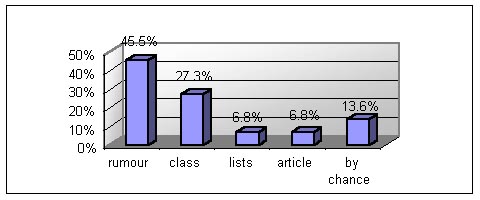
Respondents became acquainted with the MOO
in various ways, but mostly by word of mouth (45.5%). Only less than a third of
them (27.1%) learnt about it from a classroom announcement. Figure 2
illustrates the different means through which users learnt about the MOO.
Figure
2
Users'
means of getting acquainted with the MOO environment (N=88)
The amount of time respondents spend in the
MOO ranged from 1 to 80 weekly hours (M=12.66 hours, SD=15.10) and the length
of each visit ranged from 2 minutes up to 7 hours. Respondents reported
visiting the MOO about twice a day. The averaged amount of time respondents
spent in the MOO since they had first visited a MOO was 27.38 months which is a
little bit more than two years.
The most common player category in the
hierarchy of authority levels is that of members only (36.4%) and programmers
(28.4%). About a third (34.1%) expressed a wish to climb higher on the
hierarchy ladder in the future.
Respondents prefer to stay in their private
rooms (60.2%). The arguments used to explain their preference ranged from
practical; the wish to program and build undisturbed while maintaining
discussions via the page command to personal-social; preferring intimate
conversations to multi participant ones.
Those preferring the public rooms used
arguments such as the opportunity to get acquainted with new people and the
availability of objects to manipulate and play with in those public rooms. Many
of those preferring the public rooms have built those rooms or objects placed
there and enjoy seeing people's reaction and assisting them in using those
rooms. The most popular public rooms are the classrooms.
The activities respondents are most
frequently engaged in are: chatting with friends from the MOO community,
sharing ideas, reading/writing messages, helping new members, exchanging
professional tips and building objects.
The help and assistance reported by
respondents are both technical and emotional. Respondents reported a lot of
collaborative work, collaborative writing, research and teaching. Respondents
are also engaged in programming and gain a lot of satisfaction from it. Those
who program objects enjoy watching people interact with them.
Table 1 shows the distribution (in
percentage) of 24 activities. Activities are ranked from the most frequent to
the least.
Table
1
Frequencies
(in percentage) of MOO activities (N=88)
|
Activity: |
Seldom- Never 1 |
Sometimes 2 |
Often - Always 3 |
M |
|
Chatting with MOO friends |
10.2% |
27.3% |
62.5% |
2.52 |
|
Sharing ideas |
8.0% |
34.1% |
58.0% |
2.50 |
|
|
25.0% |
38.6% |
36.4% |
2.11 |
|
Helping new members |
23.9% |
42.0% |
34.1% |
2.10 |
|
Exchanging professional tips |
30.7% |
34.1% |
35.2% |
2.05 |
|
Chatting with occasional members |
22.7% |
52.3% |
25.0% |
2.02 |
|
Interacting with objects |
37.5% |
34.1% |
28.4% |
1.91 |
|
Building/programming objects |
42.0% |
30.7% |
27.3% |
1.86 |
|
Lurking/idling |
44.3% |
27.3% |
28.4% |
1.84 |
|
Chatting with occasional guests |
28.4% |
48.9% |
22.7% |
1.94 |
|
Learning different subjects |
44.3% |
29.5% |
26.1% |
1.82 |
|
Chatting with pre-MOO friends |
48.9% |
26.1% |
25.0% |
1.76 |
|
Participating in MOO newsgroups |
45.5% |
30.7% |
23.9% |
1.78 |
|
Participating in MOO projects |
48.9% |
26.1% |
25.0% |
1.76 |
|
Wandering around exploring the MOO |
43.2% |
40.9% |
15.9% |
1.73 |
|
Teaching students |
46.6% |
21.6% |
31.8% |
1.85 |
|
Participating in organized gatherings |
44.3% |
27.3% |
28.4% |
1.83 |
|
Conducting research |
53.4% |
17.0% |
29.5% |
1.76 |
|
Teasing other members |
62.5% |
21.6% |
15.9% |
1.53 |
|
Flirting |
77.0% |
16.1% |
6.9% |
1.30 |
|
Playing board games |
67.0% |
17.0% |
15.9% |
1.50 |
|
Searching for friends for off-line friendship |
73.9% |
15.9% |
10.2% |
1.36 |
|
Looking for job possibilities |
89.8% |
6.8% |
3.4% |
1.14 |
|
Role play |
76.1% |
17.0% |
6.8% |
1.30 |
Respondents grasp the MOO as both a learning
(86.4%) environment and a social (80.7%) one and less as a game (21.6%) or a
sport (5.7%). Most respondents (64.8%) consider the MOO as a supplement that
enriches their real world and only 8% view the MOO as a new and better world.
The elements of the MOO found most favorite
by respondents are the ability to meet people from different cultures (85.2%),
the sense of belonging to a community (69.3%) and equality (71.6%). Table 2
shows the elements favored by users from the most important to the least.
Table
2
Distribution
(in percentage) of favorite elements(N=88)
|
In the MOO I like ... |
Disagree 1 |
Uncertain 2 |
Agree 3 |
M |
|
Meeting people from different cultures |
6.8% |
8.0% |
85.2% |
2.78 |
|
Sense of belonging to a community |
12.5% |
18.2% |
69.3% |
2.57 |
|
Being equal to others |
10.2% |
18.2% |
71.6% |
2.61 |
|
Owning objects |
18.2% |
26.1% |
55.7% |
2.38 |
|
The ability to influence others |
20.5% |
30.7% |
48.9% |
2.28 |
|
Being anonymous |
50.9% |
22.7% |
27.3% |
1.77 |
|
Having more than one identity |
51.1% |
23.9% |
25.0% |
1.74 |
Respondents prefer to use their real name on
the MOO (55.7%). A vast majority of the respondents prefer to identify
themselves by their own gender (92%) and 88.6% claim their characteristics in
the MOO are quite similar to those they have in real life. Respondents who
cling to their name do that for various reasons but mostly because this is the
requirement in some Educational MOO environments. Other reasons reported are
their choice not to hide their own identity or just lack of imagination. Those
who prefer to appear under a different name explained that they wanted to
convey a certain message by their names or hint on their field of interest.
Another reason reported is the consent that this is an important element of the
environment and therefore should be made use of. Technical reasons mentioned
are the fact the real name was already taken by another participant, was too
long or too common.
Do MOO users from Social MOOs and Educational MOOs differ
in the above respects?
Out of the 161 respondents 88 come from an
Educational MOO (54.6%) and 73 (45.3%) come from a Social MOO.
Respondents from the educational MOO differ
significantly from their counterparts from the social MOO in terms of: mother
tongue, occupation, social status and age. Although the vast majority of
respondents from either MOO are native English speakers, the group of native
English speakers is bigger in the Social MOO - 89% as opposed to 62.5% in the
educational MOO (c 2=14.81, P<0.001). Teachers among the respondents
tend to frequent the educational MOO whereas University students or users from
the computer-related realm tend to frequent the social one. Consequently, a
t-test revealed a significant difference between the averaged age of users in
the educational MOO (31.8) and that in the social MOO (27.8) (t=2.25,
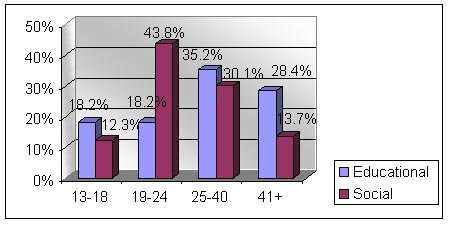
P<0.02). Chi square test indicates significant differences among age groups
between users from the two MOO environments. Whereas the most common age group
in the educational MOO is 25-40 (35.2%) the most common age group in the social
MOO is 19-24. Figure 3 presents the distribution (in percentage) of users among
the 4 age groups in both Educational and Social MOO environments.
Figure
3
Distribution
of users among the 4 age groups in the Educational and Social MOOs
The averaged amount of time respondents from
the educational MOO spent in the MOO since they were first introduced to it was
27.38 as opposed to 43.36 for respondents from the social MOO. This difference
was found statistically significant on a T- test (t= - 5.37, P<0.001).
A comparison of the two types of MOO
environments also produced significant differences in terms of use of the
environment. Respondents from the educational MOO tend to participate in
organized gathering (c 2=5.81, P<0.05), conduct research (c 2=6,
P<0.05) and teach (c 2=5.94, P<0.05) in the MOO significantly more
frequently than respondents from the social MOO. Respondents from the social
MOO are engaged in flirting (c 2=7.42, P<0.02) and lurk and idle (c 2=7.42,
P<0.02) in the MOO significantly more often than those who frequent the
educational MOO.
In addition to perceiving the MOO as both
social and educational, respondents from the social MOO perceive the MOO also
as an entertainment (86.1%), pastime (77.8%) and game (34.7%). Table 3 presents
the distribution (in percentage) of the ways the MOO is perceived by users of
educational and social MOOs including c 2 test.
Table
3
Distribution
(in percentage) of users' perception of the MOO including c 2 test
|
For me the MOO is a ... |
Disagree 1 |
Uncertain 2 |
Agree 3 |
c 2 |
|||
|
|
Edu |
Social |
Edu |
Social |
Edu |
Social |
|
|
Learning environment |
3.4% |
2.8% |
10.2% |
12.5% |
86.4% |
84.7% |
0.24 |
|
Social environment |
10.2% |
5.6% |
9.1% |
0.0% |
80.7% |
94.4% |
8.47 |
|
Entertainment |
22.7% |
6.9% |
9.1% |
6.9% |
68.2% |
86.1% |
8.21* |
|
Pastime |
34.1% |
12.5% |
15.9% |
9.7% |
50.0% |
77.8% |
13.62** |
|
Game |
48.9% |
52.8% |
29.5% |
12.5% |
21.6% |
34.7% |
7.86* |
|
Sport |
83.0% |
68.1% |
11.4% |
22.2% |
5.7% |
9.7% |
4.89 |
*P<0.05 **P<0.01
Respondents from the social MOO like the
anonymity the MOO allows significantly more than those from the educational one
(c
2=7.42, P<0.02). This fact
is also evident in their choice of identity. 65.3% of the respondents from the
social MOO chose a false name as opposed to only 44.3% in the educational MOO (c 2=6.70, P<0.008).
Do MOO users with different background
variables (gender, mother tongue, occupation and age) differ in the above
respects in the Educational MOO?
Out of the four independent variables:
Gender, mother tongue, age and occupation, mother tongue played the most
statistically significant role. Gender didn't produce any statistically
significant differences.
Out of the total of 88 respondents, 55
(62.5%) were native English speakers and 33 (37.5%) were nonnative English
speakers.
The vast majority of respondents from the
group of native English speakers are teachers (52.7%) and high school students
(27.3%). The group of non-native English speakers consists mostly of university
students (48.5%) and people who work in the computer related field (15.2%).
This difference was found statistically significant (c 2=14.77, P<0.05). Table 4 presents the distribution
of the demographic variables among Native and Non-native English speakers.
Table
4
The
distribution (in percentage) of demographic variables including c 2
|
Variable |
Value |
Native Speakers N=55 |
Others N=33 |
c 2 |
|
Gender |
Male |
67.3% |
60.6% |
0.40 |
|
|
Female |
32.7% |
39.4% |
|
|
Age |
13-18 |
25.5% |
6.1% |
33.06*** |
|
|
19-24 |
1.8% |
45.5% |
|
|
|
25-40 |
32.7% |
39.4% |
|
|
|
41+ |
40.0% |
9.1% |
|
|
Education |
K12 |
27.8% |
12.1% |
6.34 |
|
|
College-B.A |
31.5% |
51.5% |
|
|
|
M.A+ |
40.7% |
36.4% |
|
|
Occupation |
Student |
27.3% |
48.5% |
14.77** |
|
|
Teacher |
52.7% |
18.2% |
|
|
|
Computer field |
7.3% |
15.2% |
|
|
|
Others |
12.7% |
18.1% |
|
|
Marital status |
Married |
45.5% |
33.3% |
8.47* |
|
|
Not married |
54.5% |
66.7% |
|
*P<0.05 **P<0.01 ***P<0.001
Respondents from the group of native English
speakers are more motivated to climb up the hierarchy ladder and gain power and
influence more than respondents from the group of non-native English speakers (c 2=7.28, P<0.02).
Though both groups favor the activities of
chatting with friends from the MOO community and sharing ideas, findings
indicate that respondents from the group of native English speakers assist new
members, exchange professional tips, program and manipulate objects and
participate in MOO projects significantly more often than their non-native
counterparts (P<0.05). Non-native speakers of English, on the other hand,
tend to use the MOO more in order to look for friends for offline friendship (c 2=12.21, P<0.05). Table 5 presents the distribution
(in percentage) of 24 activities among Native and Non-native English speakers
including c 2
test.
Table
5
The
distribution (in percentage) of 24 actiincluding c 2
|
Activity: |
Seldom-Never 1 |
Sometimes 2 |
Often-Always 3 |
c 2 |
|||
|
|
Native |
Other |
Native |
Other |
Native |
Other |
|
|
Chatting with MOO friends |
10.9% |
9.1% |
23.6% |
33.3% |
65.5% |
57.6% |
0.98 |
|
Sharing ideas |
5.5% |
12.1% |
32.7% |
36.4% |
61.8% |
51.5% |
1.61 |
|
|
18.2% |
36.4% |
40.0% |
36.4% |
41.8% |
27.3% |
3.99 |
|
Helping new members |
16.4% |
36.4% |
50.9% |
27.3% |
32.7% |
36.4% |
6.28* |
|
Exchanging professional tips |
20.0% |
48.5% |
41.8% |
21.2% |
38.2% |
30.3% |
8.39* |
|
Chatting with occasional members |
20.0% |
27.3% |
50.9% |
54.5% |
29.1% |
18.2% |
1.51 |
|
Chatting with occasional guests |
27.3% |
30.3% |
47.3% |
51.5% |
25.5% |
18.2% |
0.62 |
|
Interacting with objects |
27.3% |
54.5% |
38.2% |
27.3% |
34.5% |
18.2% |
6.75* |
|
Building/programming objects |
32.7% |
57.6% |
38.2% |
18.2% |
29.1% |
24.2% |
5.90* |
|
Teaching students |
38.2% |
60.6% |
21.8% |
21.2% |
40.0% |
18.2% |
5.32 |
|
Lurking/idling |
45.5% |
42.4% |
25.5% |
30.3% |
29.1% |
27.3% |
0.24 |
|
Participating in organized gathering |
36.4% |
60.6% |
29.1% |
21.2% |
34.5% |
18.2% |
5.10 |
|
Learning different subjects |
40.0% |
51.5% |
30.9% |
27.3% |
29.1% |
21.2% |
1.20 |
|
Participating in MOO newsgroups |
41.8% |
51.5% |
29.1% |
33.3% |
29.1% |
15.2% |
2.23 |
|
Chatting with pre-MOO friends |
47.3% |
51.5% |
21.8% |
33.3% |
30.9% |
15.2% |
3.17 |
|
Conducting research |
56.4% |
48.5% |
18.2% |
15.2% |
25.5% |
36.4% |
1.18 |
|
Participating in MOO projects |
36.4% |
69.7% |
29.1% |
21.2% |
34.5% |
9.1% |
10.53* |
|
Searching for friends for off-line friendship |
83.6% |
57.6% |
14.5% |
18.2% |
1.8% |
24.2% |
12.21* |
|
Wandering around exploring the MOO |
36.4% |
54.5% |
47.3% |
30.3% |
16.4% |
15.2% |
3.05 |
|
Teasing other members |
61.8% |
63.6% |
21.8% |
21.2% |
16.4% |
15.2% |
0.03 |
|
Board games |
72.7% |
57.6% |
16.4% |
18.2% |
10.9% |
24.2% |
3.05 |
|
Flirting |
80.0% |
71.9% |
16.4% |
15.6% |
3.6% |
12.5% |
2.48 |
|
Role play |
74.5% |
78.8% |
20.0% |
12.1% |
5.5% |
9.1% |
1.20 |
|
Looking for job possibilities |
87.3% |
93.9% |
9.1% |
3.0% |
3.6% |
3.0% |
1.24 |
*P<0.05
The group of native English speakers like
the elements: sense of belonging to a community (c 2=11.53, P<0.01), equality (c 2=7.81, P<0.05), ownership (c 2=7.13, P<0.05) and the ability to influence others
(c
2=9.14, P<0.01)
significantly more than the group of non-native English speakers.
The two groups of teachers (N=35) and
students (N=31) varied significantly in their use of the environment. Teachers
tend to share ideas (c 2=11.70,
P<0.01) and professional tips (c 2=17.57,
P<0.01), participate in MOO projects (c 2=18.27,
P<0.01) and organized gathering (c 2=11.48,
P<0.05) significantly more often than the group of students. Teachers also
assist new members (c 2=18.2,
P<0.01) and teach on-line (c 2=16.52,
P<0.01) significantly more often than students, though it should be noted
that students reported assisting new members and teaching too. Students, on the
other hand, tend to flirt (c 2=8.21,
P<0.05) and look for friends for off-line friendship (c 2=12.64, P<0.05) significantly more often than
teachers, though these activities are rated low for them as well.
Students and teachers also vary in the way
they grasp the MOO. 80.6% of the students view the MOO as an entertainment (c 2=8.45, P<0.05) and 54.8% as a pastime (c 2=15.22, P<0.01). The sense of belonging to a
community is stronger for the group of teachers. 85.7% of the teachers reported
feeling a sense of community as opposed to 58.1% among the group of students (c 2=6.88, P<0.05). Teachers also like owning objects
(74.3%) significantly more than students (45.2%) (c 2=6.67, P<0.05).
Finally, 64.5% of the students tend to choose a different name for themselves in the MOO while teachers tend to retain their
own name (68.6%) (c 2=7.26,
P<0.01).
Out of the 88 respondents 18.2% (N=16) aged
13-18, 18.2% (N=16) aged 19-24, 35.1% (N=31) aged 25-40 and 28.4% aged 41+.
The first group (13-18) consists of high
school students, mostly male (75%) and native English speakers (87.5%).
The second group (19-24) consists mainly of
college/university students (68.8%). Respondents divide into male (56.3%) and
female (43.7%) and the vast majority (93.8%) are
non-native English speakers.
Respondents from the third group (25-40) are
mainly teachers from the academy (51.6%) or students (16.1%). More than half of
them (53.3%) have a degree of M.A or higher. 74.2% are male and 58% are native
English speakers.
The vast majority of the last group (41+)
comes from the academic world. 76% are teachers/lecturers and have an M.A or
Ph.D. degrees. Most respondents from this group are native English speakers
(88%) and they divide almost equally between male (52%) and female (48%).
Some significant differences were found in
regard to the use of the environment. Respondents in the 13-18 age group tend to do the following activities significantly more
frequently than members of other age groups: helping new members (43.8%),
writing and reading MOO messages (50%) and interacting with objects (68.8%).
They also like programming and building (37.5%) although no statistically
significant difference was found regarding this item.
Respondents in the 19-24 age group make less use of the environments than their
counterparts from the other age groups. The only activities they do
significantly more frequently are looking for friends for off-line friendship
(31.3%) and flirting and romances (18.8%) do it.
Respondents in the 25-40 age group take part in MOO projects (41.9%) and conduct research
(54.8%) and spend their time sharing ideas (83.9%) significantly more often
than respondents from other groups.
Respondents in the 41+ age group use the MOO
for teaching and exchanging professional tips significantly more than members
of other age groups. 56% reported teaching students frequently/always in the
MOO (Rs=0.45, P<0.001).
Respondents from different age groups also
vary in their perception of the MOO. In the 13-18 age group
the MOO is viewed more as a pastime and entertainment than it is viewed by
respondents aged 25-40 and 41+. Respondents in the 19-24 age group tend to
think of the MOO as a game more than respondents from other age groups (Rs=0.28, P<0.01). All respondents resemble in their
preference of elements except for the element - sense of belonging to a
community. Respondents from the age groups 25-40 and 41+ feel more sense of
community than their counterparts.
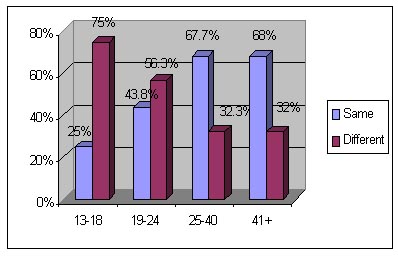
In terms of identity, only
one significant difference was found. Whereas in the age groups 13-18 and 19-24
respondents prefer to choose a new name for themselves, respondents from the age
groups 25-40 and 41+ prefer to cling to their own name and identity (c 2=10.39, P<0.01). Figure 4 presents
users' preference of name among the four age groups.
Figure
4 - Users' choice of name among the various age groups
What are the demographic characteristics
of the MOO user?
As far as the demographics of MOO users was concerned data was consistent with the literature. Most
users can fit the definition of "computer elite" (Fernback
& Thompson, 1995; Curtis, 1992; Serpentelli, 1991; Roberts, Smith &
Pollock, 1996; Sempsey,
1997). Most come from the States and are native English speakers. Male users'
numerical dominance (Serpentelli, 1991; Bruckman, 1992; Curtis, 1992; Roberts, Smith & Pollock,
1996) was evident in this research too but the gap between the percentage of
male and female users seems to be on the decrease - 64.8% male users versus
35.2% female users. However, it must be borne in mind that it is possible that
female users were more willing to participate in the research than male users
and this data does not reflect their real percentage in the MOO population. The
educational MOO's population, inconsistent with the
literature, composes mostly of University teachers and not college and
University students.
What characterizes the MOO user's
consistency in the environment?
Most users come to the MOO on a voluntary
basis and not due to an academic obligation. They devote to the MOO almost half
the time they devote to the Internet and the MOO, hence, takes a significant
portion of their online time. A of the respondents would like to climb higher
on the hierarchy ladder and reach the level of programmer or wizard. This may
indicate that they consider their membership in the MOO community as important
and plan to stay there.
For what purposes does the MOO user use
the environment?
Out of the 24 activities presented to
respondents the most frequent one was chatting with friends from the MOO
community. Chatting with occasional characters was ranked only sixth and
chatting with occasional guests ranked eleventh. This suggests that it is the
interpersonal relationship that attracts users and not the chat itself. This
finding is consistent with the literature (Bruckman
and Resnick, 1993) and confirms the claim about the
importance of consistent presence in the MOO (Turkle,1995;
Suler, 1996).
Other frequent activities were exchanging
tips and sharing ideas and assisting new members. Native English speakers
assist other members more often than non-native English speakers perhaps due to
the fact that it is easier for them to express themselves. The last, confirms
that help and assistance are rooted in the MOO culture. Activities that involve
a large audience, such as, organized gatherings and MOO projects seem less
popular than the more intimate activities that do not demand many participants.
The technical elements of the environment:
building objects and interacting with them attract the younger respondents from
the 13-18 age group. Since only 12.5% reported
participating in MOO projects, there is ground to assume that they do that of
their free choice. This finding is consistent with the literature (Bruckman, 1997) and suggests the MOO's
potential to serve as a platform for teaching programming for children.
Relating to Suler's
(1996) taxonomy, it seems that the needs that the MOO most satisfies are in the
following order: the need for interpersonal contact (talking with friends from
the MOO community), the intellectual needs and the need for self actualization
(exchanging ideas and professional tips) and the need to learn and to master
the environment (building and interacting with objects). Biological needs
(flirting) were ranked very low in the educational MOO.
How does the MOO user view the
environment and what does it mean to him?
Most MOO users grasp the MOO as being both a
social (80.7%) and learning (86.4%) environment and are engaged in activities
of both social and educational values. As to the definitions of the MOO as a
game, pastime, entertainment and sport, derived from Bartle's
(1996) typology, it turns out that respondents agree more with the definitions
"entertainment" and "pastime". Only the group
of college/university students view the MOO as a game. It should be
noted, however, that Bartle addressed MOO users of
MUD environments based on combat role plays and this might account for the
definitions of the MOO as sport and game, definitions that do not suit the
educational MOO according to the findings of the current research.
What elements of the environment attract
the MOO user?
The realistic elements: sense of community
and intercultural experience were most favored by most respondents. 85.2% of
the respondents like the intercultural contact and 69.3% like the sense of
belonging to a community. This finding is consistent with the findings of
Roberts, Smith and Pollock (1996) who studied the
sense of community among MOO users and found that 78.8% feel they belong to a
community and consider the intercultural contact as one of the most attracting
elements of the MOO. The sense of community is stronger among respondents from
the native English speakers group. Though no significant differences in terms
of amount of time spent on the MOO and seniority in the environment were found,
it seems that native English speakers managed to develop a higher sense of
belonging to a community than their nonnative speaker counterparts during the
same time span. The unrealistic elements, such as, anonymity and the
possibility to have multiple identities described in the literature (Turkle, 1995; Suler, 1996;
Curtis, 1992) were found less important. Yet, equality, a byproduct of
anonymity, is important to 71.6% of the respondents.
How does the MOO user view his identity
in the MOO environment?
The way respondents view their identity in
the MOO depends on their age. The younger the user is the more he is likely to
choose a false name for his character. Still, most users of educational MOOs seem to prefer to appear under their own name (55.7%).
It should be pointed out, however, that some educational MOO environments
require that users use their own name, and therefore this finding doesn't
necessarily reflect users' preference. Most respondents report that the
characteristics of their persona in the MOO reflect their characteristics in
real life. Some even feel that in the MOO they are more true to who they are
and feel more free to be so. The phenomenon of gender
swapping, reported in the literature, (Serpentelli,
1991; Curtis, 1992; Bruckman, 1992; Rheingold, 1994)
was found negligible (only 8%). It must be borne in mind, though, that findings
are based on self-report, and may be subject to social desirability bias.
Choosing a false name does not necessarily imply that users grasp the MOO as a
new world since only a small group (8%) views the MOO as a different world and
most regard it as an extension of real life.
Do MOO users from Social MOOs and Educational MOOs differ
in the above respects?
On the whole, respondents who regard a
social MOO as their homeMOO resemble those who
consider an educational one as their preferable place. This may stem from the
fact that both environments are built in the same fashion and require the same
level of competency. However, since by definition, each type suggests a
different objective in mind and addresses a different audience, some
distinctions among users can be made. Table 6 illustrates only the items on
which statistically significant differences were found.
Table
6
Significant
differences between users from Educational and Social MOOs
in general outlines
|
Item |
The entity developed In the educational MOO |
The entity developed In the educational MOO |
|
Mother tongue |
Multiple languages |
Mostly Native English speakers |
|
Averaged age |
31.8 |
27.8 |
|
Occupation |
Teachers Students |
College and university students people from the computer field. |
|
Marital status |
Married |
Single |
|
Averaged Seniority |
2 years and 3 months |
3.5 years |
|
The way users Perceive the MOO |
Social and learning Environment |
Social and learning Environment, entertainment, pastime, game |
|
User's identity |
Real name |
False name |
The educational MOO attracts respondents who
come for professional and academic work and therefore in addition to students
attracts also teachers. This accounts for the significant differences in terms
of age and marital status. Respondents from the educational MOO do not differ
from those from the social MOO in the amount of time spent on the MOO but
lurk/idle in the environment less than users from the social one. We may infer
that they come to the MOO for a pure academic purpose and make better use of the
time spent there. Since educational MOO environments are relatively new,
respondents from these environments have spent less time in it.
Respondents, mostly students studying for
their first degree, come to the social MOO mostly for social activities and are
engaged more in flirting than those who prefer the educational MOO. This
explains why they view the environment also as entertainment, game and pastime
and make more use of the option to appear under a new name.
Native English speakers prefer the social
MOO, which is more culturally loaded, while nonnative English speakers prefer
the Educational MOO. Possibly, the presence of teachers in the educational
environment makes it seem more supportive to the nonnative English speakers.
Moreover, they like meeting people from different cultures, which is more
likely to happen in the educational MOO.
Typology back
A typological classification of MOO users,
based on the frequenciof independent and dependent
variables, revealed three prototypes: The highly academic teacher, the student
seeking company and the young programmer.
The Highly Academic Teacher - is a native English speaker, with a second or
higher degree. He visits the environment for professional and academic
purposes, or as Suler (1996) d"the
need to satisfy one's intellectual needs." The teacher takes part in
organized gatherings and projects and likes exchanging ideas and professional
tips. He also uses the environment for experimental instruction. The teacher
resembles the "Explorer" according to Bartle's
(1996) typology, a user who is derived by the need to learn more. The teacher
tends to stay in public places, mostly classrooms, more than other users. The
teacher likes the sense of community, equality and the possibility to meet
people from different cultures. He also enjoys the feeling of ownership of
objects he has built and maybe this partially explains his strong sense of
belonging to a community. The teacher also prefers to appear in his real
identity, which may suggest that he view the MOO as an expansion of his
academic world.
The Student Seeking Company - is a non-native English speaker,aged from 19 to 24, studying for his first degree.
He visits the environment for social purposes; chatting with his MOO friends or
looking for new ones for off-line friendship. He uses the environment also as a
chat channel with friends that he is geographically far away from. He uses the
environment mainly for the "need for interpersonal contact" according
to Suler's taxonomy. He views the environment as a
social environment and an entertainment, but though he doesn't do much learning
there he views it also as a learning environment. He doesn't care about the
technical aspects of the environment and mostly stays at the category of member
only. He feels less sense of belonging to a community probably due to the fact
that he doesn't take part in social events and prefers intimate friendships
and, therefore, does not contribute to it. The aspects of the environment most
important to him are the possibility to meet people from different cultures and
the equality. The reason equality is important to him may explain why he
prefers to appear under a different name. The student seeking company resembles
the "Socialiser" according to Bartle's typology.
The Young Programmer - is a native English speaker, a high school kid
aged from 13 to 18 who likes the technical aspects of the environment and
enjoys building, programming and manipulating objects. He views the MOO mainly
as an entertainment, pastime and a social environment and less as a learning
environment. Yet, a close examination of his most frequent activities reveals
that he does a lot of learning there. He likes reading and writing messages and
interacting with objects. For this reason he likes to reach the category of
builder/programmer and, like the teacher, enjoys ownership of objects he
himself built, feels a sense of community and enjoys the intercultural
experience and the equality. According to Suler's
taxonomy the young programmer uses the MOO to fulfill his need "for
learning and mastery of the environment" and he resembles the
"Achiever" according to Bartle's typology,
a user who wants to contribute and gain esteem and status. The young programmer
makes use of the anonymity the MOO provides and prefers to appear under a new
name.
The current research attempted to advance
the knowledge about the social and educational potential of the MOO by
examining the MOO users. The current research supports Oldenberg's
definition of the MOO as a "third place" (
From the fact that MOO users grasp the MOO
environment as both educational and social, there is ground to assume that the
learning that occurs on the MOO takes place in a social setting. Since
assisting other members ranked high on users' list of activities, there is also
ground to assume that the MOO encourages mutual help and the
"care-taker" relationship that Vigotsky
(1978) considers crucial to the realization of one's learning potential.
The activities of building objects and
interacting with them, which ranked high on young MOO users' list, indicate
that the MOO also encourages active learning. This learning of constructing
knowledge by performing may be suitable to different learners with different
learning styles according to Papert (1991). Moreover,
the fact that young members consider the MOO also as an entertainment may
indicate its potential to attract and motivate young kids to use its learning
possibilities.
The sense of community was stronger among
the group of teachers, drawn to the environment for professional needs, and
less among the group of students coming to the MOO for social needs. This may
suggest that the MOO enhances the development of professional communities and
may be of a benefit to such communities.
Finally, of all the background variables
(gender, mother tongue, age and occupation) the user's mother tongue seems to
have the greatest impact on his performance. Being a native speaker of the
target language of the MOO strengthens one's sense of belonging to a community,
his wish to contribute to it and the extent to which he makes use of it.
Some possible implications for further use
of the MOO can be made based on this research:
- Since the MOO has an educational potential and since the language
has the greatest impact on the user's performance, it is worth considering
creating MOOs with different target languages.
- Relatively few high school kids come to the MOO, but those who do,
make very good use of it. More effort should, therefore, be made to bring
the MOO to the kids' awareness.
- College/University students, on the other hand, come to the MOO but
do little learning there. Effort should be made to take advantage of the
fact they are already there to engage them also in academic activities.
This research suffers from the usual
limitation of self-report, including potential social desirability bias. The
fact that respondents were sampled in a non-randomized way should also be taken
into consideration. Moreover, the method of collecting data via an on-line
questionnaire is relatively new and its reliability wasn't tested enough. One
recommendation for further research stemming from the limitations of the current
research is to examine the learning reported by respondents via observations or
depth interviews. This research doesn't address users' cognitive abilities or
personality traits. It might be interesting to examine these components as well
in the description of MOO users. Finally, there is need for research aiming to
examine the implications of the verbal activities reported by users on their
writing and reading skills or academic achievements.
|
Backer, J. (1998). Multi-User Domain
Object Oriented (MOO) as an Online Learning Environment Tool for Instruction
of English as a Second/Foreign Language. Available by e-mail: [email protected] |
|
Bartle, R. (1996). Hearts, Clubs, Diamonds, Spades: Players Who Suits Muds. [On-line]. Available: http://journal.tinymush.org/~jomr/v1n1/bartle.html |
|
Bruckman, A. (1992). Identity Workshops: Emergent Social
and Psychological Phenomena in Text-Based Virtual Reality. [On-Line]. Available FTP: ftp.media.mit.edu/pub/asb/papers/identity-workshop.rtf |
|
Bruckman, A. & Resnick, M.
(1993). Virtual Professional Community: Results from the MediaMOO
Project. [On-line]. Available: http://web.missouri.edu/~wleric/Bruckman-MediaMOO.html |
|
Bruckman, A. (1997). Programming for Fun: MUDs as a Context for Collaborative Learning. [On-line]. Available: http://black.missouri.edu/~wleric/Bruckman-Collab.html |
|
Cherny, L. (1994). Gender Differences in Text-Based
Virtual Reality. Proceedings of the |
|
Curtis, P. (1992). Muddin:
social phenomenon in text-based virtual realities. Proceedings of Directions
and Implications of Advanced Computing (DIAC'92) Symposium, FTP: ftp://parcftp.xerox.com, pub/MOO/papers/DIAC92 |
|
Falk, J. (1995). The meaning of the Web.
Paper presented at Ausweb 1995, Available: http://www.scu.edu.au/sponsored/ausweb/ausweb95/papers/sociology/falk/ |
|
Fernback, J. and Thompson, B. (1995). Virtual
Communities: Abort, Retry, Failure? [On-line]. Available: http://www.well.com/user/hlr/texts/Vccivil.html |
|
Luke, T. (1993). Community and Ecology. In
|
|
Oldenburg, R. (1991). The Great Good
Place: Cafes, Coffee Shops, Community Centers, Beauty Parlors, General
Stores, Bars, Hangouts, and How They Get You through the Day. http://condor.stcloud.msus.edu/~scogdill/netoric/thirdplace.html |
|
Oren, A. (1997). Communication in the Virtual World - Educational Potential. Computers in Education, 42, 22-29. |
|
Papert, S. (1991). Situating Constructionism.
In Harel, |
|
Roberts, L.D., Smith, L.M., and Pollock,
C. (1996). MOOing Till the Cows Come Home: The
search for sense of community in virtual environments. Paper presented at the
6th National Australian and New-Zealand community Psychology Conference,
“Promoting action research and social justice”, |
|
Sarason, S. (1997). Contexts of Productive and
Unproductive Learning. In Paldi, E. (Ed.), Education
and the Challenge of Time (pp. 105-108). Tel-Aviv: Ramot,
|
|
Sempsey III, J. (1997). Psyber Psychology: A Literature Review Pertaining to The Psycho/Social Aspect of Multi-User Dimensions in Cyberspace. [On-Line]. Available: http://journal.tinymush.org/~jomr/v2n1/sempsey.html |
|
Serpentelli, J. (1991). Conversational Structure and
Personality Correlates of Electronic Communication. [On-line]. Available: http://www.oise.on.ca/~jnolan/muds/about_muds/conv-structure |
|
Suler, J. (1996). Why is This Thing Eating my life?
Computer and Cyberspace. Addiction at the '"Palace". [On-line]. Available: http://GENIUS.rider.edu/~suler/psycyber/eatlife.html |
|
Turbee, L. (1997). Educational MOO: text-based virtual
reality for learning in community. Published as ERIC digest,
March, 1997. [On-Line]. Available: http://web.syr.edu/~lmturbee/ericedmo.html |
|
Turkle, S. (1995). Life on the Screen: Identity in the
age of the Internet. |
|
Vygotsky, L. (1978). Mind in Society: the Development of
Higher Psychological Processes. Ed. Cole, M., John-Steiner, B., Scribner, S.
and Souberman, |