TRIBES
OF
ORISSA
In India
there is an amalgam of 437 tribes, and in Orissa the number is sixty two.
According to 1981 Census, in Orissa the total strength of tribal population is
approximately six million (5,915,067), which constitutes 22.43% of the total
population of the State.
Linguistically the tribes of India are broadly classified into four categories,
namely (1) Indo-Aryan speakers, (2) Dravidian speakers, (3) Tibeto-Burmese
speakers, and (4) Austric speakers. ln Orissa the speakers of the
Tibeto-Burmese language family are absent, and therefore Orissan tribes belong
to other three language families. The Indo-Aryan language family in Orissa,
includes Dhelki-Oriya, Matia, Haleba, Jharia, Saunti, Laria and Oriya (spoken by
Bathudi and the acculturated sections of Bhuiyan, Juang, Kondha, Savara, Raj
Gond etc.). The Austric language family includes eighteen tribal languages
namely, Birija, Parenga, Kisan, Bhumiji, Koda, Mahili Bhumiji, Mirdha-Kharia,
Ollar Gadaba, Juang, Bondo, Didayee, Karmali, Kharia, Munda, Ho, Mundari and
Savara. And within the Dravidian language family there are nine languages in
Orissa, namely: Pengo, Gondi, Kisan, Konda, Koya. Parji, Kui, Kuvi and Kurukh or
Oraon.
speakers, (3) Tibeto-Burmese
speakers, and (4) Austric speakers. ln Orissa the speakers of the
Tibeto-Burmese language family are absent, and therefore Orissan tribes belong
to other three language families. The Indo-Aryan language family in Orissa,
includes Dhelki-Oriya, Matia, Haleba, Jharia, Saunti, Laria and Oriya (spoken by
Bathudi and the acculturated sections of Bhuiyan, Juang, Kondha, Savara, Raj
Gond etc.). The Austric language family includes eighteen tribal languages
namely, Birija, Parenga, Kisan, Bhumiji, Koda, Mahili Bhumiji, Mirdha-Kharia,
Ollar Gadaba, Juang, Bondo, Didayee, Karmali, Kharia, Munda, Ho, Mundari and
Savara. And within the Dravidian language family there are nine languages in
Orissa, namely: Pengo, Gondi, Kisan, Konda, Koya. Parji, Kui, Kuvi and Kurukh or
Oraon.
The tribes of Orissa though belong to three linguistic divisions, yet they have
lots of socio-cultural similarities between them. These commonalties signify
homogeneity of their cultures and together they characterise the notion or
concept of tribalism. Tribal societies share certain common
characteristics and by these they are distinguished from complex or advanced
societies. In India tribal societies had apparently been outside the main
historical current of the development of Indian civilization for centuries.
Hence tribal societies manifest such cultural features which signify a primitive
level in socio-cultural parameter.
HABITAT
A major
portion of the tribal habitat is in the hilly and forested regions. Tribal
villages are generally found in areas away from- the alluvial plains close to
rivers. Most villages are ethnic in composition and smaller in size.
Villages are often not planned at all.
ECONOMY
Tribal
economy is characterised as subsistence oriented. The subsistence economy is
based mainly on collecting, hunting and fishing (e.g., the Birhor, Hill Kharia),
or a combination of hunting and collecting with shifting cultivation (e.g., the
Juang,, Hill Bhuiyan Lanjia Saora, Kandha etc.) Even the so-called plough using
agricultural tribes do often, wherever scope is available, supplement their
economy with hunting and collecting. Subsistence economy is characterised by
simple technology, simple division of labour, small-scale units of production
and no investment of capital. The social unit of production, distribution
and consumption is limited to the family and lineage. Subsistence economy is
imposed by circumstances which are beyond the control of human beings,
poverty of the physical environment, ignorance of efficient technique of
exploiting natural resources and lack of capital for investment. It also implies
existence of barter and lack of trade.
Considering
the general features of their (i) eco-system (ii) traditional economy, (iii)
supernatural beliefs and practices, and (iv) recent "impacts of
modernization" the tribes of Orissa can be classified into six types, such
as: (1) Hunting, collecting and gathering type, (2) Cattle-herder type, (3)
Simple artisan type, (4) Hill and shifting cultivation type, (5) Settled
agriculture type and (6) Industrial urban worker type.
 Each type has a distinct style of life which could be best understood in the
paradigm of nature, man and spirit complex, that is, on the basis of
relationship with nature, fellow men and the supernatural.
Each type has a distinct style of life which could be best understood in the
paradigm of nature, man and spirit complex, that is, on the basis of
relationship with nature, fellow men and the supernatural.
(1) Tribes of the first type, namely Kharia, Mankidi, Mankirdia and Birhor, live
in the forests of Mayurbhanj, Keonjhar and Sundar garh districts, exclusively
depend on forest resources for their livelihood by practicing hunting, gathering
and collecting. They live in tiny temporary huts made out of the materials found
in the forest. Under constraints of their economic pursuit they live in isolated
small bands or groups. With their primitive technology, limited skill and
unflinching traditional and ritual practices, their entire style of life
revolves round forest. Their world view is fully in consonance with the forest
eco-system. The population of such tribes in Orissa though is small, yet their
impact on the ever-depleting forest resources is very significant.
Socio-politically they have remained inarticulate and therefore have remained in
a relatively more primitive stage, and neglected too.
(2) The Koya which belongs to the Dravidian linguistic group, is the lone
pastoral and cattle-breeder tribal community in Orissa. This tribe which
inhabits the Malkangiri Sub-Division of the Koraput District has been facing
crisis for lack of pasture. Rehabilitation of Bangla Desh refugees in the Koya
traditional habitat has created certain socio-economic problems for the latter.
(3) In Orissa Mahali and Kol-Lohara practice crafts like basketry and
black-smithy respectively. The Loharas with their traditional skill and
primitive tools manufacture iron and wooden tools for other neighboring tribes
and thereby eke out their existence. Similarly the Mahalis earn their living by
making baskets for other communities. Both the tribes are now confronted with
the problem of scarcity of raw materials. And further they are not able to
compete with others, especially in the tribal markets where goods of other
communities come for sale, because of their primitive technology.
(4) The tribes that practice hill and shifting cultivation are many. In northern
Orissa the Juang and Bhuiyan, and in southern Orissa the Kandha, Saora, Koya,
Parenga, Didayi, Dharua and Bondo practice shifting cultivation. They supplement
their economy by food gathering and hunting as production in shifting
cultivation is low. Shifting cultivation is essentially a regulated sequence of
procedure designed to open up and bring under cultivation patches of forest
lands, usually on hill slopes.
In shifting cultivation the practitioners follow a pattern of cycle of
activities which are as follows: (i) Selection of a patch of hill slope or
forest land and distribution or allotment of the same to intended practitioners!
(ii) Worshiping of concerned deities and making of sacrifices, (iii) Cutting of
trees, bushes, ferns etc., existing on the land before summer months, (iv)
Pilling up of logs, bushes and ferns on the land, (v) Burning of the withered
logs, ferns and shrubs etc., to ashes on a suitable day, (vi) Cleaning of the
patch of land before the on-set of monsoon and spreading of the ashes evenly on
the land after a shower or two, (vii) Hoeing and showing of seeds with regular
commencement of monsoon rains, (viii) Crude bundling and weeding activities
follow after sprouting of seeds, (ix) Watching and protecting the crops, (x)
Harvesting and collecting crops, (xi) Threshing and storing of corns, grains
etc., and (xii) Merry-making. In these operations all the members of the family
are involved in some way or the other. Work is distributed among the family
members according to the ability of individual members. However, the head of the
family assumes all the responsibilities in the practice and operation of
shifting cultivation. The adult males, between 18 and 60 years of age under-take
the strenuous work of cutting tree, ploughing and hoeing, and watching of the
crops at night where as cutting the bushes and shrubs, cleaning of seeds for
sowing and weeding are done by women.
Shifting cultivation is not only an economic pursuit of some tribal communities,
but it accounts for their total way of life. Their social structure, economy,
political organization and religion are all accountable to the practice of
shifting cultivation.
In the past, land in the tribal areas had not been surveyed and settled.
Therefore, the tribals freely practiced shifting cultivation in their respective
habitats assuming that land, forest, water and other natural resources belonged
to them. The pernicious, yet unavoidable, practice of shifting cultivation
continues unchecked, and all attempts made to wean away the tribals from
shifting cultivation have so far failed. The colonization scheme of the State
Government has failed in its spirit.
In certain hilly areas terraces are constructed along the slopes. It is believed
to be a step towards settled agriculture. Terrace cultivation is practiced by
the Saora, Kandha and Gadaba. The terraces are built on the slopes of hill with
water streams.
(5) Several large
tribes, such as, Santal, Munda, Ho, Bhumij, Oraon, Gond, Mirdha, Savara etc.,
are settled agriculturists, though they supplement their economy with hunting,
gathering and collecting. Tribal agriculture in Orissa is characterised by
unproductive and uneconomic holdings, land alienation indebtedness, lack of
irrigation facilities in the undulating terrains, lack of easy or soft credit
facilities as well as use of traditional skill and primitive implements. In
general, they raise only one crop during the monsoon, and therefore have to
supplement their economy by other types of subsidiary economic activities.
Tribal communities practicing settled agriculture also suffer from further
problems, viz: (i) want of record of right for land under occupation, (ii) land
alienation (iii) problems of indebtedness, (iv) lack of power for irrigation (v)
absence of adequate roads and transport, (vi) seasonal migration to other places
for wage-earning and (vii) lack of education and adequate scope for
modernization.
(6) Sizable agglomeration of tribal population in Orissa has moved to mining,
industrial and urban areas for earning a secured living through wage-labour.
During the past three decades the process of industrial urbanization in the
tribal belt of Orissa has been accelerated through the operation of mines and
establishment of industries. Mostly persons from advanced tribal communities,
such as Santal, Munda, Ho, Oraon, Kisan, Gond etc., have taken to this
economic pursuit in order to relieve pressure from their limited land and other
resources.
In some instances industrialization and mining operations have led to uprooting
of tribal villages, and the displaced became industrial nomads. They lost their
traditional occupation, agricultural land, houses and other immovable assets.
They became unemployed and faced unfair competition with others in the labour
market, Their aspiration - gradually escalated, although they invariably failed
to achieve what they aspired fort Thus the net result was frustration.
Occasionally their disappointment has been reflected in unrest and agitation.
The Jharkhand movement also capitalises on these issues.
The overall kinship
system of the tribes may be label led as tempered classificatory. In
terminology the emphasis lies on the unilinear principle, generation and age.
Descent and inheritance are patrilineal and authority is patripotestal among all
the tribal communities of Orissa.
Among the tribes
there is very little specialization of social roles, with the exception of role
differentiation in terms of kinship and sex and some specialization in crafts,
the only other role specializations are Head-man, Priest. Shaman and the
Haruspex.
There is very little rigid stratification in society. The tendency towards
stratification is gaining momentum among several settled agricultural tribes
under the impact of modernisation. The tribes of Orissa are at different levels
of socio-economic development.
The position of
priest, village headman and the inter-village head-man are hereditary. The
village headman is invariably from original settlers' clan of the village, which
is obviously dominant. Punishments or corrective measures are proportional to
the gravity of the breach of set norms or crime, end the punishments range from
simple oral admonition to other measures, such as corporal punishments,
imposition of fines, payment of compensation, observance of prophylactic rites
and excommunication from the community. Truth of an incident is determined by
oath, ordeals and occult mechanism.
As regards the acquisition of brides for marriage
the most widely prevalent practice among the tribes of Orissa is through
"capture", although other practices, such as, elopement, purchase,
service and negotiation are also there. With the passage of time negotiated type
of marriage, which is considered prestigious, is being preferred more and more.
Payment of bride-price is an inseparable part of tribal marriage, but this has
changed to the system of dowry among the educated sections.
The religion
of the Orissa tribes is an admixture of animism, animalism, nature-worship,
fetishism, shamanism, anthropomorphism and ancestor worship. Religious beliefs
and practices aim at ensuring personal security and happiness as well as
community well-being and group solidarity. Their religious performances include
life-crisis rites, cyclic community rites, ancestor and totemic rites and
observance of taboos. Besides these, the tribals also resort to various types of
occult practices. In order to tide over either a personal or a group crisis the
tribals begin with occult practices, and if it does not yield ny result the next
recourse is supplication of the supernatural force.
CRISIS
RITES:
As most of
the tribes of Orissa, practice agriculture in some form or the other, and as
rest others have a vital stake in agriculture, sowing, planting, first-fruit
eating and harvest rites are common amongst them. Their common cyclic rites
revolve round the pragmatic problems of ensuring a stable economic condition,
recuperation of the declining fertility of soil, protection of crops from
damage, human and live-stock welfare, safety against predatory animals and
venomous reptiles and to insure a good yield of annual and perennial crops.
The annual cycle
of rituals commence right from the
initiation of agricultural operation, for instance, among the Juang, Bhuiyan,
Kandha, Saora, Gadaba, Jharia, Didayee, Koya and Bonda, who practice shifting
cultivation, the annual cycle begins with the first clearing of hill slopes
during the Hindu month of Chaitra (March-April) and among others it starts with
the first-fruit eating ceremony of mango in the month of Baisakh (April-May).
All the rituals centering agricultural operation, first-fruit eating, human,
live-stock and crop welfare are observed by the members of a village on a common
date which is fixed by the village head-man in consultation with the village
priest.
Thus the ideological system of all the tribes surrounds supernaturalism.
The pantheon in most cases consists of the Sun God, the Mother Earth and a lower
hierarchy of Gods. Besides there are village tutelaries, nature spirits,
presiding deities and ancestor-spirits, who are also propitiated and offered
sacrifices. Gods and spirits are classified into benevolent and malevolent
categories. A peculiarity of the tribal mode of worship is the offering of blood
of an animal or a bird, because such propitiation's and observance of rites are
explicitly directed towards happiness and security in this world, abundance of
crops, live-stock, plants and progenies. Sickness is not natural to a tribal, it
is considered as an out-come of the machination of some evil spirits or
indignation of ancestor spirits or gods. Sometimes, sickness is also considered
as the consequence of certain lapses on the part of an individual or group.
Therefore, riddance must be sought through propitiation and observance of
rituals.
Among all the tribes conformity to customs
and norms and social integration continue to be achieved through their
traditional political organizations. The tributary institutions of social
control, such as family, kinship and public opinion continue to fulfill central
social control functions. The relevance of tribal political organization in the
context of economic development and social change continues to be there
undiminished. Modern elite in tribal societies elicit scant respect and have
very little followings. And as the traditional leaders continue to wield
influence over their fellow tribesmen, it is worth-while to take them into
confidence in the context of economic development and social change.
Tribal
Handicrafts
POTTERY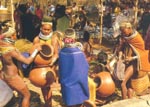
Though there are
very few potters among the tribals, the tribal people extend their patronage to
the other potters. The elemental quality of earth as a substance has long been
used by them in the execution of both ritual and utilitarian objects. A variety
of roof tiles, utensils such as pots, bowls, plates and jars, and cooking stoves
meet specific requirements of daily life. Simultaneously the potter creates
votive offerings in strong forms of bulls, elephants and horses as well as
terracotta temples and toys.
CANE,
BAMBOO, REEDS, GRASSES AND WOOD:
Bamboo and cane
have all the fertile, lively and tactile qualities of nature's raw materials
which craftspersons have successfully harnessed. The structural qualities of
bamboo, its high-tensile strength and pliability have led to its widespread use
for architectural purposes. Besides which, bamboo splits are woven together to
make baskets of diverse shapes and sizes depending on the nature of goods they
are required to carry or store. Similarly the elasticity and sturdiness of cane
has been utilized in the manufacture of a variety of domestic goods, while
countless local fibres and reeds are used by people with household skills to
make ropes, strings, brooms and the like. These products are largely geared for
local consumption. However, the potential of these materials is so great that
new applications can be explored for the new customers.
PLASTER AND
PAPIER MACHE
Papier Mache:
This skill has been creatively practiced by craftsperson from all over Orissa.
Paper, waste cloth and different kinds of natural fibres are soaked and beaten
into a pulp, then mixed with a variety of seeds and gums for strength and as
protection from termites. Special clays and bio-wastes are added for body and
reinforcement. The entire process results in a malleable that it requires little
skill to be moulded into countless forms. however, despite its versatility this
craft has remained neglected.
Plasters: The application of plasters to her dwellings is often the rural
woman's medium of creative statement reflecting, both in terms of colours and
symbols, the close identification of man with nature. From clay come the colours
ochre, gheru, charcoal grey and white which are either used naturally or mixed
with pigments purchased in the markets. The images created by her are timeless
yet ephemeral, with the sun and the rain taking their toll. The predominantly
geometric forms - a straight line, a square covered in dots, waves, triangles
pointing to the sky and downwards - can have the most disparate of meanings but
the symbolism of fertility is implicit in all of them. The tools used for
applying the plasters whether on hut walls or floors are basic. They use twigs,
fingers, whole hands and rags.
STONE AND
THEATRE CRAFTS
Stone:
Artisans practicing the craft of stone carving in Orissa have remained largely
tradition-bound while producing objects of ritualistic, decorative and practical
use. Turned utensils for both cooking and serving and artefacts of tourist
interest are made in Khiching located on the borders of Mayurbhanj and Keonjhar
districts, from a semihard, grey stone which takes on a deep, dark polish, while
beads and figurines are carved out of soft stones available in many shades of
orange in Phulbani district.
Theatre crafts:
The Desiya Natya of tribal Orissa derives its distinctive style in some part
from Prahlada Natakams and Jatras of the Hindus. Its colourful costumes -
embroidered head-dresses and painted masks which adorn the key actors, and the
use of imaginative props are a craft in themselves. Masks carved out of papier
mache and sholapith, the weightless bark of a water plant, represent various
gods, goddesses, demons and animals.
SEEDS, HERBS AND
MEDICAMENTS
In Koraput
district alone, at least 200 different varieties of rice are produced or grow
wild. Some are for consumption during festivals and marriages, others for their
taste, colour or smell, and yet others are grown for their pesticidal or soil-
fertilization characteristics. The traditional dependence of many indigenous
communities on biological resources is also evidenced in the use of several
plants which have medicinal values. For instance, the stem of the 'Hadbhanga'
plant is applied to fractured bones for quicker mending and the fruit of the 'Utkapali'
is used to cure migraine. However, the rapid destruction of forest cover,
pollution of water-bodies along with pesticide poisoning and a host of such
destructive activities have taken their toll.
NATURAL
DYES
The knowledge and
use of vegetable and mineral dyes goes back to pre-historic times in India
where, according to data collected so far, there are nearly 300 dye-yielding
plants available. However, after chemical colours flooded the markets, only a
small number of dyers continued with natural dyes such as indigo. Cotton yarn
dyed in madder is still used by the weavers of Kotpad in Koraput district. In an
age where the tide is turning against the use of synthetic dyes in the rest of
the world, one needs to promote the use of eco- and wearer-friendly natural dyes
in this country.
LEAF STRAW AND DRIED
FLOWERS
Tribal women have
been the traditional gatherers of leaves whose delicate hues and unique
qualities have been used in a multitude of ways for the manufacture of useful
products. Farm laborers and cattle grazers wear hats made of dried leaves which
provide protection from the sun and are water-proof. In temples and at village
feasts, food is still served in leaf plates and bowls. Given the rising demand
for biodegradable goods in a world which is becoming more ecologically aware,
one has to find if it is possible to evolve a range of highly durable, hygienic
leaf-product tableware which can meet the most stringent international quality
standards!
LACQUER
Lacquer is the refuse of an insect gathered by the tribals in the forests. The
Hindu women of Baleshwar and Nowrangpur districts mix it with colours and apply
it on small cane boxes made by tribals, and terracotta figures which they make
themselves. After several coats of lacquer have sealed the core, the surface is
decorated with motifs borrowed from nature, geometric patterns and religious
symbols. Although the visual power of colour and design combine to ornamental
effect, the artisans have not explored the area of material, form and technique.
METAL
Rich in minerals, tribal Orissa offers many variations in the types of metal
used, the techniques and form of production, combining both the functional and
the aesthetic, from the rivetting of the flexible brass fishes, snakes and
crocodiles of Phulbani district, to the tiny bronze-cast beads shaped like
grains. The rice and oil measures of Sambhalpur and Bolangir made from
bell metal, and Dhokhra-ware both richly decorated with tribal motifs, as well
as the bronze figures crafted for the Kondh tribes, are just a few examples.
SANTHAL AND
SAORA PAINTINGS
Tribal paintings are like prayers that become part of the offerings made to
gods, ancestors and spirits. Members of the Saora tribe draw ritualistic
pictographs on the inner walls of their mud dwellings called 'ittlans'.
The icons are painted to preserve the abundance of the crops, avert disease,
honour the dead, promote fertility, honour the tutelary and so on. The spirit is
then invoked and invited to occupy the one dimensional painting which actually
represents a house made for it. Once captured therein it is propitiated with
appropriate chantings. The icons are a curious amalgamation of an early memory
and contemporary impressions. Since they are basically the expressions of an
agricultural community there is an emphasis on nature, the great outdoors and
also on the cycle of ploughing, sowing and harvesting. But as the outside world
increasingly impinges on their lives, cars, chairs, tables and planes have begun
to appear innocently in the paintings, and are offered as vehicles for their
gods in hierarchical order!
Tribal
Handloom
Orissa is a
thickly tribal inhabited state, consisting of sixty two tribes living in
different parts of the state - in the highlands, forests, valleys and in the
foot hills. They make their own traditional ethnic cottage and live in it. In
order to proclaim the self identity intra Group wise, socially and culturally
different tribes live in different places. Each tribal community has separate
mode of living and they differ significantly in their dress, ornaments, skill in
building houses, and moreover in their way of life. This difference in their
life is clearly discernible from their material culture, art objects from the
paintings and drawings and also from the size and shapes of different objects
that they use. To the tribal, dress is a cultural need and it is also a
part of their tradition.
Among the tribal the use of dress is very significant and worthwhile. The tribal
do not use dresses just merely to hide their nakedness rather it reflects
the racial feeling and their cultural identity. The tribal use separate costumes
at the time of festivals and ceremonies. In a specific tribe the dresses from
birth to old age has immense variety. The costumes of the male members of the
tribe and the females are also different. It is a fact that the female community
pay more attention in covering their body. In some tribal communities the
women folk want their male partners to be dressed elegantly and impressively. A
tribal woman also wears a variety of dresses from her birth to death
corresponding to different stages other life. For instance, a Dhangedi(a maiden)
adorns with fine clothes to attract the attention of others while the Gurumai,
the priestess wears formal clothes to worship the Goddess for the betterment of
her community. Dress also helps them in many adversities and also helps to
propitiate Gods and Goddesses who safeguard them against the malevolent
atrocities of the ghosts spirits etc.
The tribal also use dress according to the position of individual in the society
like the clan's head, the priest, and the revenue collector etc. The dress that
they use at the time of marriage, birth, death, worship etc. are also different.
They use dresses keeping in view the occasion, age, sex and other factors. For
example, the priest does not use the normal dress at the time of worship. And
again at the time of dancing they dress in a very attractive manner. And they
dancing costume has also special significance. They also wear dresses in
different styles. While dressing they also keep in their mind the surroundings.
They also think of their convenience and inconvenience while dressing themselves
for an occasion. Especially they do not like to dress very pompously at the time
of any work. But when they go for shopping to the near by market place or to
visit any fair or festival they dress themselves quite exuberantly and
exquisitely.
Different tribal
communities use different kind of dresses, varying in their colour and size.
Their dresses are designed keeping in view their necessity and their
surrounding. The socio-cultural and the religious views of the tribals slightly
contribute for the variety in their dresses. There are several tribes like the
Bonda and Gadaba who weave their own clothes. While the other tribes purchase
their dress from another community or the neighboring Damas or Panas. The tribal
dress and ornaments mostly belong to the non-tribal group and there are very few
tribal artisans. The non-tribal artisans like the weavers they live adjacent to
the tribal villages. These people manufacture the costumes of a specific tribe
and sell them in the weekly village market. Sometimes these weavers are being
paid in cash or in kind in the form of agricultural products. The tribal
costumes are very simple and it provides immense comfort to the wearer.
Generally, in the Kandha community the Dongria Kandha, the Kutia Kandha and the
Desia Kandha, Lanjia Saora and the Santhals depend on other communities
(non-tribal artisans) for their clothes. Lanjia Saora and some other tribal
community make threads by themselves and give it to the Damas to weave for them.
And again they purchase that cloth from the Damas by cash or kind. While the
Bonda and the Didayi, the Gadabas weave their own clothes though the Dangrias
purchase the cloth from the neighbouring Damas. They knit fine needle work on it
and use it.
There is a little similarity among the tribals as regards their attire
especially those who live in a specific area. The Koyas, the Halabs and the
Gandias are inhabitants of the same districts. Though it seems that they have
some kind of similarity in their costume but in reality they differ from each
other. The Kandhas live in a specific area, like the Kutia Kandha and the
Dongria Kandh both the communities live in two different sides of the same hill.
But as far as dress is concerned they differ significantly. Similarly, the
Mundas and the Santhals though they live as neighbours they differ in their
dress and in culture. The Juangs and the Bhuiyan high lander live in close
proximity but they differ in their dress. The Kisans and the Gundas
though live in the same belt they have also difference in their dress. At times
there are similarity of the dress in colour, design and pattern but they differ
in their cultural and social life as well as in their ritual and rites.
The artistic
nature of the tribals is very innate in their heart and mind, to them the
artistic and aesthetic essence is to make life more enjoyable and to fulfill the
cultural, social and religious needs. Even there are some tribes they envisage a
better future with the help of art and craft, for the tribals art objects and
the skill of the artist is a fit medium to propitiate their deities, Gods and
Goddesses. The tribal art is not the contemporary one. It has the heraldry of a
hoary past. It was the art which once widely acclaimed in the midst of the
forest the mountains, and in the springs. Art is the base and basis of the
tribal life. It is the economic, social and cultural reflection of the tribal
life. Hence art is the yardstick by which they measure their success.
The material culture is also part of their artistic life. Even their costume and
dress materials have the touch of artistic workmanship. It is also
reflection of the art which had been passed onto them from generation to
generation. That art has the accumulated knowledge of ages, which has
assimilated in their social tradition. It is a medium to express their inner
quest. Dress has multi-farious significance in their social life. At the surface
level one can observe that they use dress only to avoid the nakedness, or to
protect from cold, rain and sunshine. But in fact, the tribal costume exhibit
the uniqueness of the specific community, their self-identity. The possession of
the right kind of dress is a matter of pride and a great source of
enthusiasm. The "Ringa" of the Bondos and the embroidered shawl of the
Dangarias have a special social and cultural significance. The Dangria shawl has
a direct link with the marital relationship and the success of their conjugal
life depend upon it. The dance costume of the Lanjia Saoras as well as their
general dress is a fine testimony of their rich cultural heritage. At the time
of dancing from the dress of the clan's head "Gamango" they get the
trace of the regal pride and heroism.
The origin, history and development of tribal textile commensurate with the
general history of man's progress from primitive barbarism to
civilization. The state of nakedness was disgusting, to avoid that the tribal used leaves as their dress. This was used in a crude form. Then they used bark
of the tree as their dress. This gave them much discomfort, so they used some
son bark to avoid this inconvenience. It was not so soothing either, hence they
started extracting fibres from the barks and subsequently converted it
into thread. Gradually they came to know more about fibre, thread etc. and then
began the weaving of clothes. Later on, they also dyed the fibres to make it
beautiful. They also use turmeric to colour the threads. These are also several
trees in the forest that excrete colour in their bark and the tribal use the
bark of these trees to dye the thread. Firstly, they boiled the bark and soak
fibres in it. By that way they got various coloured threads and wove according
to their requirement. Sometimes instead of making the coloured threads
themselves, they purchase them from the market and then weave. Some tribes like
to wear clothes of a single colour, while some others like to use multi-colour
clothes and at times they knit fine embroidery work on it and make it fit for
their use. Through the dress they reflected their traditional culture, artistic skillfulness
and thoughts. For which their cultural life they believe flourishes
on the basis of dresses. It gave a special luster to their community life and
differentiated one tribe from the other.
To weave clothes they use their own indigenous technology. They use bamboo and
other trees to get the fibre usually, they install the wooden loom in
front of their house or in the backyard and some of them also install it in the
narrow path of the village. They weave during their leisure time. Both men and
women weave. In some communities only women weave. The women weave various
clothes for them as well as for the male members of their family.
In the olden times the tribal wove their clothes from their loom. But now a
days, after they came in contact with the civilized world, they purchase their
clothes from the market, resulting in the decay of their culture. Now a days
they do not have the slightest inclination to wear old fashioned clothes and
have even expressed their hesitation to use their traditional cloth. After the
advent of the industrial textile culture, they have already forgotten about
their looms. In the changing scenario they no more boast for their tradition and
culture. In some of the tribal communities the dress culture is in a complete
state of extinction. And in some other communities it is in a dormant state or on
the way of decay. In the Kutia Kandha tribe it has almost decayed. In the Didayi
community to find a cloth woven in their own fashion has become a difficult
affair. Among the Bondo community the alien cultural assimilation is so strong
that, forgetting their own traditional dress they have started wearing the
dresses of the non-tribal especially the print sarees manufactured by textile
industries. Among the Santhals the condition is the same as in the other
communities. Though the elderly members of the community wish to preserve their
tradition, the younger generation abhor the idea. The young ones of the
community are not at all worried about the depletion of their culture and the
disintegration of their social and community life, to which the elder members
express their dissatisfaction. The intrusion of the alien cultures shuns them.
Neither are they capable of restricting it, nor can they fully assimilate it.
They are caught in a dilemma which is unprecedented in their racial history. The
industry based textiles and the process of deforestation is also to some extent
responsible for the partial annihilation of their cultural life. It is not a
simple matter that ponders only the tribal communities rather it is a matter of
contemplation and retrospection for the researchers, philosophers and thinkers
those who really value their pristine culture.
It is time to preserve and revive their culture which is gradually decaying,
whole-hearted efforts showed be made by adopting various measures and techniques
to preserve and revive it, or else a great cultural tradition will be buried in
the sandy-shores of time.