PALM LEAVE PAINTING
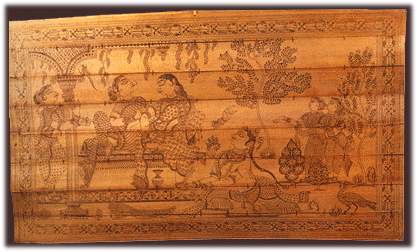
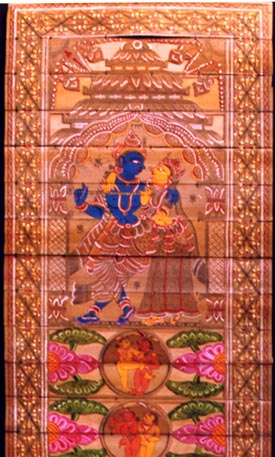
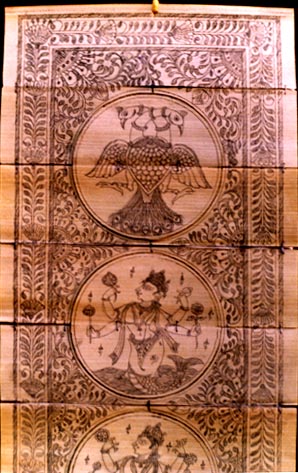
In Orissa the palmleaf illustrations are mainly of two types, simple engravings or illustrations in pure line on palmleaf and engravings with colour fillings. The majority of the illustrations are in line only. Strictly speaking these illustrations cannot be termed as paintings, not only for want of colour but also for the very fact that they are not primarily meant for the application of colouring materials.
Palmleaf illustrations are executed on oblong palmleaf. When these are intended for a manuscript they are bound together with a thread, passing just through the middle of the leaves. Generally, a portion is left blank for making the hole and neither illustrations nor text is scribed on that portion. But when the illustration covers the whole of the leaf at a stretch, no portion is left inscribed for making a hole. In certain other manuscripts two holes are made on both ends, one hole is provided towards one side of the leaf and not in the middle. Two wooden boards, either carved with floral motifs or painted, are fixed on both ends of the palmleaf manuscripts to protect them. There are also covers with ivory inlay works. The paintings are done on the reverse of the board, which is not visible from outside. This is contradictory to modern book covers, which are illustrated on the front portion of the covers leaving the inner portion blank. Then name of the manuscript and the name of the author do not appear on the cover.
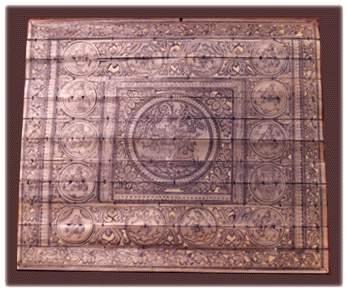
Apart from making illustrated palmleaves into manuscripts, other types of innovations were made. When a story is depicted within the limit of six or seven folia or even little more, these are joined lengthwise with the help of threads to form a rectangular or square format. These could be folded and opened or could be hung on the wall. This practice is borrowed from the Pata Paintings. Some illustrated palmleaves are given a temple shape after they are made into rectangular formats. The illustrations in these rectangular hangings may be limited to a single leaf of the format or may spread to the other leaves. A temple in incised on this, with a pair of plamleaf doors provided to create the impression of the shrine.
 |
 |
 |
 |
 |
 |