
GOVERNMENT OF ORISSA
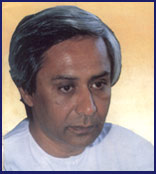
Shri Naveen
Patnaik, Chief Minister
Sri Naveen Patnaik, son of Late Shri Biju Patnaik and Smt. Gyan Patnaik was born on 16.10.1946 at Cuttack, Orissa. He was educated in Doon School at Dehradun. In 1967, he graduated from Delhi University. A bachelor, Shri Naveen Patnaik has written a series of non-fiction books on India which have received wide acclaim both in India and abroad. Sri Naveen Patnaik was a pioneer in achieving international recognition for Indian design while also working with handloom weavers to enlarge home markets for Indian textiles. As a founder member of INTACH (The Indian National Trust for Art and Cultural Heritage), he has been a prime mover for the preservation of Indias cultural wealth.
Sri Naveen Patnaiks books reflect his deep interest in Indian cultural history and tradition. His authored books include "A SECOND PARADISE" dealing with Indian culture, "A DESERT KINGDOM" with Indian history and "THE GARDEN OF LIFE" with Indias environment and traditional knowledge. All three books were published not just in India but also very successfully in the U.S.A. and Britain.
After the death of his father, the legendary Biju Patnaik, Sri Naveen Patnaik was compelled to enter politics to serve the people and interests of Orissa and India. In June 1997 he was elected as Member of Parliament for the first time to the 11th Lok Sabha in a bye-election from Aska Constituency in Orissa. In the Lok Sabha he drew the nations attention to the severe water shortage creating drought conditions in Aska and neighboring constituencies. He also toured his constituency extensively and his close association with Aska enabled him to take urgent action on the severe water shortage by reactivating village wells, drilling new tube wells and bringing medical assistance on an urgent basis by mobile medical van and ambulance, as well as organising village clinics.
As a member of the 11th Lok Sabha, Sri Naveen Patnaik sat on the (1) Consultative Committee of Ministry of Steel & Mines (2) Standing Committee on Commerce (3) Library Committee of Parliament.
As a result of his dedication to the problems of the people Sri Naveen Patnaik earned the reputation of being a worthy son of his father, whose name is synonymous in Orissa with development. In December 1997 this led to the formation of a new regional political Party, the Biju Janata Dal, in Orissa, under the leadership of Sri Naveen Patnaik. He was elected to the 12th and 13th Lok Sabha from Aska with huge margins.
Sri Naveen Patnaik served as the Union Minister for Steel & Mines and Minister of Mines & Minerals on two occasions.
He assumed the Office of the Chief Minister of Orissa on 5th of March, 2000. Honble Chief Minister, Orissa is also the Minister, Information Technology.
COUNCIL OF MINISTERS
| Chief Minister | Departments |
| Shri Naveen Patnaik | Home,G.A.,Water Resources, Agriculture, Information Technology |
| Cabinet Ministers | |
| Shri Ananda Acharya | Excise |
| Shri Bedprakash Agarwalla | Food Supplies & C.W. & P.E. |
| Shri Bhagabat Behera | School & Mass Education |
| Dr.(Smt.) Kamala Das | Health & Family Welfare and Women & Child Development |
| Shri Samir Dey | U.D. & P.G.P.A |
| Shri Arabinda Dhali | Co-operation, Textiles & Handoom |
| Shri Biswabhusan Harichandan | Revenue, Law, Fisheries & Animal Resources Development |
| Shri Mangala Kisan | ST & SC Development and Minorities & Backward Class Welfare |
| Shri Nalinikanta Mohanty | Works, Housing & P.A. |
| Shri Surendranath Naik | Panchayati Raj |
| Shri Ramakrushna Pattnaik | Finance, Planning & Co-ordination |
| Shri Adwait Prasad Singh | Forest & Environment |
| Shri A.U.Singh Deo | Steel & Mines, Energy |
| Shri K.V.Singh Deo | Industries |
| Minister of State (Independent Charge) | |
| Shri Bimbadhar Kuanr | Labour & Employment |
| Shri Duryodhan Majhi | Information & Public Relation |
| Smt.Droupadi Murmu | Commerce & Transport |
| Shri Bijayshree Routray | Tourism & Culture |
| Shri Prasanta Nanda | Rural Development & Higher Education |
| Shri Ranendra Pratap Swain | Sports & Youth Services, Science & Technology |
| Ministers of State | |
| Shri Devi Prasad Mishra | Health & Family Welfare |
| Shri Rabi Narayan Nanda | Food Supplies & Consumer Welfare |
| Shri Golak Naik | Planning & Co-ordination |
| Shri Amar Prasad Satapathy | Agriculture |
IT Policy-1998
The government of Orissa has recognised Electronics and Software as a thrust area and a priority sector because of its great potential for employment and foreign exchange generation. Initial steps have already been taken in the industrial Policy' 96 (IP) by announcing the following measures.
Information Technology in IP96
The State Government would formulate a policy for establishment of new technical institutions of good quality and standard in the private sector.
Computer training institutions of high standard in the private sector would be encouraged.
A technical University would be established in the State at the earliest.
Special efforts would be made to set up high quality training facilities in computer software.
Established software training houses in the country would be encouraged to set up training facilities in the State.
Electronic Hardware and Software Parks with dedicated Earth Station would be established.
The Orissa state Electronics Development Corporation (OSEDC) has been designated as the nodal agency for promotion of electronic hardware and software industries in the state.
A software division under this Corporation will be organized to attract and guide software industries.
Electronic/Telecommunication (hardware & software) industrial units are allowed exemption/ deferment of sales Tax on machinery, spare parts, raw-materials, packaging materials and finished products up to a limit of 250% of the Fixed Capital Investment within a specified number of years (at least 9 Years).
Land at Bhubaneswar, including Chandaka Industrial Area would be allotted at Rs.5 lakhs per acre. In other places, rates varying from Rs.25,000/- to rs.2.25 lakhs per acre are charged.
Electronic/ telecommunication (Hardware & Software ) industrial units would be eligible for incentives applicable to Zone-A, irrespective of their actual location.
Provision has been made for Venture Capital and Travel assistance.
In addition, all the other incentives applicable to general industries would also be available to electronics (hardware & software) industries.
However, in order to bring about co-ordinated development in IT Sector, it is considered desirable to announce a separate and integrated set of measures in the form of a Information technology Policy. These will apply together with the provisions under IP 1996 for the state.
Objective of the Policy :
To accord primacy for the growth of Information Technology Industry in the state; to accelerate the use of information technology at the Government level with a view to providing better and expeditious services to the citizens the State; To improve productivity and efficiency of government services to the citizens of the State; To improve productivity and efficiency of Government services; To improve revenue and tax collections; to plug leakages in revenue and tax collections; To hasten the process of decision making at the Government level and provide an efficient and transparent tool for monitoring implementation of various Government supported Programmes and Schemes.
To serve as an important tool to increase employment potential for the educated unemployed in the State.
To enable the State and in particular Bhubaneswar, to develop as a destination of choice for the Information Technology industries.
To enhance domestic and export earnings in the software and the hardware area of the information technology Industry.
To encourage and accelerate the use of Information Technology in Schools, colleges and educational institutions in the State in order to enable the youth of the State to acquire necessary skills and knowledge in this important sector, which would make them highly employable, both within the country and outside.
To provide an administrative framework for quick clearance of IT proposals by the Government and regulatory authorities.
IT POLICY Classified for Different Sectors :
Information Technology Policy for the Government
The Government shall endeavour to have connectivity between all its offices within a period of five years so that Information and communication can flow through E-Mail and large-scale use of computers, video conferencing facilities etc. A Government network spanning the entire state will be create d for this purpose.
1.The Government shall endeavour to put in place training programme enable government employees to use Information Technology to enhance productivity within five years. This raining programme will be repeated periodic intervals for giving insight to technological upgradation and also new employees. Services of OCAC will be utilised for training public servant teachers and other professionals.
2.NIC will be requested to extend DISNIC to block Level. It will assist in training of personnel and computerisation in Government.
3.The Government shall edeavour to computerize collection of government revenue within a period of five years.
4.With a view to providing better and expeditious services to the citizens of the State as well as others, Government activities in sectors like land registration, land records and licensing etc. will be computerised .
5.Employees in the public services and public sector undertakings will be given advances for purchase of computers and related equipment.
Information Technology in the Educational Sector :
The use of Information Technology in Schools, Colleges and educational institutions shall be accelerated.
The Government shall, with the help of the Industry start a training progamme for School and college teachers to help them use Information technology in the teaching process.
At the School level, children would be taught to use computers. At the college level, the students will be provided facilities to take a three months course in the use of information Technology and in working on computers. The Government shall endeavour to increase the number of college students who specialise in the Information Technology to meet the needs of the Information technology industry both for exports and for the domestic market. The syllabi for specialization in computer education would be reconfigured with the help of Industry to make it more relevant.
At the beginning, selected schools would be chosen. Each of these schools would have a computer laboratory and children would be given hands on training in computers. Private participation in School Computer Education will be encouraged. For this purpose, companies would be invited to set up these centres with CD-ROM library and interactive teaching facilities which would be named after them. The number of such schools would be increased in a phased manner.
The above schools would be given Internet connectivity through the VSNL or the STP or ERNET at a concessional rate.
School Teachers from all over Orissa would be required to undergo a three day computer awareness programme every year. In this programme, they would be taught how to use computers and how to use a computer to educate children. This training programme would be continuous programme with more and more teachers getting trained progressively.
To popularise progressive use of computers sales tax and octroi on IT related equipment would be rationalised. Banks would be requested to frame special schemes to finance such purchase at concessional rates of interest.
IT training and education being generally expensive, State will make efforts to finance it through loan stipend schemes or through Banks in collaboration with their financial institutions.
Likewise selected colleges would be provided a computer lab with a minimum of 16 computers and LAN systems. Each of these colleges would have internet connectivity given by VSNL/STP/ISP/ERNET at concessional costs. A special computer training fee would be charged for this purpose. In course, all College graduates would undergo a three month course in the use of computers.
A teachers Training Programme would be initiated whereby college teaching would undergo a one-month raining programme on computer teaching enable them to teach the students. Industry will be involved in designing the course curricula. This would also include working on the Internet.
Separate provision in S7T department budget will be made to fund training of teachers through OCAC.
The number of graduates in computer science and electronics would be increased so that at least 1000 engineering graduates in these courses would be available every year. The course content for this would be configured along with industry.
To give a push to computer based education and create excitement in the educational circles, and internet mela would be held in the selected schools and colleges all over Orissa. A V-SAT and ten computers would be taken with presentation equipment to such schools and colleges where a presentation would be made on the Internet. The network would be kept for about two days to enable the students to work on the Internet for that period of time.
All the polytechnics and the ITIs would be require to use computer based educational tools with facilities for training in CAD/CAM.
Typewriting institutes would be advised to start courses on word processing so that a large body of people with computer based skills would be created at low cost. C-DAC developed GIST Platform and ALP software in Oriya language will be utilised for training in Oriya word processing.
An autonomous Indian Institute of Information Technology (IIT) would be set up at Bhubaneswar. This would be funded by the State Government, the Union government, foreign Foundations, IT industries, Non-Resident Indians and others. Besides regular Bachelor and Master level course, the IIIT would conduct research in software engineering and productivity and conduct short term courses for industry. All efforts shall be made to make the IIIT and institute of excellence, which would not only be recognized in the country, but also outside.
High End Training Institutions like Orissa Centre of IBM software will be encouraged to be set up both in public and private sector either singly or jointly by reputed IT Companies and the Universities.
Information Technology Policy for the Industrial Sector
The term "Information Technology Industry" would mean and include computer software sector, the hardware sector and communication systems (computers, computer peripherals and related equipment
Thereafter, the Government will also set-up Electronics Parks Government will arrange to set-up a dedicated Electronics Park in Bhubaneswar in the 1st phase in other potential location including Rourkela,Berhampur and Sambalpur. These Electronics Parks shall be reserved for the sole purpose of promoting and developing Information Technology and hi-tech industries. These shall be provided with comprehensive Infrastructural facilities inclusive of adequate power, water and Tele-communication facilities and ready to occupy wired accommodation. Adequate residential facilities will also be developed in r near the Electronics Parks to provide campus accommodation to the professionals working in these parks.
Land in Cuttack including Jagatpur, Rourkela including Kalunga industrial area and Bhubaneswar including Chandaka industrial area will be made available at IP rates or Rs.5 lakhs per acre whichever is lower.
Government will also provide facilities to Videsh Sanchar Nigam Ltd., Department of Telecommunication and the Software Technology Park of India to expand communication links in the State an also provide all necessary infrastructure an other assistance to private entrepreneurs who are desirous of establishing software technology parks in the State.
The Orissa State Electronics Development Corporation as the Nodal Agency of the government will make block booking for telecommunication connections in potential locations so that entrepreneurs who come forward to set-up Information Technology Industry can be sanctioned telecommunication facilities immediately on application.
Efforts will be made to improve air connectivity of Bhubaneswar with the Metropolitan cities, Bangalore and Hyderabad.
With a view to drawing up a comprehensive action plan not only for development of Information Technology Industry in the State but also for accelerated use of Information Technology in various sectors of the economy, Government will constitute a special task force comprising representatives of leading Information Technology Industries in the State and the concern Departments and agencies of the government. The task force will submit its detailed recommendations to the Government within a period of three months on the following issues.
(ii) To assess the requirement of man power for various categories during the 9th Plan period and to suggest introduction of new courses both in the academic and training institutions to cater to the man power requirements.
(iii)To examine the existing syllabi/curriculum in the academic and training institutions and suggest modifications and to identify the assistance and support that the Government will have to extend to encourage establishment of such academic training institutions.
ISO 9000 and Software Engineering Institute (SEI) Certification are the two most recognised quality certification requirements insisted by the International Companies. In order to ensure that Information Technology Industries in the State are in a position to obtain these certifications without any difficulty, efforts would be made to establish an organisation in Bhubaneswar, which will assist in getting such certification.
3.3.08 With more and more export oriented industries being established in the State, Government of India would be requested to designate an Officer in Bhubaneswar to grant necessary clearances/approvals under the 1005 Export Oriented Units Scheme.
State Financial Institutions and Industrial Promotion Institutions of the State will formulate a special package for providing financial assistance to the Information Technology Industry in consultation with commercial banks, wherever require. This package shall have the following features
equity contribution on small and medium promoters
Reduced margin money from the promoters
Reduced Interest rate
Speed Capital/ venture Capital assistance in deserving cases
Liberal norms for lending compared to other industries
Operation in a rented space should not be viewed as a negative factor
If necessary, a separate cell will be opened in IPICOL/OSFC to speedily clear I.T. proposals with relaxed norms.
Software industries will be treated as Industrial (and not commercial) consumers and electricity tariff applicable to the Industrial consumers will be levied on such industries. These units shall be given power connection on priority basis.
Software Industries will be totally exempt from the provisions of the Pollution control Act, both in respect of air and water pollution.
Continuous uninterrupted and quality power supply being one of the pre requirements for sustenance and growth of Information Technology Industries, these Industries would be given priority in sanction and supply of power and would also be exempt from power -cuts, wherever possible, without any time limit.
All the incentives announced by the state Government for the Electronics Industries in Industrial Policy of Orissa 1996 will be applicable to I.T. Industries.
Development of Telecom infrastructure for the I.T. sector will be regarded as a Service Industry and this sector would be eligible for incentives applicable for I.T. Industries.
State Government will try to provide optical fibre network to the districts and below as a part of National Information Infrastructure of Department of electronics.
A venture capital fund of say Rs.15 crores would be set up to fund software companies in Orissa. Of this 50% would be contributed by SIDBI and 50% by one or more government Corporations.
Administrative Setup :
The Department of Science & Technology will attend to all governmental functions of Electronics hardware and software related subjects in appropriate cases, it will submit proposals to State Level nodal Committee set up under IP 1996.
A Directorate of information Technology will also be created as the field unit of the Department to implement Government decisions.
The OSEDC will be the Nodal agency for development of information technology so that a more focussed promotional effort can be mounted. It will be funded and enrusted with the job of creation of infrastructure, technology parks, communication net work and private STPs etc. for the IT Sector, and also creation of employment potential.
A State Level Coordination Committee will be set up to bring together and encourage IT training institutions. It will ensure maintenance of standards and quality in training institutions.
A special cell will be created for maintaining data bases about the computer educated persons in the state and possible employers, both within the country and outside, so that match making can be made between the employer and the unemployed.
Efforts will also be made to disseminate information relating to opportunity of employment in foreign countries. To facilitate such employment, a finish school providing proficiency in foreign languages and personality development will be opened in an IT Training Institution.
To facilitate NRI/NRO Investments, an NRI Guidance Bureau will be opened to advise on legal/financial and procedural matters and provide information as required.
A campaign about facilities available in Bhubaneswar and other places in the State will be launch to attract large IT Houses both national and international to set up their facilities in the State.
Views of finance Department on proposed IT Policy
Finance Department concur with the draft Information Technology Policy subject to the following:
Special grants proposed to be given to schools, colleges and Educational Institutions to put up necessary infrastructure for the use of Information Technology should be met out of the budget of the Department (s) concerned. (a) of the draft policy.
Lowering of Sales Tax on Computers, Printers, CD roms, floppy disks and other consumable on home computers to be bought by the children will have to be separately examined from the legal pint of view. Discriminately tax incidence will not be sustainable in law.
The state share of the funding of the autonomous Indian Institute of Information technology likely to be set up at Bhubaneswar should be provided from the budget of the science & Technology Department.
50% of the venture capital fund or Rs.15.00 crores should be contributed by a government Corporation.