FESTIVALS OF ORISSA
| Makar Sankranti | January |
| Magha Mela | February |
| Konark Dance Festival | February |
| Maha Shivratri | March |
| Holi | March |
| Basant Panchami | February/March |
| Chaitra Parba | April |
| Rath Yatra | June/July |
| Raja Sankranti | June/July |
| Durga Puja | September/October |
| Kumar Purnima | October/November |
| Lakshmi Puja | December |
RATH YATRA (CHARIOT FESTIVAL)
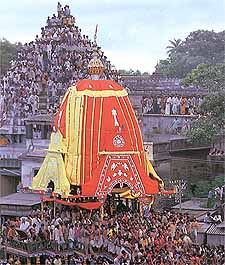
Each year, in mid summer, the proxy images of Jagannath, Balabhadra and Subhadra, the deities enshrined in the Jagannath Temple at Puri, are carried in colourful processions every evening for 21 days to the Narendra Tank where they cruise in a bright decorated boat. In gaiety and colour this festival stands next only to the Car Festival. On the full moon day of Jyestha (June), the Snanajatra or the bathing festival is observed when the images in worship are actually brought out for public viewing. After the bathing festival, the deities spend 15 days in seclusion during which period they are repainted and prepared for the Car Festival. The Car Festival is celebrated on the second day of the bright fortnight of Ashadha (June-July) and the deities are taken on a journey of around 3 kms in stupendous and decorated chariots for sojourn in the Gundicha Ghar till the return Car Festival which is held 9 days later. The chariot of Lord Jagannath, known as'Nandighose' is 23 cubits high and has 18 wheels. The chariot of Balabhadra which is 22 cubits in height and has 16 wheels is named 'Taladwaja'. 'Devadalan', the chariot of Subhadra is 21 cubits in height and has 14 wheels. The chariots are constructed anew every year in accordance with strict and ancient specifications and are pulled by several thousand devotees at a time. In terms of splendor and fervent devotion, the Car Festival is one of the world's most incredible spectacles.
The concept of temple procession, of which the Rath Yatra is probably the most famous illustration, is an important one in Hinduism. The term ratha (chariot) is itself often used as a word meaning 'temple', as both the palace and the vehicle of the god. The chariots in which the images of the deities in the Jagannath temple are pulled through the streets actually resemble moveable temples. In fact, these are designed keeping in view the features of the Bhaskaresvara Temple in Bhubaneswar which resembles a chariot. The relation between temple and chariot form is fascinating. Some scholars feel that the temple form may have developed, in part, from early wooden processional carts. And in Orissa, of course, we have the supreme example of influence in the other direction: the Konark Sun Temple, clearly and beautifully replicating a huge chariot.
When the Rath Yatra (Chariot Festival) was first observed by European spectators in the eighteenth century, the stunned reports they sent home gave rise to the European term 'juggernaut' (corrupted from Jagannath). The occasional accidental fall of a devotee in front of a rolling chariot gave rise to the grossly erroneous misperception of humans sacrificing themselves under the wheels. The misperceptions have long been cleared, but the festival remains one of the most amazing and exhilirating events most of us are ever likely to witness.
Because the divine images of the Puri temple are wooden, they must be periodically replaced. On a cycle determined by the Hindu calendar, and generally once in 12 years, the deities cast off their old frames and assume new ones. The process of renewal of the body known as Nava Kalebara (literally 'new embodiment'), is one of the great secrets of the world. Performed by distinguished temple priests, each of whom knows only his own part of the ritual, the process includes selection and felling of the tree, carving and painting of the new images, and transferral of the divine essence from the old to the new frame. The latter critical activity reaches its culmination when an unknown 'divine substance' is transferred from the chest cavity of the old image to that of the new. This final, crucial step is performed in the dead of night by a senior priest, working with eyes blindfolded and hands covered with cloth.
Basanta Panchami
This festival is observed differently in the temple of Jagannath. As this festival marks the advent of the spring season with winter receding, the warm clothings of the three deities are removed and they are again clad in saffron-colour clothes. A special variety of cake is prepared and offered to the deities which is known as 'Basantapistaka' (cake of the spring). Thereafter, a peculiar festival continues from this day to Dola Purnami in which the representative deity of Lord Jagannath Ramachandra goes out hunting. This part of the festival is known as 'Benta Yatra'. The deity eceives a bow and an arrow made out of split-bamboos from Budha Lenda and goes to Bentapokhari (a pond) situated in the campus of the Jagannath Ballav Math which is very close to the temple. There the deity shoots arrows to a bundle of cocoanuts and Kasturi which represent a deer.
Chitou Amavasya
As Lord Jagannath is the presiding deity of Orissa. Many of His festivals are
also devotionally followed in Oriya households.
Chitalagi or Chitou Amavasya is one such festival which falls on the new-moon
day of the sravana (August). On this day, in the temple of Jagannath, the deity
bears a golden mark (chita) on the forehead. A special variety of rice-cake
known as Chitou pitha is given to the deity as food-offering. This variety is
also prepared in every household of the Oriyas of the coastal districts. In
rural areas this is more or less observed as an agricultural festival. On this
occasion the farmers worship the paddy-fields. After a purificatory bath in the
morning they go to their respective paddy-fields with cake, flowers, milk etc
and pray the fields to yield a good crop.
It is in the primitive tradition to appease evil powers through worship; whether
they are animals, serpents, inspects or plants.
People worship and pray them to avoid their wrath. Pilas breed enormously in the
paddy-fields and tanks during the rainy season. Farmers while working
bare-footed in the fields often get their feet cut by the sharp edge of their
shells. Therefore, during the festival the piles is appeased as a female form of
evil power known as 'Gandeisuni' (Genda is pile). The farmer girls go to the
fields and while offering cakes pray "Oh, Gandeisuni, be appeased and do
not cut the legs of my father or brother".
In Sambalpur areas this festival is known as 'Harali kans'. People of the areas
believe it to be a day of the witch, Tandei who moves in the dark to suck the
blood of the children. To save children from her wrath mothers draw peculiar
designs below the naval zone of the children before the night falls. As they
believe that would scare away witch, a common variety of rice-cake Chakuli Pitha
is offered to the witch to be appeased and thereafter the cake is taken by all.
Chandan
Yatra
Chandan Yatra marks the conclusion of the cycle of religious festivals
observed in the famous shrine of Lord Jagannth at Puri
followed by similar other shrines of Orissa. The festival, starting from
Akshyaya Trutiya, lasts for twenty-one days and is held in the month of Baisakh
at the height of the summer heat when Chandan (sandle-paste) and water are
essential to keep people
cool. As the Hindu deities are modelled on the behaviour of human beings, they
are also given the same treatment. During this festival they are taken out of
the temples in procession for perambulation in water on floats or boats. The
richly decorated boats are called 'Chapa'. 'Chapa' is the Oriya equivalent of
'float'. In most of the Vishnu as well as Shiva temples the festival of the
'float' marks the conclusion of the prime annual festival and it is celebrated
with much pomp and eclat. The belief probably is that the deity having concluded
his ceremonial perambulation with all attendant paraphernalia on land, must have
his aquatic sojourn before He returns to the sanctum of the temple to come out
only for the next
festival.
This festival is most elaborate in Puri and attracts thousands of pilgrims from
far and near. On all the twenty-one days the entire road from the shrine of Lord
Jagannath leading up to the Narendra Sarobar (a sacred tank in Puri town) along
with the houses on both sides is decorated. At some places, especially in front
of Maths (monasteries) or at cross-roads big toranas (arches) are erected where
the idols take casual rest and receive offerings The representative images of
the deities installed in temples such as Madanmohan (representing Lord
Jagannath), Laxmi and Saraswati are taken in a richly decorated palanquin by the
sevakas accompanied by priests, musicians and dancers to the Narendra Sarobar at
night. The tank is profusely lighted with thousands of spectators milling and
jostling all around in expectation of the arrival of the procession. The
principal deities are also followed by different deities from different shrines
of the town. After reaching the Narendra Sarobar, the images are then placed on
different well decorated boats and they are rowed for a long time by the Sevakas.
During the rowing ceremony Devadasis (temple-dancers) dance and sing on the
boat.
Generally, the colours chosen for the boats are red and white and they are so
designed to look like huge swans floating on water. The peculiarity of the
ceremony is that Madanmohana with Laxmi and Saraswati rides on the white
coloured raft where-as Ramakrishna with pancha Shivas rides the red one. All the
deities on the boat take several rounds in the water which continue till early
hours of the morning and then retire to the respective shrines.The last day of
the festival is called Bhaunri (Bhramari or circle) when special elaborate
arrangements are made.
Most of the important festivals of Lord Jagannath at Puri are also followed in
all other important shrines of Orissa. Following
tradition of the Puri the images are taken out in procession on planquins to the
nearby tanks and perambulated in water on boats. In all such temples it is
observed only for the last three days. After the ceremony which usually takes
place at mid-night, people enjoy performances of dance, drama and music
specially arranged for
this occasion.
At Bhubaneswar the Chandan festival of Lord Lingaraj is observed in Bindu
Sarobar, a huge tank near the temple. Here, the
float is moved to the Mandapa in the middle of the tank. The mandap is an
inlet-like structure which is more an elevated
platform.