As the curtain rises on the stage of deceit we learn that CBS used songs and
lyrics for international recording artist, Bob Dylan. Bob Dylan's name is credited to the songs. One of those songs is nominated for a Grammy as best rock song of the year. Ironically the title of that song is Dignity.
Since auditioning for the legendary CBS Record producer John Hammond, Sr., who influenced the careers of music industry icons Billy Holiday, Bob Dylan, Pete Seger, Bruce Springsteen and Stevie Ray Vaughan, James has engaged in a multimillion dollar copyright infringement law suit with Bob Dylan.
About something else
I might have lied
Somthing personal
I might deny
Another time
I might have tried
About something else
I might have lied
I have faith
I can do without
Be the fool
Find cause to doubt
If I didn't believe
I wouldn't try
To live the truth
I'd live a lie

James Damiano
It is uncontested by Bob Dylan and or Bob Dylan's law firms Manatt, Phelps & Phillips ,Parcher Hayes & Snyder, Gibson Dunn & Crutcher and Heck Brown and Sherry that Bob Dylan and people in Bob Dylan's entourage have solicited James Damiano's songs and music for over ten years.
It's shocking that Dylan needed four Law Firms to try defend himself in this litigation.
Robert Lenzner, 04.30.01 Forbes Magazine
When Bruce Springsteen, Bob Dylan or the Rolling Stones have a date in court, they call on Peter Parcher
When singer Luther Vandross was charged with manslaughter after his best friend died in a car accident with Vandross driving, lawyer-to-the-stars L. Peter Parcher devised a decidedly slick defense: An olive tree had dropped its slippery nuggets precisely where the crash occurred on Laurel Canyon Boulevard. "It might as well have been ice and snow," Parcher says slyly.
Vandross walked. It was classic Parcher handiwork. In three decades he has repeatedly rescued a rogues' gallery of trouble-prone or troublesome stars: the Rolling Stones, Bob Dylan, Bruce Springsteen and Paul Simon, as well as boxer-thug Mike Tyson, author Frank McCourt, the estate of Andy Warhol and titans such as Sony and Time Warner.
Parcher and his key partners, Steven Hayes and Orin Snyder, have gotten star clients out of many a jam�drug arrests, murder charges, sexual harassment allegations and that particularly pernicious evil, copyright infringement.
Click here for Peter Parcher link
Peter Parcher's partner in this litigation is Orin Snyder who lied to the court at will. Gibson Dunn & Crutcher now are harboring the criminal Orin Snyder
Click here for Orin Snyder link
http://www.gibsondunn.com/Lawyers/osnyder
More Shocking News !!! Recently Discovered
BOB DYLAN DID NOT WRITE BLOWIN IN THE WIND. However if you examine the original album cover it credits Bob Dylan as the writer of the song. Most people even educated people consider that plagiarism

Dylan didn't write "Blowin in the Wind" even though he claims to have written it. It has recently been discovered that "Blowin� In The Wind" was inspired by the apocalyptic 1959 film On The Beach - and for the melody Dylan lifted a traditional tune from the anti-slavery song "No More Auction Block".
How "Blowin' in the Wind" Came to Be
Dylan had blown into NYC in the early 1960s and hung out at Gerde�s Folk City in Greenwich Village. Gerdes was a long room - on one side was a bar and a cash register - then a half wall and on the other side, some round tables, chairs, and a very small stage with a microphone. We, the New World Singers, a group that some thought might one day inherit the mantle of the Weavers, were at that time myself, Gil Turner, Delores Dixon and Happy Traum. Delores was a black woman, a New York City school teacher who had a deep alto voice.
In our set at Gerde's Folk City, Delores would step forward in the middle of the set and sing solo "No More Auction Block For Me" - a very moving song of freedom written during slavery times, insisting "no more, no more" and sadly reflecting on the "many thousands gone." She sang it with spirit and determination. Alan Lomax, calling it "Many Thousands Gone" writes: "This is one of the spirituals of resistance (W.E.B. Dubois called them 'Sorrow Songs'), whose ante-bellum origin has been authenticated. Runaway slaves who fled as far north as Nova Scotia, after Britain abolished slavery in 1833, transmitted it to their descendents, and it is still in circulation there. At the time of the Civil War an abolitionist took it down from Negro Union soldiers." (p. 450, Lomax, Alan - Folksongs of North America, Doubleday, 1960).
Dylan liked our group. In his recent memoir: Chronicles Vol. I, he writes: "�with my sort of part-time girl-friend, Delores Dixon, the girl singer from The New World Singers, a group I was pretty close with. Delores was from Alabama, an ex-reporter and an ex-dancer." - p. 64) - and then when I met Delores about ten years later, she remarked that Dylan had gone home with her one night and the next morning he was working on "Blowin' in the Wind" and she said to him: "Bobby, you just can�t do that" (take the melody of that traditional song and write new words to it - it�s a scene similar to the scene in the Ray Charles bio pix when Ray�s new wife tells Ray that he just can�t take an old Gospel song she sang in her group and make it into a love song.) Both Bob and Ray preceded anon.
So one day soon after that, Dylan says to us: "Hey, I got this new song" and we go down to the basement at Gerdes (filled with rats, roaches and other folkies) and he sings his new song: "Blowin' In the Wind" which was based on the melody of "No More Auction Block". In those days we spoke of "borrowing" tunes, something Pete Seeger called "the folk process". Woody Guthrie and Joe Hill and even J.S. Bach had done it. We thought it was great and started to sing it. We would bring Dylan up on that postage stamp of a stage to sing it along with us. It seemed to me then as it does now that his re-working or recreation of that spiritual carried on its original message and was in itself a song of resistance to all the injustice in the world. We would go on to sing it in Mississippi in 1963-64 where it became a civil-rights anthem.
During our sets at Gerdes, Dylan would sit at the bar drinking wine that we often bought for him. He listened to us night after night. After about a year when we made an album for Ahmet Ertegun, head of Atlantic records and son of a Turkish diplomat, (Ahmet loved the blues and he is wonderfully portrayed in the recent film Ray), Dylan would write the liner notes for our album much in the same style he uses in his new book, Chronicles, writing generously about each of us. Ironically, when we sang "Blowin' In The Wind" for Ahmet Ertegun he said that if we could change the lyrics to make it a love song then he would include it on our album! But we were too far into the essence of that song to change it, singing it at college rallies to raise money for the Student Non-Violent Coordinating Committee and its voter registration work in the South.
When Moe Asch (Folkways) decided to release an album of topical songs on Broadside Records (Broadside, the topical song magazine that first printed many of Dylan's songs along with others) we were asked to sing "Blowin' In the Wind" and we did - making it the first recording of that song, even before Bob did it on Columbia Records. Delores insisted on singing the chorus as "The answer my friend is blown in the wind" and we couldn�t talk her out of it - so that�s what you hear. I think she thought that "blowin'" was improper English usage. It reminds me of a funny story about the lyricist, Jack Yellen, who wrote the words for the song "Ain�t She Sweet" on which he made a bundle, going back to his high school reunion and being scolded by his English teacher: "And I thought I taught you that 'ain't' is bad grammar!"
Smithsonian-Folkways released our recording of the Dylan song as part of a 5-CD set "The Best of Broadside" which got two Grammy nominations (in 2000) for best notes and production, but we lost to Louis Armstrong and John Coltrane respectively. I read recently that it actually won two Indie awards.

James Damiano & The Freedom Of Speech Band Video
This website, the book and manuscript "Eleven Years" and the movie "dignity" of which was based upon the manuscript "Eleven Years" is protect under copyright law and copyrighted under James Damiano's name through the Library of Congress.

DISCLAIMER NOTICE FOR MOVIE TRAILER BELOW
BE ADVISED THAT NO UNITED STATES CITIZEN MAY VIEW THE MOVIE TRAILER BELOW AS PER ORDER OF JUDGE JOEL B. ROSEN AND JUDGE JEROME B. SIMANDLE OF THE UNITED STATES DISTRICT COURT.
THE MOVIE TRAILER IS DISPLAYED FOR ATTORNEYS INTERESTED IN TAKING PLAINTIFF JAMES DAMIANO'S CASE ONLY. ANY UNITED STATES CITIZEN CAUGHT REVIEWING THE MOVIE TRAILER BELOW COULD BE SUBJECT TO FINES AND IMPRISONMENT.
This movie trailer contains video taped deposition materials which are designated as confidential by the federal court which incriminated Bob Dylan
SEEKIN ADDITIONAL COUNSEL
For more information see address below [email protected]
Racism
A diversion of reality
That the worst segregation
In the world today
Is not between
Yellow, Red, Black or White men
Muslims Jews Buddists or Christians
But between
The rich and the poor
Damiano (C) 2003
All rights are reserved. Permission to use any or all of this material must be addressed to the publisher at [email protected]
Alternate E-mail [email protected]
Also please take notice that this website is a document in a federal lawsuit. District of New Jersey Judge Jerome B. Simandle presiding in Camden, New Jersey.
After eight years, fifty hours of video taped depositions and after over eight million dollars have been spent on this litigation Bob Dylan still to this date has not filed a counter suit.
The music analysis of Dylan's song "Dignity" and Damiano's song "Steel Guitars" was prepared by Dr. Paul Greene who graduated magna cum laude from Harvard University.
There was never a counter-suit filed.
The following text was copied From the opinion of Judge Jerome B. Simandle
Matter of Public Record
a. Access
[6] Plaintiff asserts that "the bulk of his life's work" was submitted to Sony beginning in 1982. (Compl. at 2).
He also alleges that he was told to bring his songs to several concerts which he attended courtesy of Sony.
Plaintiff has produced evidence that after these concerts, he was allowed backstage and gave his work to Dylan or his agents. (Damiano Decl. at PP 2, 5; Dep. of Pam Damiano at 77-84, 97-104; Dep. of Brad Wright at 105-112).
Taking these allegations as true, plaintiff has demonstrated a genuine issue of material fact as to whether defendants had access to his work."
b. Breach of Confidence and Fraud
..."this court will accept as true plaintiff's allegation that Sony represented to him that he would be credited and compensated if Dylan used his work.
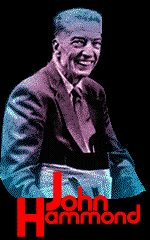
Years ago I read an unauthorized biography about Bob Dylan, in which the author made reference to a man who at one time was considered to be the president of CBS Records. His name was John Hammond, Sr. He was family to the Vanderbilts, Attended Yale law school, the most sought after record producer in the United States, and had signed Pete Seeger to Columbia Records 1960.
In fact John Hammond Sr. was and probably will always be considered the most influential music executive in the world by music industry professionals.
After years of working in the music industry, Mr. Hammond established himself as a legend and accomplished a reputation as having the best ears in the business by signing a fascinating number of legendary artists to the record world.
Billy Holiday, Count Basie, Charlie Christian, Duke Ellington, Aretha Franklin, George Benson, Bob Dylan, Bruce Springsteen along with many other artists including Stevie Ray Vaughan were John Hammond affiliates.
Bob Dylan and John Hammond Sr.
Inspired by the book I read, I decided to take a long shot and called CBS Records on the phone. The operator answered and I asked to be put through to John Hammond's office. The receptionist rang his office and a woman named Mikie Harris answered the phone.
Mikie Harris
Mikie Harris I told Mikie that I was a lyricist and asked her if she had a few seconds to listen to one lyric. She replied yes by saying "Shoot." I then recited a lyric to her that I had recently written and said "the lyric is: Just think how beautiful you'd feel if you knew your love was real." Within a few seconds I could tell Mikie liked the lyric.
I in turn did not want to push to hard on the first phone call fearing that I might put her behind schedule, so I tried to inch my way out of the conversation politely while trying not to show my emotions but before the conversation ended between Mikie and me, she made it explicit that she wanted me to call again. She repeatedly told me to feel free to call her there at the office. So began a relationship where we would converse through actual meetings or correspond over the phone, that lasted close to seven and a half years.
Mikie told me that her name would be appearing in the credits on Stevie Ray Vaughan's album that was released in 1983. When the album was released it listed John Hammond Sr. As Executive producer and Mikie Harris as Production Assistant.
Stevie Ray Vaughan later recorded on Bob Dylan's "Under the Red Sky" album, released in 1990.
December 1982 Mikie Harris sent James Damiano the Christmas card below:
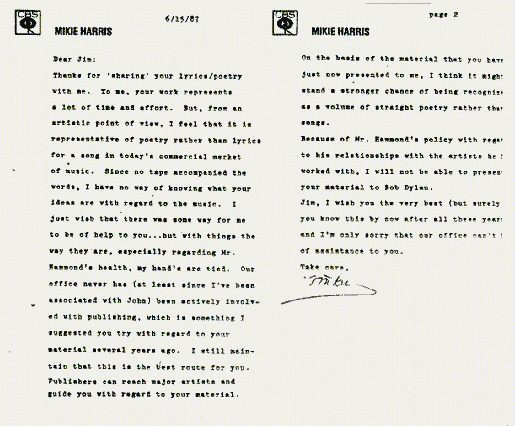
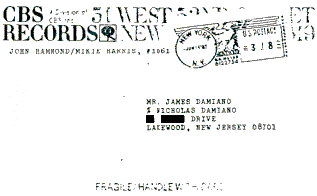
On June 6th 1987 Mikie wrote a letter to me stating ;
Mikie Harris is given production credits as Assistant to Producer John Hammond.
Stevie Ray Vaughan played on Bob Dylan's album "Under the Red Sky." In fact, numerous musicians that played on the "Bob Dylan Unplugged" album also shared similar credits on Stevie Ray Vaughan albums.
Mikie Harris is given production credits as Assistant to Producer John Hammond
on Stevie Ray Vaughan's album.
When I (James Damiano ) received the June 15th, 1987 letter from Mikie Harris stating that she could not be of assistance to me, I called her at CBS and asked to speak to her. A man answered the phone and told me that Mikie was at the hospital with Mr. Hammond. His name was Tony Tiller and he said that he was watching over the office while Mikie was out.
Mr. Tiller then asked me if I was the person who wrote the material on Mr. Hammond' s desk. I asked him what material he was referring to and he replied the songs in the big black notebook. I replied yes and we started to converse about the songs. He told me that he liked them and invited me up to CBS to meet with him. Tony showed a great deal of enthusiasm for my material. We started meeting or corresponding over the phone as Mikie and I had and Anthony started inviting me to parties in New York that other CBS people would attend.
The following
To continue reading the rest of this book please e-mail us at [email protected] and we will sent you a link.
Racism
A diversion of reality
That the worst segregation
In the world today
Is not between
Yellow, red, black or white men
Muslims Jews or Christians
But between
The rich and the poor
As per Judge Joel B. Rosen's confidentiality order the video taped depositions of Elliot Mintz, Mohammad Marhoumy, Pam Damiano, James Damiano, Brad Wright, Katheryn Baker and Tony Tiller have been removed from this website.
All discovery is complete except for Bob Dylan's deposition.
It has been estimated that Bob Dylan and sony Music made over 70 million
dollars on songs written by James Damiano and released by Bob Dylan.
"Dignity" alone was the hit on Bob Dylan's Greatest Hits Volume 3 CD, and cassette tape. Dignity was also the hit on Bob Dylan's MTV unplugged video tape, DVD and the unplugged soundtrack CD.
Dignity was also the title track for Bob Dylan's release of "Dignity" in Europe
Other Dylan plagiarism
Dylan plagiarisms are starting to be reported in the media.
One article reports that Dylan used lines from a 19th century Confederate poet Henry Timrod for Modern Times.
He�s been lifting lines from other people for his entire career � for one, huge chunks of his 1985 disc Empire Burlesque was based on Humphrey Bogart movies.
Here are a half dozen of Dylan�s greatest �appropriations� � can you think of any more?
Dylan:
Go �way from my window,
Leave at your own chosen speed
- �It Ain�t Me Babe� (1964)
Source:
Go away from my window
Go away from my door
- John Jacob Niles, �Go Away From My Window�
Dylan:
�A phrase in connection first with she I heard
That love is just a four-letter word.�
- �Love is just A Four-Letter Word� (1967)
Source:
�You don�t know what love is. To you its just another four-letter word.�
- Paul Newman, Cat on a Hot Tin Roof
Dylan:
�Well, I have had some rotten nights,
Didn�t think that they would pass.�
- �Seeing the Real You At Last� (1985)
Source:
�I�ll have some rotten nights after I�ve sent you over - but that�ll pass.�
- Humphey Bogart, The Maltese Falcon
Dylan:
�When I met you, baby,
You didn�t show no visible scars,
You could ride like Annie Oakley,
You could shoot like Belle Starr.�
- �Sweetheart Like You� (1985)
Source:
�I�m looking for a woman who can ride like Annie Oakley and shoot like Belle Starr.�
- Clint Eastwood, Bronco Billy
Dylan:
Lot of water under the bridge, Lot of other stuff too
Don�t get up gentlemen, I�m only passing through
�Things Have Changed (1999)
Source:
�Don�t get up, I�m only passing through�
- Vivien Leigh, A Streetcar Named Desire
Dylan:
�My old man, he�s like some feudal lord.
- �Floater� (2001)
Source:
�My old man would sit there like a feudal lord�
- Confessions Of A Yakuza
MASTERS OF WAR
JACKIE WASHINGTON:
I found a song of Jean Ritchie's called "Nottamun Town." It's sung in a minor key against a major, like a lot of these mountain songs. It sounds nice, but I just couldn't do it, so I changed the tune to minor and made sort of a drone sound with the guitar. Dylan loved this. I was playing at Gerde's and he would come in every night and ask me to sing it. He went over to Vanguard, and Maynard gave him a copy of my record. The next time I heard my tune -- which was my tune -- it was "Masters of War."
Fact: Orin Snyder has ruined Bob Dylan's reputation by giving him extremely bad legal advice.
This website is a document in a Federal lawsuit
Laura Browning has now joined the team of Bob Dylan's lawyers who have committed an abundance of fraud in this litigation. neither Orin Snyder or Steven D. Johnson will even sign their own signature to their briefs to the court.
Click here for Laura Browning link
It is uncontested by Bob Dylan and or Bob Dylan's law firms Manatt,
Phelps & Phillips formerly (Parcher Hayes & Snyder) and Gibson Dunn &
Crutcher that Bob Dylan and people in Bob Dylan's entourage have
solicited James Damiano's songs and music for over ten years.
Fact: Orin Snyder has ruined Bob Dylan's reputation by giving him extremely bad legal advice.
This website is a document in a Federal lawsuit
Laura Browning has now joined the team of Bob Dylan's lawyers who have committed an abundance of fraud in this litigation. neither Orin Snyder or Steven D. Johnson will even sign their own signature to their briefs to the court.
Click here for Laura Browning link
It is uncontested by Bob Dylan and or Bob Dylan's law firms Manatt,
Phelps & Phillips formerly (Parcher Hayes & Snyder) and Gibson Dunn &
Crutcher that Bob Dylan and people in Bob Dylan's entourage have
solicited James Damiano's songs and music for over ten years.
Click here for James Damiano on my space link to Moon Rock Records
Click link below for language translator