I don't think people get Darwin or evolutionary theory. Well, Darwin is easy to get. He was a rich guy that was both great at observation and thinking. Rich guys can afford that kind of thing back then. No, he didn't steal evolutionary theory from Alfred Wallace. They come up with their ideas independently of each other. The primary difference was that Darwin didn't have an interest in publishing about it and Wallace did. Darwin got the kudos because his cronies convinced him to write his book "Origin of Species" before Wallace beat him to it. It helped that Darwin lived in England and Wallace was out in the Australian sticks. Hey, no internet, no 747s. Distance was an issue.
Evolutionary theory is another matter. It's boggling, I think. Some people don't want it taught in schools because, according to them, it's wrong and has been proven so (missing link!), there is no evidence that it's right, it's just a theory, and God (pick one) says otherwise. Of course, I've met precious few that knew what evolutionary theory is. All they know is that "I didn't come from an ape!" I've met the father of one of them and I beg to differ.
So. What is it? Evolutionary theory is not the theory of how life began on earth, but how speciation occurs. How one set of ancestral parents will lead to different species that cannot interbreed viably a few lengths of geologic time down the road. Geologic time is measured in millions of years and "recent" means in the last 10,000 years.
Darwin came up with this idea that organisms change over time. Wow, watch a kid grow some time, huh? He meant that as time progresses, the overall species will change over time. Like people moved to Sweden, got tall, blonde, and started a bikini team while other people moved to Jamaica, grew dreads, and dressed like Bob Marley. Okay, not like that.
In his travels aboard the HMS Beagle, Darwin noticed two things. The first is Overproduction. Populations of many species produced or have the potential to produce a butt load of babies. Like, way more than the environment can support. Kind of like my sister-in-law. The thing about overproduction is that it makes the struggle for food, water, shelter (resources) and, correlationally, survival inevitable. The second thing he noticed was that there was individual variations in the population. Every member of the population had its own unique traits. We are not all exactly the same. From these two observations, he concluded that there is Differential Reproductive Success, which he called Natural Selection. What happens is that some individuals have traits that are best suited to getting them to the stage in life where they reproduce and those individuals with the better traits have a disproportionately larger share of surviving, fertile offspring.
Natural selection causes evolution, or adaptive evolution as its better put. This is where things get muddled in lack of working knowledge of theory. Natural selection isn't a "create" process so much as it edits or fine tunes what's already there. Evolution doesn't create anything even as it appears to "create" new species. Analogously, if 30 kids were to collaborate and write a poem all together, then each would take that poem home and edit it once a week through the school year, at the end of the year, there would be 30 different poems. Some would be so different that they didn't really resemble each other at all. Some would be similar enough that you could tell they came from the same original poem. Evolution is like that. There is a species. For some reason, reproductive populations within the species become isolated from each other (geographic stuff like a canyon, or maybe the ones with longer necks started mating only with the others with longer necks), and they breed within each other. And that keeps happening. Over time, it's possible for species with a common ancestor to not be like one another at all. Hello evolution.
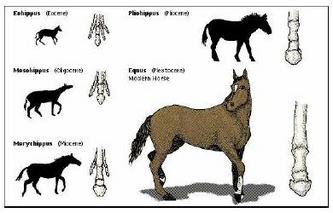
The problem? Evolutionary theory's skeleton (that would be Natural Selection) hasn't really altered since it was first proposed by Wallace or Darwin or both if you prefer. The meat of the matter has. For instance, we have a fossil record that has a pretty reasonable geologic time line of human evolution, except the jump from homo neandertalensis to homo sapiens. The so called "missing link." Creationists jump on this and say "Evolution is completely wrong! You have no missing link! There is no transitional fossils!" The meat of the theory has altered a bit, instead. Neanderthals are not ancestors of humans, say some, rather, they're a branch of the homo genus that didn't survive. But the transitional fossils? Well, there are two problems with that idea. The first is most obvious. All fossils are transitional, according to Natural Selection. Why? All species are constantly in evolutionary transition. The second is that, yes, there are "transitional fossils." There are fish fossils with vestigial feet. Horses have vestigial toes. Humans have vestigial tails.
So what is evolution? I think it's mostly misunderstood. How many people actually take a class where it's thoroughly explained? It doesn't take long, a week of class time, at most. A day if you've got a few hours. Origin of Species is a tough book to wade through because it's written in a syntactical style that we've evolved out of. We prefer short, direct, and too the point sentences whereas Victorian Era writers were, erm, comparatively wordy.