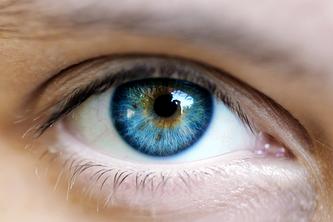
Sensation, in pscyhophysics (yes, that's actually a field of endeavor), is the detection of physical energy from the environment and encoding it as neural signals. Aka "bottom-up processing." Perception, also in psychophysics, is the selection, organization, and interpretation of sensations into something meaningful. Aka "top-down processing." Yay! Your retinas receive reflected light waves, turn that reception into a neural signal, pass it along the optic nerve to ye ole temporal lobe which picks out which part of the neural signal to pay attention to, organizes it into a picture, and then says, Hey that's a dog! Why is it wearing a fuzzy pink sweater? Poor thing. Must belong to one of those weird chicks that never got over being a cheerleader. Probably sells insurance.
Anyway. The interesting thing about this is that people receive millions of these little sensory neural impulses from everywhere millions of times per second. Estimates are 11 million bits at the moment, but that can change if you're indulging in a rubber paraphilia. We only actually process about 40 of those bits and block out the rest. It's called "sensory adaptation." Even though the rest of us call it "common sense, duuuuuuuh." The rest is used intuitively. Heck, some of it doesn't make it past the spinal cord into the brain. Anyway. The point? Sensory adaptation reduces sensitivity, but enables us to focus on informative changes in our environment without constant distraction (it's a survival skill). It's why you don't see the outline of the deer about jump in front of your car until it moves or the headlights make its eyes flash like Roswell Bambi.
Where does this all lead? There is an idea, one that's pretty much borne up under much actual testing and a lot of not testing, but still makes the news (eyewitnesses, for example, never see the same thing). The idea is that we perceive the world not as it is, but as it is useful for us to perceive it. And that is a very interesting scientific factoid.
How far does this type of perception extend? The Big Guy doesn't find it useful to perceive where his wallet, keys, glasses, book, shoes, socks, or pretty much anything he wants might be. He does find it useful to perceive the spouse (me) and ask me where these things are (generally right in front of his face). It's called, wait for it, "Selective Attention." Psychophysicists are an original lot. Sensually, we pay attention to what's useful and disregard the rest until it does something to get our attention. Consciously, we do the same thing with the rest of our lives. A lot of what we pay attention to, we don't just assign labels to, we make assumptions about them and expect things from them. We see the taco bell dog in a pink sweater and assume the owner is an older woman that really needs to get a life, and maybe sued for cruelty to animals. And then we note that the older woman is actually, well, built like the Hulk and wearing Armani. So not only do we see a weight lifter who does the lawyer 0r stockbroker thing, we assume he's gay, too. And we still think he should be sued for cruelty, this time to everyone. Pink sweater? Oy.
Do we see what is? Yes. Do we perceive what is? No, actually we don't. Is it good to "read into things?" You know, see the weight lifter and his poor mutt and make a few judgments about the guy. If you're right, you're a "good judge of character" and not only should you be commended, you should put it on your resume. If you're wrong, you "shouldn't jump to conclusions" and you should redirect any potential employer's selective attention to your more sterling qualities. I think this is where the jumping off point between perception and expectation comes into play. The eyes don't see the dog and the guy. The eyes see reflected light waves. The brain is what sees the dog and the guy, and that only from neurotransmitters, chemical impulses. When sorting through the dog rolodex, it makes associations and assigns labels. Dog. Chihuahua. Pink sweater. Frou-frou mutt popular with older women and starlets. Feminine kind of a dog. And so on and so forth. If the dog was wearing a black leather collar with spikes, the associations would be different. Same dog, different associated memories.
It's difficult to learn to see things as they are, not as they ought to be according to our brains. Mnemonic association happens more and more instinctively and less and less consciously as we grow older. There's way more than 200 gig hard drive (soft drive?) in the skull with information to sort through. We can't just run through it consciously and expect to do anything but sit there and wonder where we've seen something like that before. More information = success. Less information = failure. The brain is adapted to make sure we succeed because, hey in the real world, failures starve and successes get to live and breed to pass on the genes. Natural selection at work, baby. So, the brain is adapted to make sure we do make these snap judgments. That's great if you're trying to work out whether or not you're seeing a megalania prisca or a moa. One you run from, one you put a big stick into and roast for the whole family. It's not so great if you've got a lot of stress from things not being what you expected them to be.