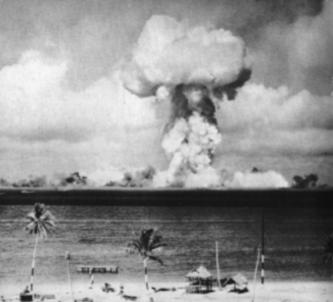
by Jane Cooper, in 1951
The atom bellies like a cauliflower,
Expands, expands, shoots up again, expands
Into ecclesiastical curves and towers
We pray to with our cupped and empty hands.
This is the old Hebraic-featured fear
We nursed before humility began,
Our crown-on-crown or phallic parody
Begat by man on the original sea.
The sea's delivered. Galvanized and smooth
She kills a tired ship left in her lap
---Transfiguration---with a half-breath
Settling like an animal in sleep.
So godhead takes the difficult form of love.
Where is the little myth we used to have?
This is my favorite poem. It used to be Christina Rossetti's Mirage, until I found this one. It's a sonnet, Petrarchan or Italian (same thing), depending on how you label it. It's a convergeance of the dichotomy between subject and form as well as the depth and breadth of this poem. There is so much packed in such a little space. The lore of the Trinity test site, Bikini atoll, Genesis. It's all there.
The Italian sonnet was created by Francesco Petrarca as a set of brief love-lyrics based on complex rhyme schemes with aspects of religious devotion and metaphysical association. That comes from Mary Kinzie. And this poem fills the form with subtle Homerian satire. There are love-lyrics. Well, one distinct one and some intimations. Sitting in a woman's lap is reminiscent of maternal love because who else sits in a woman's lap but a child? The poem takes the aspects of religion to its fullest. I've spent hours searching for "original sea" and what it might allude to. Literally? The Trinity test site was the bottom of an ocean eons ago. The Bikini Atoll tests took place in the Pacific Ocean, the Ocean that was Ocean when Pangaea was around.
One of the foremost things that brings depth to the poem is the form. The surface of the poem is ostensibly about devotion, particularly religious devotion. One might even call it satirical or gently sarcastic. The poem is about atmoic warfare and humanity's transfiguration into godhood via an almost religious devotion to whatever we hope to gain from nuclear detonation. On a deeper level, however, the tradition of the Italian sonnet is upheld. In the beginning, we may "pray to" the atomic bomb tests "with our cupped and empty hands," but in the end, after the test is finished and the sea settles back "like an animal in sleep," god is no longer us and returns to the godhead to "take the difficult form of love." The devotion we may have lavished on the atom bomb has once again transfigured back into the real devotion, not of man to God, but in God to man. The last line hammers this notion home. What happened to the devotion we used to have for God? Where did it go? Was it only a myth?