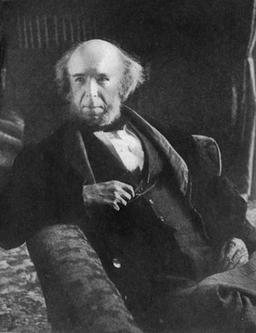
Herbert Spenser was a biologist and sociologist and psychologist and some other ologists in the later part of the 1800s. He, not Darwin, coined the term "Survival of the Fittest" after reading Darwin's Origin of Species. Spenser fell deeply and irrecovably in love with evolution. He called it Master of the Universe. He applied both is love of categorization, biology, and evolution to society and came up with a theory that was later called Social Darwinism.
Herbert says that the process of social change is evolution. While social change is change in everything from how individual interactions are done all the way to how an entire society is structured, Herbert was more into macrotheory, or the big picture. Societies began simply and changed over time to complex structures. Small, nomadic tribes of hunters and gatherers evolved into the huge metropolitan industrial centers of his day, like London. The mechanism that drives social evolution is adaptation or, as Herbert preferred to think of it, integration. He emphasized understanding society as a social system, an organic ideal that he took from biology. To him, society was an organism with boundaries, parts, and cells. From that viewpoint, the whole is greater than the sum of its part. Society, the whole, is more important than the individuals or smaller social structures (like family, congregations, worker groups, businesses, government offices etc.) that it's made of. Some parts fail or are removed and society continues.
Because society is more important than the individual, integration into society (adaptation, aka survival of the fittest) becomes the difference between success and failure of both individuals and of society itself. The individual or social structure that adapts itself well enough to integrate with society survives and reproduces itself through culture. The individual or structure that does not integrate, does not remain to reproduce itself. More importantly, in a society where the parts do not adapt the society disintegrates. Lack of integration is not a threat to the individual or smaller structures, but to the entire society. The corollary is that as the adaptation and integration happens, society itself progresses. One of the effects of social evolution into a more complex society is increasing social stratification and inequality. Individuals and social institutions achieve what they achieve in the social structure because of how successfully they've adapted to society and how they've integrated with society. Deviance exists, not because of inequality, but because individuals fail to integrate with society. They seek solutions to their problems and those solutions are not in the interests of society, so are deviant.
Social Darwinism and, particularly, Survival of the Fittest fit in very well with both the rapidly industrializing British Empire and the expanding American economic "barons" (like Rockefellar) of the time. Social Darwinism gave these top individuals and the upper class a means of explaining not only why they were at the top and the poor were at the bottom, but why they had every right to be there. Why did Britain dominate the world? Because they were the most evolved and advanced, therefore it was only right that they did so. Why was Rockefellar the richest man in America while the children he employed could barely feed themselves? He was the most fit to advance, so it was only natural that he did so. Competition, which feeds that adaptation mechanism inherent in evolution, particularly fit with British and American dominance. In competition, there is a winner (usually the British Emprie) and a loser. It's only natural that they win and therefore reproduce the British culture because, via evolutionary standards, Britain proved itself most fit of the cultures it dominated.
Social Darwinism lost favor in Britain at the turn of the century, but persisted in America until the middle of, almost the end of the Great Depression. The theory could not explain the Great Depression in any context and the middle class that fed sociology departments in universities all over the world started turning to Marxism in droves. Social Darwinism does have some relevance today, particularly when examining why certain things in competition succeed and others fail.
Note: I am not a Social Darwinist. I am a sociologist wannabe interested in theory and, therefore, Social Darwinis. Theory is my playground.