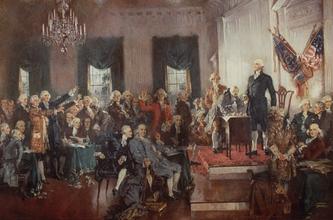
The only point of government where the founding fathers' personal beliefs are truly an issue is the Second Amendment of the Constitution. "A well regulated militia being necessary to the security of a free State, the right of the People to keep and bear arms shall not be infringed." The point of their intentions is relevant in this case because laws to regulate guns are being passed and it's iffy on their constitutionality: can only government sponsored militia members have free access to guns or is it everyone kind of thing. It's hard to say.
Their personal beliefs, religion-wise, have absolutely no bearing on today's Constitution or government. All that matters about their views on religion is the first part of the First Amendment, "Congress shall make no law respecting an establishment of religion, or prohibiting the free exercise thereof;" This has been interpreted by the Supreme Court to mean that there will be a separation between the Church and the State. And that, legally speaking, is that. The Supreme Court is the final authority on what the law means and how it's applied in the US.
The only real purpose that the founding fathers' religion serves is the logical fallacy argumentum ad verecundiam, or an argument appealing to authority. While, on the surface, the religious beliefs under which the US Constitution, and therefore the US, was created are important; the intentionally changeable nature of the government added with the First Amendment and legal interpretation thereof makes those beliefs immaterial. What's important is their beliefs as evinced by the Constitution itself.
However, when it comes time for Christians and non-Christians to clash in the legislative arena over whether or not religious things belong in the government (eg, prayer in schools), Christians use the ad verecundiam fallacy in an attempt to mitigate the real authority on the subject: the Supreme Court. It's an idea as old as running to Mom and Dad when the Babysitter says no. Hold the Founding Fathers (the parents) as a higher authority than the Supreme Court (our Constitutional stewards) and you can enforce your way since they, in theory, would agree with you based on religious beliefs. The reality is that the Supreme Court isn't trumped by the Founding Fathers (the Founding Fathers made sure of that in the Constitution itself) and their religious beliefs are unimportant beyond their historical significance.
I answered a question on Yahoo Answer, Religion & Spirituality section last night and decided, hey, I should save that. So I did. Right here.