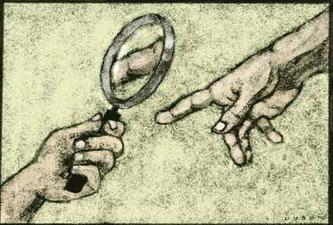
Durkheim figured it out. Maybe not first, but he did phrase it in a most interesting way. Or something. Anyway. He wanted to point out two things. One, religion is not divinely nor supernaturally inspired; it was, in fact, a product of society. Two, there are common things that religion places emphasis on, no matter what the religion, and there are common effects that religion has on the lives of the members of society.
Of course, there's the question. What is religion? The quick and dirty is the belief and worship of some sort of supernatural being(s) that's superior to human beings. The problem is that definition excludes a variety of religions or religion-like belief systems that have no divine being or don't follow through with the whole worship thing. Buddhism is one that comes to mind. There is the argument that Buddhism isn't a religion, but a philosophy. *shrugs*
Molloy says that academics generally note that what we call religion has some degree of the following:
- Belief System aka worldview. It's a systematic interpretation of the world/universe and humanity's place therein.
- Community The belief system is shared by a group.
- Central myths Stories that express the beliefs that are retold and often reenacted.
- Ritual Beliefs enacted and made real through ceremony.
- Ethics Rules about human behavior, usually viewed as originating from the supernatural, but can be socially generated.
- Characteristic emotional experiences emotions or feelings that a person feels is connected to the belief system and that are common to the group, rather than just the individual.
- Material expression physical elements from inanimate objects, animals, and plants to vocal or artistic expressions that are associated with the religion and often elevated.
- Sacredness A distinction between the sacred or holy and the ordinary or mundane.
I'm pretty much on board with Molloy here, because it covers the human experience of religion. Durkheim takes the academic view of religion further in that he tries to explain why and how religion is there, not just what it is. What I've read of Molloy (admittedly not much) is more of an exploration of what religion is and what different types of practice there are. He does touch on the why, but not that much.