several miles from his home, which was on the other side of the ridge. The other
reason Cordy wanted to sell, was Anderson Creek. The land all lay on the other
side of the creek. But we immediately fell in love with that beautiful piece of land, and it was cheap! Normally Anderson Creek was a gentle little stream less
than a foot deep and two or three feet across at the crossing into the property.
Local folks told us the creek could get high, but we were unprepared for reality
when it hit.
There had been a good typical Tennessee storm. Like most of the storms that
batter Tennessee it started in the Gulf of Mexico and picked up a lot of moisture.
The storm dumped about five inches of rain in two days. As I looked out from the
travel trailer which was serving as our temporary home it seemed that all I could
see was water. Anderson Creek was now about five hundred feet wide across
the bottom, and probably twelve feet deep at the creek bed. We were
homebound for two more days while the water receded. We later found out that
even an inch of rain could make the creek impassable. There was high ground
by the road on the other side of the creek where we could park our car, but how
would we get there when the water was up? That’s when I remembered
something from my high school days in Arizona.
During high school there were times my buddies and I would cut school and
drive out to the river for tubing. At one place along the river there was a sort of
cable car that ran across the river. I asked around and found out that the Navaho
shepherds used it to cross over to their sheep when the river was swollen. That
was just what we needed to cross Anderson Creek.
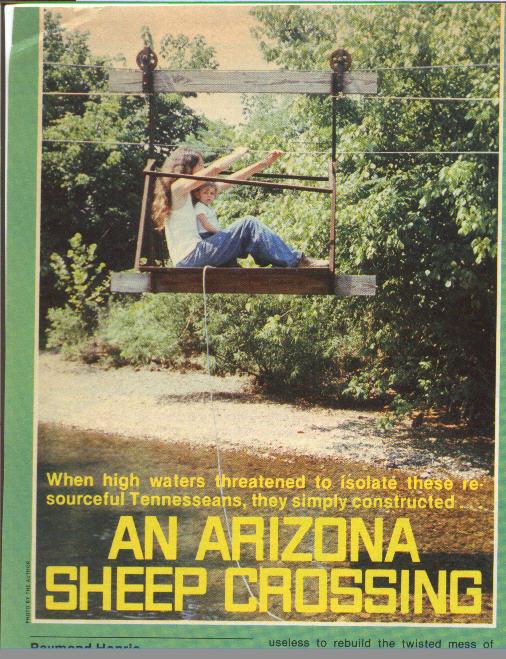
A surplus cable supplier in Nashville sold me some half-inch galvanized cable.
Some angle iron for the frame, some cast iron pulleys for the wheels, and some
plywood and bolts, and I had all the materials. In short order I had built a small
car that would hold two adults and a couple of children. Then some friends we
had met in Arkansas, Gary and Jean, stopped by to visit. Gary and I stretched
the cable all the way from the other side of the creek to a large tree on the hill
across the bottom, about five hundred feet. We used the old John Deere to
tighten the cable, tightened the clamps, and it was ready for a test ride. I
climbed aboard and went sailing down the cable towards the creek. Bur five
hundred feet was a good distance. With the weight of me and the car the cable
sagged until the cable car, traveling at a good clip, hit the ground about midway.
The sudden stop catapulted me head over heels out of the car. Thankfully the
ground was soft.
Gary and Jean left for home. I trashed the idea and decided to use the cable
to build a foot bridge across the creek. I spent about a week constructing a
platform on the low side of the creek, and a lower one on the high side. Then the
cable was divided in to four pieces and strung across, two runs for the bridge
itself, and two runs as hand holds. Some sawmill lumber became the bridge,
suspended on the cables. The bridge worked fine. It was about ten feet above
the creek, and several times the creek rose, and we just walked across. But
then we had another Gulf of Mexico gully washer. The water was to deep to get
to the bridge, and when it was all over the bridge lay alongside the creek, a
twisted mess.
That is when I decided to try the sheep crossing where the bridge had been.
The little car could be kept at one end and pulled to the other with a rope. The
cable it rode on would be about four feet higher than the bridge was. It worked
splendidly. A few times we crossed Anderson Creek with the water touching the
bottom of the car. The local people thought I must be nuts, but it worked, and a
visit to Anderson Creek over fifteen years later finds the car still intact and
useable.