|
|
||
|
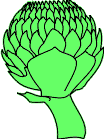
Globe Artichoke |
Jerusalem Artichoke |
|
|
The unopened flower heads are the edible part. |
The edible portion is the tuberous root. |
|
Comments: - Artichokes are perennial and can be planted throughout South Africa
|
Artichoke, Globe |
|
|
Genus |
Cynara scolymus |
|
Family |
(Asteraceae) |
|
Common name |
Globe Artichoke, |
|
History |
|
|
Artichokes belong to the family Asteraceae [ Compositae ] and grows wild in the southern parts of Europe. |
|
|
The leaves proceed from the base of the plant and are long, silver and spiny. Some plants may not have spines at all. Variations are also noticeable in the flowers. |
|
|
The plant can grow up to 1 meter high when in flower and as wide. The branched flower stalk can produce several flower heads. The flower resembles a large Thistle. |
|
|
The flower in also very attractive and can be used in the garden as an ornamental plant. The flower attracts many insects, but the leaves of the artichoke are a food source for the painted lady butterfly. |
|
|
Cultivation |
|
|
Germinate from seed, or grow by removing the young suckers that develop around the old plant at the end of the season. |
|
|
Germinate the seed in seed trays, or direct in the ground. Seedlings in trays can be planted out into bigger containers once they are 5 cm tall. |
|
|
Grow in lightly sandy soil to which compost has been added. Add a little bone meal and guano to the soil. |
|
|
Plant out into the ground at about 75-cm to 1 meter apart. |
|
|
Care |
|
|
The only problem insect on Artichokes are the larvae of the Painted lady Butterfly( Vanessa cardui). Larvae are black and have white rings around the. They have growth resembling spikes on their backs. |
|
|
They eat the leaves and leave droppings that can be seen. The leaf is spun into a cover that they hide in and venture out at night. |
|
|
Control them by removing the larvae by hand and dropping them into a container of soapy water. Paraffin can also be used. Check for the butterfly to indicate the presence of the larvae. |
|
|
Harvesting |
|
|
The flowers are formed only after the second year of growth, are harvested when they are still immature. At this stage the flower heads are the size of a tennis ball. |
|
|
Seed Collecting |
|
|
Select the plants that produce a lot of flowers, and those that do not have to many thorns or spikes on the flower head. Before the flowers mature, cover them with a paper bag and secure the base with twine or elastic band. |
|
|
Check the flower every day, and when fully open take a dry, clean, paintbrush and collect pollen from one flower and paint the pollen over the flower of a second fully open flower. Cover again to prevent cross-pollination by bees and insects. |
|
|
Leave to mature. |
|
|
Once the flower has dried out (which takes a long time) break open the flower base and remove the plumes from the head. The seeds are similar to sunflower seed, and are brown in colour. |
|
|
Varieties |
|
|
Purple Globe |
|
|
|
|
|
Popular Variety is "California 500" |
Asparagus is a perennial with a life of 10 or more years.
|
Propagation |
Plant seeds in Spring transplant 12months later. Obtain plants or crowns for a quicker yield. Do not harvest for 2 years for best results. |
|
Cultivation |
Space crowns 450mm apart in furrows 1m apart and 75mm deep. |
|
Soil Type |
Fertile, well drained and neutral to slightly acid soil. |
|
Hardiness |
Hardy grows best in cold soils in Winter |
|
|
|
|
Varieties |
|
Annual
|
Propagation |
Plant seeds in trays and plant out when the soil is warm. |
|
Cultivation |
600mm apart with rows spaced 600mm |
|
Soil Type |
Neutral Soil |
|
Hardiness |
Brinjals are very tender to frost. |
|
|
||
|
Bush Beans |
Climbing Beans |
|
|
Seminole, Topcrop, |
Lazy Housewife, Witsa |
|
Beans are mainly Annual but Perennial varieties are available.
|
Propagation |
Plant seeds in situ a few days before final frost. |
|
Cultivation |
75 to 125mm apart in rows spaced 0.4 to 0.7m (150 to 230mm in rows 1m apart for climbing beans) |
|
Soil Type |
Any soil except very brak or very acid. |
|
Hardiness |
Beans are tender to frost. |
|
|
|
|
Varieties |
|
|
Crimson Globe, Detroit Dark Red |
Annual
|
Propagation |
Sow seeds in situ or in trays. Avoid Winter in cold areas and Summer in sub-tropical areas. |
|
Cultivation |
Plant seedlings 50 to75mm all around. Harvest tennis ball size. |
|
Soil Type |
Well manured soil from previous crop. pH between 5.8 and 7.0 |
|
Hardiness |
Frost hardy. Keep soil moist during germination. |
|
|
|
|
Varieties |
|
|
Aquadulce, Leviathan Longpod |
Annual
|
Propagation |
Sow seeds in situ. Bushes bear in Winter & early Spring. |
|
Cultivation |
Space 150mm apart in rows 1m apart. Pinch out the tips when flowers appear to encourage setting of pods. |
|
Soil Type |
Deep fertile soil. |
|
Hardiness |
Frost hardy |