
FACTORS AFFECTING SYMBIOTIC NITROGEN FIXATION IN ORGANIC FARMING SYSTEMS
Ian Sanders
PhD Thesis
Faculty of Science and Engineering
THE UNIVERSITY of EDINBURGH
2002
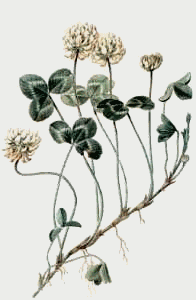
Nitrogen (N) fixation by white clover (Trifolium repens L.) was measured in the ley phases of three experimental organic ley-arable rotations at two sites, between 1997 and 2000, using the 15N dilution technique. Soil nitrate, ammonium, and total soluble N were measured at one of the sites between 1999 and 2001. Variation of soil N was assessed in different ages of ley, year, month, rotation, site and microsite type (grass or clover). Data for soil pH, organic matter, P, K, and Mg, was also compared, as was weather data for the period. Variation of N fixation, grass and clover dry matter, proportion of nitrogen derived from the atmosphere, grass and clover N concentrations, grass and clover non symbiotic N-yield, and N transfer from clover to grass were compared in different ages of ley, years, months, rotations and sites. Flowering rates and presence of clover tap-roots were also examined. Above ground N fixation varied between 26 and 75 kg ha-1 over the course of the growing season. Estimated total N fixation ranged from 70-214 kg ha-1. N fixation was closely related to yield of clover. There were clear relationships between soil nitrate and the behaviour of the grass and clover components of the leys. Nitrate was slightly higher under clover patches than under grass patches in mid-late summer.
White clover and perennial ryegrass were grown in circular chambers, divided radially, and their invasion into microsites with different vegetation, different management and different N treatments was observed. Ryegrass was not capable of rapidly colonising microsites by vegetative spread alone. Clover was more likely to successfully invade microsites containing grass with no added N than microsites with added N, or bare soil microsites.
Declaration
I hereby declare that the work presented here is my own, with the exception of the following:
The weather data (Figures 3a-d), the ground cover data (Figure 14) and the long term soil P, K, Mg and pH values (Figures 23a-d), which were collected by the Scottish Agricultural College.
6.1.2003
Acknowledgements
This project was funded by SEERAD. Special thanks to Olive Pauline and Mary Shepherd for technical assistance, to Derek Simpson for help with fieldwork and to Catriona Brady for love and keeping me sane. I would also like to thank my parents for their financial assistance
Abbreviations and glossary of technical terms used in the text
DMC – Dry matter yield of clover
DMG – Dry matter yield of grass
FYM - Farmyard Manure
J -Joules
K – Potassium
K2SO4 – Potassium Sulphate
LU - Livestock Units (1 livestock unit = 1 large dairy cow)
Mg – Magnesium
%NC – percentage N (by weight) in dry clover herbage
%NG– percentage N (by weight) in dry grass herbage
%XS15NC – 15N enrichment of clover
%XS15Ngmo– 15N enrichment of grass in monoculture
%XS15NGmx– 15N enrichment of grass in grass-clover mixture
N - Nitrogen
N2 – Nitrogen gas
NO – Nitric oxide
N2O – Nitrous oxide
NO3- - Nitrate
NO2 – Nitrite
NH4+ - Ammonium
NfixIT - Nitrogen fixation including transfer
NfixET - Nitrogen fixation excluding transfer
P - Phosphorus
pNdfaIT - Proportion of Nitrogen in clover herbage that is derived from the atmosphere, including transfer
pNdfaET - Proportion of Nitrogen in clover herbage that is derived from the atmosphere, excluding transfer
ppm – parts per million
SON - Soluble Organic Nitrogen