FINALLY : A peek at XWEBS Browser !
Oh my god! It seems like centuries
long just to get something new on XWEBS, the supposedly miraculous web browser.
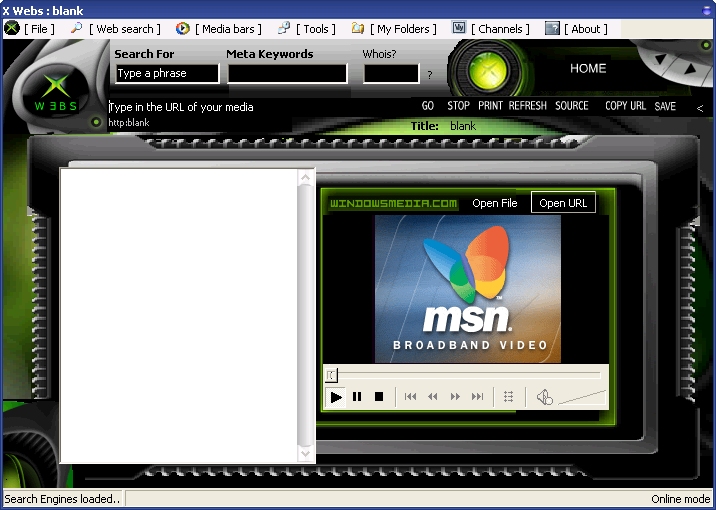
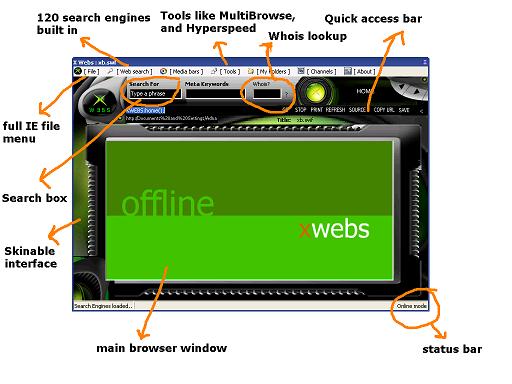
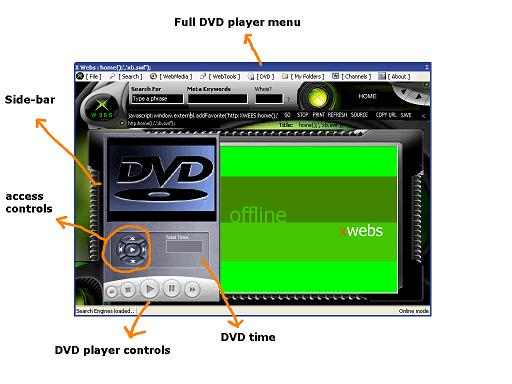
Here are the screenshots taken by the author himself, for public viewing:
>>Dark Daemon
>>ORG
.
Karlin Lillington's Full Write Up on XWEBS
Since 16-year-old student Adnan
Osmani won the Young Scientist of the Year competition, he has been critically
acclaimed by technology experts, and his computer browser is creating a furore
in Internet discussion groups. He talks to Karlin Lillington
At 5:30 a.m. on a bitterly
cold Tuesday morning in early January, Mullingar student Adnan Osmani climbed
alone into the early bus to Dublin, lugging his laptop and a two-page printout
of a project in which he'd invested two years of his 16-year-old life.
He'd had only two hours sleep,
a result of trying to organise himself amid the mayhem of a move into a new
house, putting some last-minute finishing touches to his project and general
anxiety. Arriving in Dublin, he headed out to the RDS. There, he joined the
bustle of hundreds of other teenagers as they set up carefully-planned booths
explaining their entries to the Esat/BT Young Scientist of the Year competition.
Adnan simply stuck his two pages on the booth, opened his laptop, and waited.
He could hardly, in his wildest
imaginings, have guessed at what would happen next. By the following week,
tens of thousands of people around the world would flood Internet search
engines with three search terms: "Adnan", "Osmani" and "Xwebs". He would
make radio and television appearances, including the Late Late Show. And
out in the virtual world of the Internet, on some of the biggest programmer
discussion sites, such as Slashdot.org, and in Ireland on Boards.ie, he would
be the subject of angry debates, long pontifications, and hopeful postings
as thousands debated how the browser might work; indeed, if it could work
at all.
Osmani had won the title of
2003 Young Scientist of the Year with a web browser - a means of navigating
the Internet - called Xwebs that judges felt showed the assuredness and programming
capability of the very best final year university students. But what caught
the attention of the web world was Osmani's claim that he'd coded an algorithm
into the browser that enabled it to speed up browsing by up to six times.
"I just wanted it faster, for
myself," says Osmani simply. "I wanted to make the perfect browser." Osmani
is mostly oblivious to the web furore he has caused - he doesn't really like
discussion sites ("they can make you over-confident or destroy your confidence"),
and has also been advised not to read them at the moment.
Which is a good idea, as the
majority of comments are sceptical and often downright brutal - mostly coming
from adult men in the technology industry who seem to have forgotten that
Osmani is only 16, and the browser is a school project, not a submission
to an international journal by a boastful professional researcher.
But his programming precocity
and finesse is undoubted, say the industry and academic judges for the Young
Scientist competition. Indeed, such was its demonstration of accomplishment
that three additional judges with computing expertise were called in to view
it, to make sure that Osmani did indeed have the ability to write a program
so complex and comprehensive.
"The student certainly displayed
enough knowledge to prove he'd written it himself," says UCD's Dr John Dunnion,
one of the additional judges and a computer science lecturer. "And it certainly
is a very impressive piece of technology, a very feature-rich browser."
"What impressed us most of
all," says Dr Leonard Hobbs,Intel head of engineering and competition judge,
"is he absolutely knew what he was doing. It was a complete work, a whole."
What Osmani was demonstrating, he says, "is the science of the web." Numerous
judges have emphasised that the panel decided early on that it would not
include the speed claims as a feature for assessment, as they could not be
verified. In other words, the browser won on the strength of all its other
elements.
Dr Gary McDarby, a senior researcher
at the Massachusetts Institute of Technology's Media Lab Europe, says he
was astonished at the ability shown by the 16-year-old. "Years ahead," he
says. He is unsure whether the speed claims could be commercially implemented,
but he believes Osmani's algorithm would probably work and, overall, notes
that the browser shows new and creative ways of thinking about browser applications.
"What he's certainly doing conceptually is raising the bar for the commercial
companies."
Osmani, who decribes Xwebs
as "a megabrowser", spent two years producing about 200,000 lines of code
for his project that folds in direct, browser-based access to 120 search
engines and contains five popular media players for sound and video. He also
added a DVD player that can be enlarged to fill the screen or miniaturised
into a small window. And it has a talking character named Phoebe, who welcomes
you by name at start-up, guides the user through some of the processes of
the browser and can read a web page out loud for children or the sight-impaired.
The browser is structured on the basic form of Microsoft's Internet Explorer
that developers would use to create add-ons for the browser, or programs
that work with it.
Osmani is sitting in the dining
room of his large, comfortable home in Mullingar, a house still full of boxes
from the family's recent move. Half Arab and half Indian - his immigrant
parents are both consulting doctors, in paediatrics and obstetrics - Osmani
is the antithesis of the weedy programmer stereotype: solid and broad for
his age, with a shock of dyed-blond hair, a bit wary and shy, but charmingly
polite.
A plasterer arrives at the
house and, breaking off a chat with Osmani's father Suvi, peers in at Osmani.
"Is this the man?" he asks. "Let me shake your hand!" Osmani looks acutely
embarrassed, but also shyly pleased as he stretches out an arm.
SUVI Osmani is full of pride
and enthusiasm for his son, but is clearly bewildered by this child who speaks
in an alien tongue about things he barely comprehends. Adnan's oddly American-accented
voice speaks in the language of bits and bytes, algorithms, caches and protocols
that makes no sense to his father.
He looks on with a vaguely
shocked expression as his son eagerly dives into conversation about computing
and programming and the digital personalities of various computer operating
systems, and vigorously sketches out diagrams, boxes and arrows that show
how his browser actually works. Suvi Osmani admits that he hardly knew how
to use the Internet until Adnan showed him how to use the Google search engine
to see how his son was being written about out on the web.
Adnan Osmani got his first
computer at 10 (now passed along to his younger sister), and began to teach
himself to program at 12. He's entirely self-taught - none of his schools
ever had computing classes, he says with exasperation.
Programming - along with writing
fiction and poetry and drawing - seems to have filled a friendship gap for
him as well. He has been moved around to various Irish towns with his parents
as they completed their medical training, and thus has changed schools several
times. "You don't have time to make friends," he says. "Some people integrate
better with machines than people, I guess."
Yet Osmani is in no way socially
awkward - no more so than any teenage boy. He's voluble and cheerful, clearly
has a deep, curious intelligence, and is absolutely passionate about computing
and programming. He's read all the hip cyberpunk writers that produce literary
cyber-fiction, lighting up as the conversation touches upon Neal Stephenson
and William Gibson. He also loves reading the classics and poetry, he says.
"Not modern stuff. That's all guys writing on something like, a cup. It's
boring."
Only a 16-year-old can obliterate
decades of contemporary writing with such aplomb. His computing heroes are
Apple Computer founders Steve Jobs and Steve Wozniak, and infamous hacker
Kevin Mitnick.
For now, Osmani is going through
the long process of seeing if he has done something that he can copyright
or patent, and is enjoying the attention, even though he says he never expected
to get the top prize. At most, he thought he might get something in the technology
subsection, but when that didn't happen he wasn't really paying attention
when they called out his name for the Young Scientist award. "I just thought
you'd better get up and start walking because you've won something. I didn't
really know what," he says. He hopes the award will help him get into a good
university, with Harvard his aim.
As for programmers and programming? "We like doing what we're doing, and it's great if you can get recognition."
Copyright 2003 Karlin Lillington.