"All matter is composed of small particles called atoms that are in constant, random motion. The rate at which these particles move governs the physical state of matter of a substance and the interactions between these particles"
Look around you. The desk your computer rests on. The chair you are sitting in. You yourself as you read this passage. The air you are breathingThese big items are all made of very small particles called atoms. We know that atoms can combine to form molecules, and molecules can combine to make larger structures that makes up you and everything around you. But did you know that these very small particles, the atoms are always moving? Even the atoms that make up the seemingly unmoving desk is moving. The fact that atoms are always moving is a very important concept in chemistry.
Kinetic molecular theory explains almost all of the phenomena of chemistry. SImply stated, KMT merely says that the particles that make up matter are always in motion. Energy governs how fast and what kinds of motion that the particles have. This in turn can give us some information about how the particles iwill interact with one another The energy of moving particles is called kinetic energy. We meassure the average kinetic energy of the particles that make up matter by measuring the tempurature. We can add energy in the form of heat to matter to change how fast the particles move. This is how we change the state of matter. Matter comes in 4 confirmed states, three of whih we will discuss below. The other confirmed state of matter called plasma and one other theoretical state called the Bose-Einstein condensate. Click on the links to read more about these states of matter (Note-Bose-Einstein Condensate is a very advanced topic).
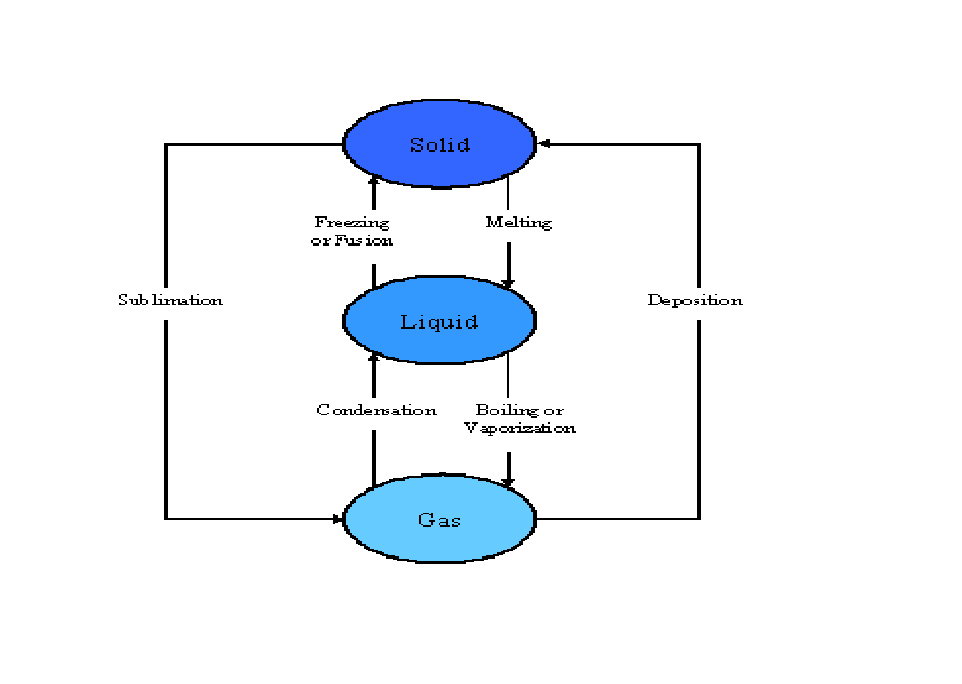
You probably know that when you melt an ace cube, you are changing it from a solid to liquid water. But how would you describe changing a solid into a gas (which is what happens to solid carbon dioxide or dry ice when you let it sit out for a while). We have complied a nice little chart that you can refer to describe hase changes.

The solid state of matter forms when the kinetic energy is very low, meaning the particles are hardly moving around all. But, they are moving indeed, in the form of vibrations. Solids are rigid and the particles are very close together. This lack of empty space makes solids incompressible., meaning solids cannot be made to fit in smaller volumes.
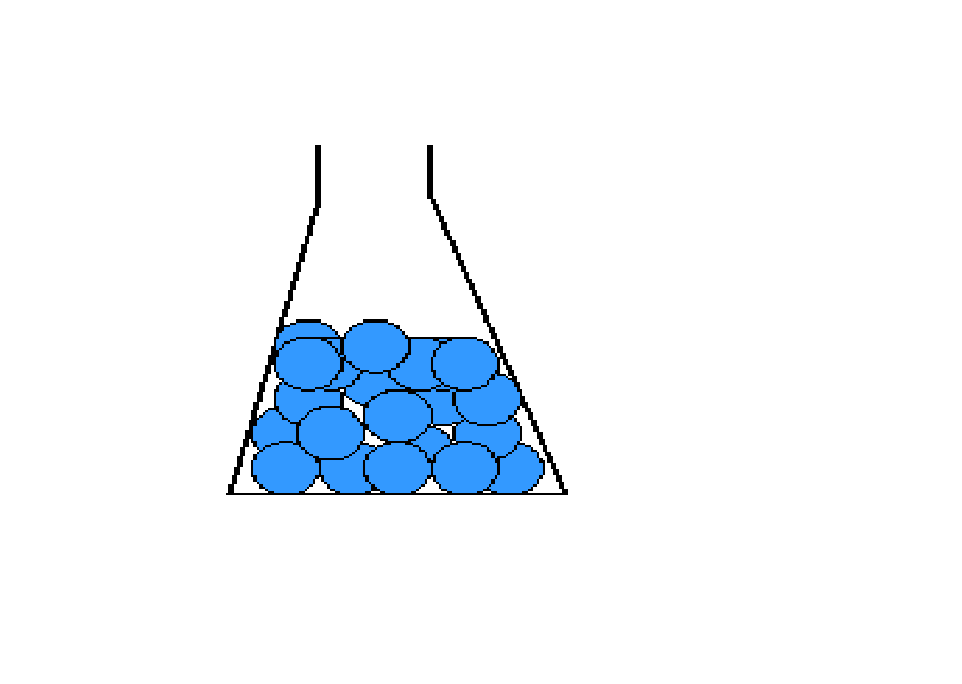
If you add enough heat to a solid, you will cause it to melt into a liquid. The particles in a liquid have a higher kinetic energy than particles in a solid , meaning they move faster. The particles in a liquid are still pretty close together, but have more room to slip and slide past one another. Because of this, liquids are said to be fluid; they can flow from one place to another. Particles in a liquid still are too close together to be compressed however.

Adding more heat will cause a liquid to vaporize into a gas. Particles in a gas have a great deal of kinetic energy, meaning gas particles move very fast. They are also very far apart from each other and rarely come in contact with one another. Since there is so much space availible, gasses are very compressble. Like liquids, gases are also fluid.