 |
|
|
|
|
|
|
|
|
|
|
|
|
|
|
|
|
|
|
|
|
|
|
|
|
|
|
|
|
|
|
|
|
|
|
|
|
|
|
|
|
|
|
|
|
|
|
|
The Atom
A Mysterious World |
|
|
|
Introduction
We have always wondered about what we and other things are made of. This has gone back to as far of the Ancient Greek philosophers,. One such school of thought was the Atomists, lead by Democritus. The atomists belived that everything was made of small indivisible particles called atoms. Throughout history, scientists have investigated this postulate and we have learned more about the atom. However, the more we uncover, the more questions we have and the more we find out how little we know. In this presentation, we take a very brief look at the history of the atom. As usual, you can click on links to other resources that will give you a deeper insight into the topic at hand. |
|
|
|
 |
|
|
|
 |
|
John Dalton(1766-1844) was the first scientist (in modern times) to lay down a theory of what matter was composed of. Basically Dalton's Atomic theory states that all matter is composed of small, indivisible particles called atoms (very similar to the Greek Atomists). These atoms combine in small whole numbered ratios to form compounds. He also stated that elements are made of one kind of atom and in chemical reactions atoms merely rearange themselves and cannot be created or destroyed. |
|
|
|
|
|
Daltons "Indestructable " Atom!! |
|
|
|
 |
|
|
|
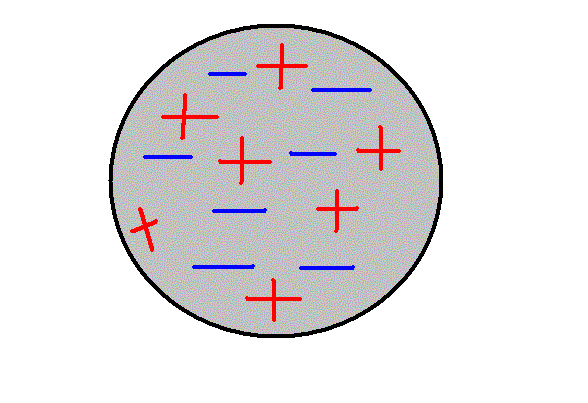
For a long time, chemists beleived that atoms were the smallest pieces of matter. But in the late 1800's Joseph John Thomson (1856-1940) proved that atoms have smaller constituents. Using a cathode ray tube (ancester of the television tube) he discovered that atoms contain negatively charged particles, later named electrons. He also determined the charge to mass ratio of the electron, indicating that it is much smaller than the atom itself. Thomson' s discovery lead chemists to describe the atom as electrons embedded in a sea of positive charge, like "plums in a pudding". The discovery of the electron was very important because electrons are responsible for chemical reactions. |
|
|
|
 |
|
|
|
|
|
Thomson's "Plum Pudding " Atom!! |
|
|
|
|
|
|
|
|
|
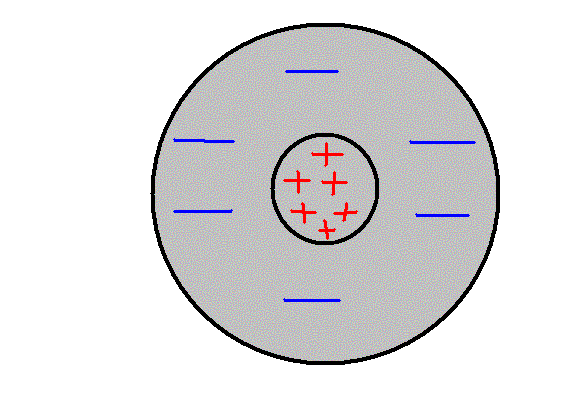
Now that chemists knew that the atom had smaller parts, they worked with physicists to further unlock the mysterious structure of the atom. Another breakthrough came in the early 1900's when Ernest Rutherford (1871-1937) and his research assistants experimented with bombarding goild foil with alpha particles. They discovered that the positve charges are concentrated in the center of an atom,(refered to as the nucleus) with the electrons circling around it. Later, Rutherford discovered these positive charges to be "protons" . |
|
|
 |
|
|
|
|
|
|
Rutherford's Atom!! |
|
|
|
|
|
|
|
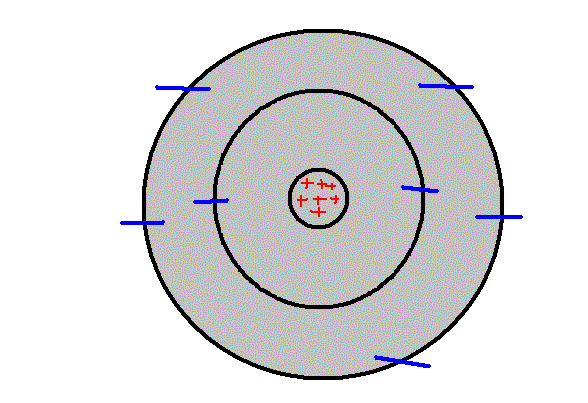
Rutherford's model gave more insight into the structure of the atom, but raised more questions too. Since positive and negative charges attract one another, wouldn't the atom eventually collapse onto itself? Physicist Niels Bohr (1855-1962) propsed a solution to this dilemma, using quantum theory. He proposed that electrons exsist in orbits around the nucleus of the atom., much like our solar system. These orbits exist at discrete energies and electrons can only move to different orbits if they emit or absorb a certain "quantity or quantum" of energy. This theory explained a great deal of things about matter, including line spectra of different elements. |
|
|
|
 |
|
|
|
|
|
Bohr's Planetary Atom!! |
|
|
|
|
|
|
|
|
|
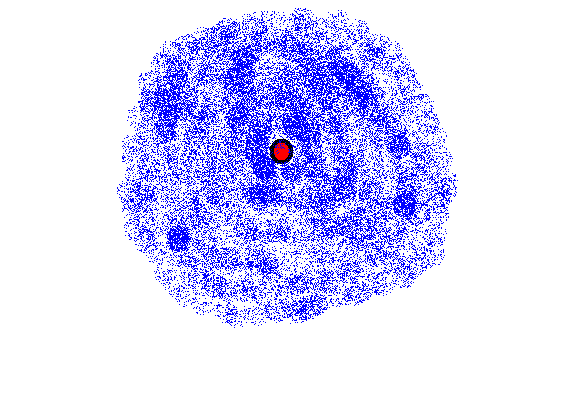
Bohr's theory was very useful for estabilshing the concept of atomic energy levels, but fell apart when used to explain the structure of atoms other than hydrogen. Soon many developments in quantum mechanics helped to shed a little light on the small world of the atoms. The modern view of the atom is now shrouded in uncertainty. The nucleus contains protons and neutrons and takes up the majority of the atom's mass, although it is very small in volume. The electrons wizz around the nucleus in a "cloud" of probability waves and we can never be sure of were an electron is exactly, we can only predict. |
|
|
 |
|
|
|
|
|
The Quantum Mechanical Atom: A world of Uncertainty!! |
|
|
|
|
|
|
|
|
|
|
Resource
-"General Chemistry" 7th Edition Ebbing |
|