 |
|
| The SBE 35 is a laboratory standards thermometer with the unique ability to be used both in fixed point cells and at depths up to 6800 meters (22,300 ft). It is unaffected by shock and vibration encountered in shipboard and industrial environments, making it ideal for use in calibration laboratories in the range of -5 to +35� C, and in the thermodynamic method of measuring hydro turbine efficiency. |
| Deep Sea Reversing Thermometer |
| The SBE 35 is designed to operate with an SBE 9plus CTD / SBE 32 Carousel Water Sampler system, and records a temperature measurement in EEPROM each time the water sampler closes a bottle. Each record also contains the bottle position and a time stamp to coordinate the thermometer data with CTD and water bottle data. Using one SBE 35 eliminates the need for reversing thermometers and provides higher accuracy temperature readings at lower cost. |
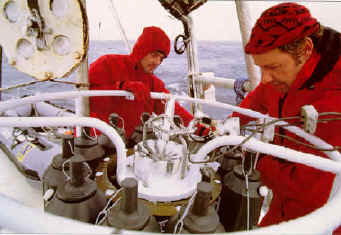 |
| SBE 32 Carousel Water Sampler |
| Photo by S. Compoint / Sygma |
| An innovative design, free of the reliability problems associated with motor-driven types. The Carousel has no moving-shaft seals that can bind up at low temperatures or under pressure because each bottle position has its own magnetically-activated lanyard release latch. Only the magnetic field -- not a moving part -- links the Carousel's lanyard release mechanism with the pylon control electronics. |
| The thermometer is supplied with a small desktop interface box that connects the SBE 35 and a PC and is required for setup and data display or retrieval. The interface box is 110/220 VAC powered, provides 15 VDC to the SBE 35, and buffers the communication lines to minimize interference from external noise. |
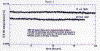 |
| Temperature is determined by applying an AC excitation to reference resistances and an ultrastable aged thermistor with a drift rate of less than 0.001 �C per year. Each of the resulting outputs is digitized by a 20 bit A/D converter. The reference resistor is a hermetically-sealed, temperature-controlled VISHAY. The switches are mercury wetted reed relays with a stable contact resistance. AC excitation and ratiometric comparison using a common processing channel removes measurement errors due to parasitic thermocouples, offset voltages, leakage currents, and gain errors. Maximum power dissipated in the thermistor is 0.5 microwatts, and contributes less than 200 �K of overheat error. The output from the sensor is a raw count related to resistance measurements: Raw Counts = 1048576 * (NT - NZ) / (NR - NZ) where: NR is output from the reference resistor, NZ is output from zero ohms, and NT is thermistor output Each measurement acquisition cycle takes 1.1 seconds. The number of acquisition cycles per measurement is programmable. Increasing the number of cycles per measurement increases the time to acquire the sample while reducing the RMS temperature noise from the sensor. In a thermally quiet environment, the temperature noise standard deviation is 82 * sqrt (1/n cycles) [�K]. |
| Measuring |
| To find more information on DSRT Click! |
 |