| Pictures from Great Britain |
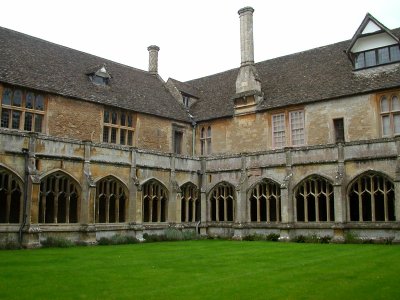
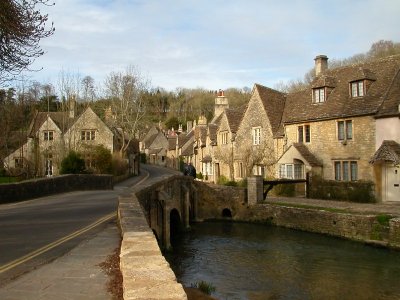
| Pictured at right is the interior courtyard of Lacock Abbey, where some scenes for Harry Potter were filmed. Castle Combe, below, is a quaint one-street village in England's Cotswolds. It was named prettiest village in the 1960s and was used as the set for the original Dr. Doolittle. |
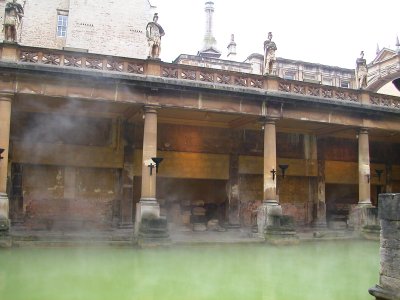
| Bath was settled by the Romans in the first century. It quickly gained fame for its three hot springs, which the Romans used to develop a bath. Appeasing the local Celtic tribes, the Romans dedicated the bath and temple to both the local goddess Sulis and the Roman goddess Minerva. In Roman times, the city was known as Aquasulis. The bath and temple fell into ruin when the Roman Empire fell. |
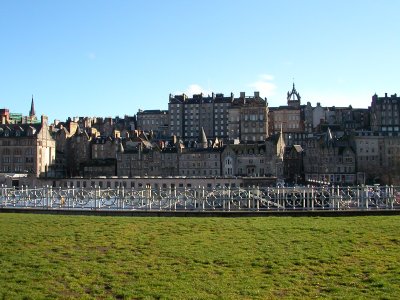
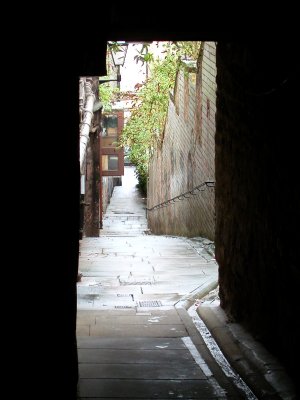
| We next traveled by train to Edinburgh, Scotland, where we spent two nights. Edinburgh developed in the sixteenth century and was once the most dense city in medieval Europe. Pictured at right is the Old Town, the city's medieval beginnings. Below is an example of a narrow walkway, called a Close, that permeate the Old Town. |
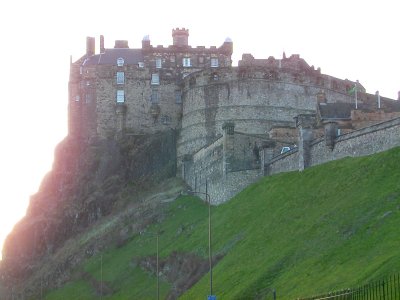
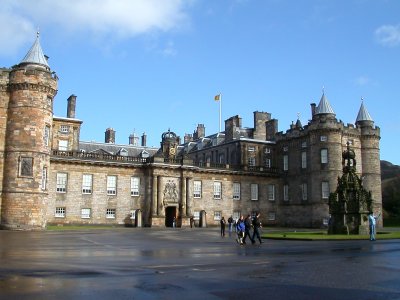
| The Old Town grew up along what is known as the "Royal Mile", a street, about a mile long, that travels from Edinburgh Castle at one end, pictured above, to Holyroodhouse Palace, at the other end, pictured at right. The Royal Mile was the processional path of the Scottish royalty when Scotland was a more autonomous country. |
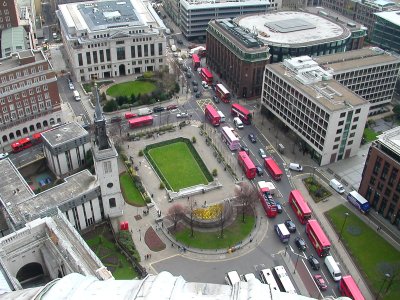
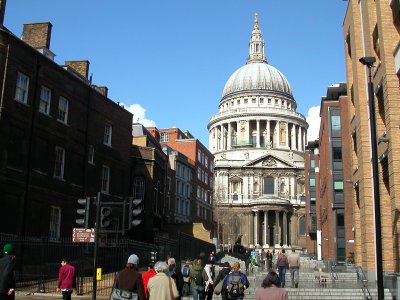
| At right is St. Paul's Cathedral, built at the beginning of the 1700s on the site of Old St. Paul's, which was completely destroyed during the great London fire of the late 1600s. The two pictures above were taken from the top of the dome, at the bottom of the spire. |
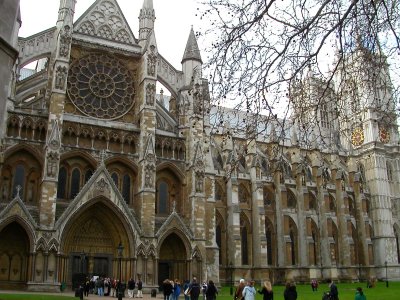
| Our final stop was London, where we spent four nights. Pictured at right is Westminster Abbey, which has served the British royalty since at least the 1500s. While from the outside it looks like a magnificent cathedral, inside is a hodgepodge of individual tombs and memorials that break the grand interior into confusing pieces. |
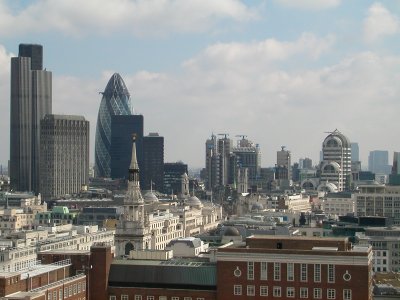
| The pictures at left and below were taken from atop St. Paul's Cathedral in Central London. The base of the dome of the Cathedral is at the very bottom of the picture below. |
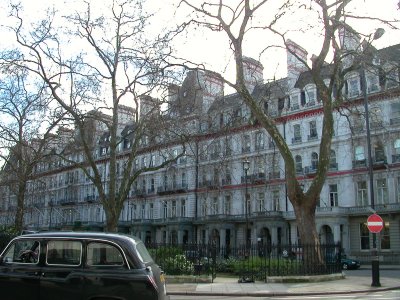
| Central London is dotted by squares lined with row houses, such as this one at right. While they make urban living more enjoyable, because of the way they are numbered, they make travel confusing. Houses on a square are given an address on the square, instead of on the street that passes through the square. |
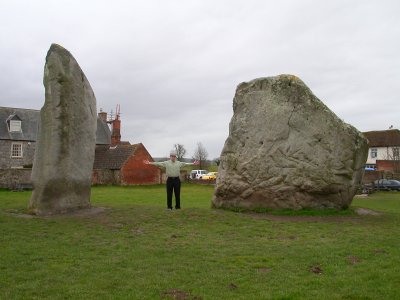
| Bill and I spent ten days in Great Britain, March 16-25, 2004. We spent the first three days in Bath, a 1.5 hour train ride west from London. Our first day of sightseeing was with a small tour group to Stonehenge, Avebury (picture at right), Lacock Village and Castle Combe. |
 |
 |
 |
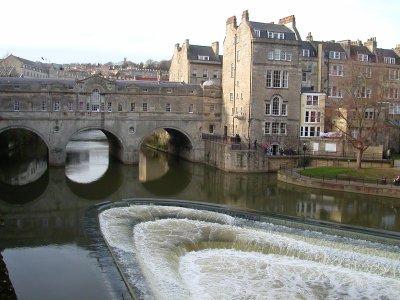 |
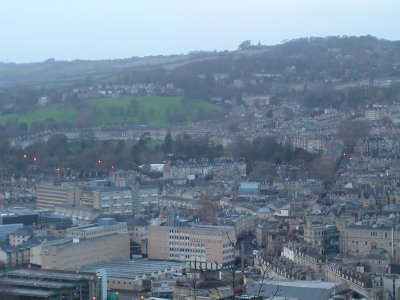
| The city we see today, above, was developed in the 1700s. Nearly every building is constructed of honey-colored limestone, which is abundant in the area. The remains of the Roman baths were discovered in the nineteenth century, and are a huge tourist attraction for Bath. At left, the lower portion of the bath is Roman, while the upper portion was added in the late 1800s. |
 |
 |
 |
 |
 |
 |
 |
 |
 |
 |
 |
 |
 |
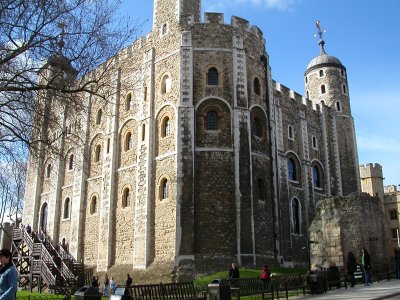
| The picture at right is the central building of the Tower of London, her majesty's defensive post. This is also the oldest building in the Tower, originally constructed in the 1100s. |
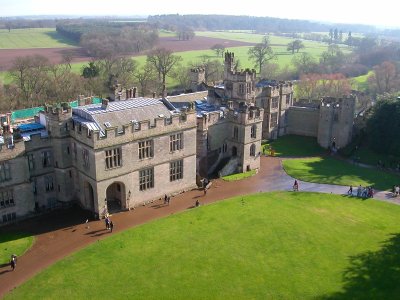
| Our last full day in London was spent on a small group tour of Oxford, Stratford-upon-Avon and Warwick Castle. The picture at left is the main interior building of Warwick Castle and its surrounding countryside. The castle was constructed in the 1500s during the reign of King Richard VIII. |