

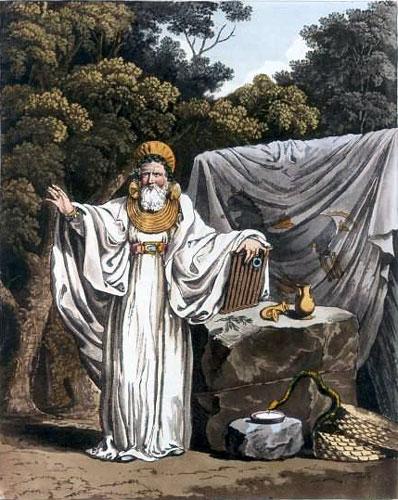

By calling upon our gods through the rites and ceremonies prescribed by our doctrines, we are allowed to focus their power in order to bring about effective changes within our lives and enviroment. Honoring the gods in this way with our devotion encourages them to favor us and act on our behalf through their direct intervention in our daily lives. In developing this spiritual aspect of one's self, a greater sense of inner-harmony results, enabling us to achieve a state of peace and balance which transcends the material existence characteristic of the mundane world.
As long as this balance between the contrary forces inherent in the four natural elements is sustained by the harmonious influence of the spirit, the organism created of them continues to exist in a healthy state. However when this balance becomes upset by one of the four natural elements becoming dominant over the others, a process of decay results, which leads to the decline of that organism.
Whenever any living thing dies, the spirit is released and the natural elements which composed the physical form return to their disassociated state, eventually coming together again to create new life inhabited by the spiritual essence once more.
We, as humans, represent a state of existence which is of an order between that of the animal and the divine. Our lives are given to us that we may learn from our experiences in the mundane world as a means of perfecting our knowledge, allowing our spirits to be strengthened through wisdom.
By achieving wisdom we become closer to the divine as the more animalistic tendencies of our natures diminish. It is the ultimate purpose of the lessons learned in life that our spirits may eventually achieve the highest state of perfection, allowing them to finally reside in the supernatural plane inhabited by the gods themselves, the realm of Siabra.
From these were born Bel, the god of the sun, and Danand, the goddess of the moon, and from their union came the deities who are known as the Tuatha De Danann; Lir the lord of the depths of the oceans, and his son, Manannan ruler of the waves of the seas; and Dagda the all-father, god of benevolence, and his daughter, Brighid the goddess of knowledge and inspiration; and Nuada the war leader of the gods; and Oghma the mighty, god of eloquence and writing; and Midhir the proud, guardian of the treasures that lie buried deep within the earth.
The Tuatha De Danann lived on a beautiful island called Tir nan'Og, which lay in the middle of the great ocean. Here they built four wonderous cities, Falias to the north; Gorias to the east; Findias to the south; and Murias to the west. In each of these four cities there stood a watchtower overlooking the island, and in these resided four great masters of wisdom and learning, Morfesa of Falias; Esras of Gorias; Uiscias of Findias; and Semias of Murias. They were the guardians of the four treasures of the Tuatha De Danann.
In the midst of Tir nan'Og spread a vast plain called Mag Mell, where many groves of apple trees grew, so that the island was sometimes called Emhain Ablach, the Isle of Apples. At the heart of this plain sprang a fountain known as the Tobair Segais, or Well of Knowledge, from which five springs did flow. In these streams swam five salmon who fed upon the nuts of the nine hazel trees which grew about the well.
For many ages the gods of the Tuatha De Danann lived in peace and harmony upon their isle, but there was also another race of elder beings known as the Fomoraig, who had been banished from the fellowship of the gods. Misshapen and malevolent, the Fomoraig had been expelled and cast into the sea; making a kingdom for themselves far off in the frozen north in the country of Lochlann. Yet one of them, who was much beloved by the gods in his youth for his mirth and merriment, was allowed to remain. He was called Cerna, meaning the horned one, because of the antlers that grew from his head. For many ages he watched over the animals of the forest, tending to the herds and flocks that grazed upon the fields and meadows in the land of Tir nan'Og.
There, the goddess Brighid would often wander, because of her great love of all green things that grew upon the earth. One day Cerna saw her and fell in love with her. At first she was frightened by his wild and strange appearance, but eventually the two became lovers and from their union was born the race of man.
When Tuireann, the lord of the heavens learned of this he became angry because of it, thinking it was unfit that a goddess of the Tuatha De Danann should have consorted with Cerna and borne children by him; so Cerna was banished from Tir nan'Og and sent to rule over Tech Duinn, the land of the dead, for the race of men was not permitted to remain on the isle of the gods and were sent to dwell in the mortal lands of the earth where age and death would come to them.
Because Brighid had eaten the berries of a rowan tree which grew in Cerna's forest while she was with him, she was required to reside with Cerna in the land of the dead during the winter season; but not in the form of the beautiful maiden who had filled his heart with longing. Instead she would be transformed into the likeness of an old hag known as the cailleach, Morrigan; often appearing to strangers as three dark birds of death who croaked out the warning: "Do not enter, keep away, pass by!"
Each spring however Brighid would return to the land of Tir nan'Og where she would go at dawn on the morning of Imbolc and drink from the well of youth so that she was transformed again into the form of a beautiful maiden whose touch turns the grass to green once more and whose kiss is like the gentle winds of a summer's day.
With the passing of time the race of man spread across the four corners of the world, seeking new lands as their numbers grew. But the Fomoraig also sought other lands, so that they often challenged men to battle against them in contest over the territories they wished to possess. After one such battle, a man named Baath together with his son Iobath set out to sea, their people having been defeated by the Fomoraig. In their voyage the ship they sailed on was driven off course in a storm, so that they drifted far out into the great ocean until at last they came ashore upon the island of Tir nan'Og.
The strangers were welcomed by the gods who invited them to stay upon their isle, and from them the men gained great wisdom and learned the arts of sorcery and magic. In time they were given wives of the Danann women, fathering children by them. When the Fomoraig learned of this, they grew jealous, as they wished to possess the isle of Tir nan'Og for themselves; and they sent Elatha, a prince of their people, to the island of the gods so that he might seduce one of the goddesses, and by her sire an heir, allowing the Fomoraig to have a claim to the island.
When Elatha's ship came ashore on Tir nan'Og, he was greeted by a beautiful maiden named Eriu, who gave her love to him, as he had been transformed through cunning spells into the likeness of a handsome young warrior. And Eriu conceived a child by Elatha, so that the son who was born to her was the heir to the prince of the Fomoraig.
Rather than allow the Formoraig to ever lay claim to Tir nan'Og, the god Tuireann decided that the island should be sunk into the depths of the ocean, and so the Tuatha De Danann departed from it as it sank into the sea to become known as Tir fo Thonn, or the Land beneath the Waves; leaving Manannan to guard over it as they set sail for the country from which Baath and Iobath had come, the distant green isle of Ireland.

When the man called Ith son of Breogan first came ashore on Ireland, he was brought before the three kings of the Tuatha De Danann who then ruled the country. Ith praised their land with such eloquence that some of the Tuatha De Danann grew suspicious of his motives and killed him as he was departing to return to the country from which he came. Having learned of his death, Ith's kinsmen journeyed to Ireland to take revenge for his murder, fighting a battle against the Tuatha De Danann and slaying the three kings and their wives, and taking possession of the country.
Defeated by the very race that the gods had once banished from their own enchanted Isle, the Tuatha De Danann were allowed to reside in all the parts of Ireland that lay beneath the earth, and so they divided among themselves all the ancient mound dwellings called Sidhe that are found throughout the Irish countryside. By their power these were transformed into splendid palaces made invisible to mortal men, existing not in the physical world but in their own mystical realm known as Siabra.

the Lebor Feasa Runda
click here
