
Issue One, March 2002
your regular cat article
 Remembering
the Thylacine
Remembering
the Thylacine�
It was one of the world's strangest
looking creatures, and also one of its most beautiful. Unfortunately,
the thylacine (more commonly known as the tasmanian tiger) was
made a scapegoat by the Australian government for dwindling sheep
numbers in Tasmania and an effective plan of genocide was enforced.
It is now believed that the decreasing sheep population was more
the result of poor farming methods by inexperienced farmers, wild
dog packs, and inhospitable temperatures. Once again a species
of animal became endangered because of human intervention. Too
bad the human race never turns on itself because of the damage
they do to their environment.
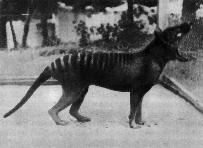
The thylacine become such a rarity that in 1936 the last died
in captivity in the Hobart Zoo. The frame above is actually taken
from archival footage in which the thylacine snorts, yawns and
paces with the effects of zoo psychosis. It is one of the saddest
films ever recorded - a noble animal reduced to the degradation
that humans had enforced upon it. It died a lonely death, away
from the wilderness it inhabited, without any of its companions
- a death no creature should ever suffer.
Yet, the thylacine has grown into a legend. Urban myths still
abound of sightings which inspire hope in all those who hope that
supposedly extinct animals still live happily in some pocket of
wilderness that we have never explored thoroughly. This is something
I want to believe in. Who doesn't thrill to the hearing of a new
sighting? And yet part of me doesn't want it to be true either,
just like the recent sightings of the 'black panther' in Gippsland.
For it would ins pire
hunters to track them down, and also the well-meaning souls who
would want to protect them, to go and invade their sanctuary and
perhaps set off some catastrophic event that would wipe them out
all over again. They would be captured by scientists, prodded,
poked, vivisected all in the name of science. Stuck in a zoo like
their ancestor to die more lonely deaths. If they still exist,
I hope they're safe in their well-covered Tasmanian forestland,
until a time when the world is ready to accept them again on their
own terms.
pire
hunters to track them down, and also the well-meaning souls who
would want to protect them, to go and invade their sanctuary and
perhaps set off some catastrophic event that would wipe them out
all over again. They would be captured by scientists, prodded,
poked, vivisected all in the name of science. Stuck in a zoo like
their ancestor to die more lonely deaths. If they still exist,
I hope they're safe in their well-covered Tasmanian forestland,
until a time when the world is ready to accept them again on their
own terms.
�
Had your own thylacine experience ? If so, please email us at [email protected]
�
�
�
�