| Lasers and More Lasers |
| Yea, it's just a conglomeration of used and tossed out lasers, but they're all mine. :) OK, there are a few new ones in there, but they are mostly the cheap laser pointers like from the corner dime store. Anyway, this page is just for me to show off my little collection and maybe show what can be had with a little patience looking around on ebay, as well as stumbling upon the occasional surplus electronics find. I put the emphasis on patience because lasers can be, and usually are, quite expensive and only patience and persistance (with the 'hunt') will turn up the best deals. I've been at it for a while and have come up with a few to show off. Every item you bid on when on ebay has a certain amount of risk attached to it and I have been bitten a few times, so be careful and expect a few 'oops' items. Bid accordingly. Technical information on most of these lasers, if not all, can be found on Sam's Laser FAQ. That website is invaluable to the laser hobbyist and I have visited it many times, as well as contributed to it. OK, here's my stuff... |
 |
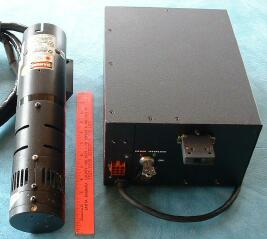
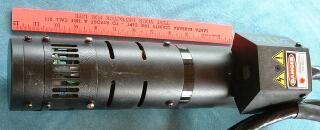
| It's a blue beam little argon gas beastie that sucks down about 10 amps or so off the mains, so if you end up with a couple of these, plug them into seperate AC circuits or you'll pop the breaker. It's not very efficient at only 15mw optical power output from 1200 watts of AC power. Can't wait until blue diode lasers come down enough in price! I got the laser first, then the power supply later. You MUST have a high flow rate fan or blower to suck air through the laser while it is powered up and for a few minutes after power down. It can be powered up without one for a few seconds for a quick test, but any more would be unsafe for the laser. The nice thing about these 'smaller' gas lasers is that many of them can be powered from the standard 120 volt AC sockets in your home. The two clip leads you see in connector are to enable the power supply to power up the laser. |
| I used this one for a new years eve laser show in 2003. 15 mw of power isn't much, but it was fine in the dark outside. I get it out every few months to power it up. It's not good to let a gas laser go very long without running it for a while. The laser enclosure has mounting points underneath for use in securing it to a laser table. The power supply can remain external to the projector or laser table, but the laser should be secured on the same surface or assembly that the scanner and effects devices are mounted on. I've used it so far just pointing at the scanner and hoping it stays put, but hard mounting with the rest of the hardware is the much preferred arrangement. The blower or fan can be mounted atop the laser enclosure (over the large opening), but this may introduce vibration, so be aware of that possibility. It may be necessary to use flex ducting between the laser and the blower to isolate vibration. |
| Cyonics 2210-15slb Argon Laser |
| Here's another argon gas laser that's even lower power that the one above, but it's cool because of the purple beam. It's a different shape (duh) and outputs only 4 or 5 mW of optical power, but it was cheap. It's a little more difficult to mount being round, so having just obtained it, I havn't gotten it mounted to anything yet so I can use it. The air flow is implimented by attaching flex hose to the rear end of the housing and there are vents around it to allow the air to flow in. This one too requires quite a bit of air flowing into it to keep it from burning up. I have a small "lab" (a converted part of my garage) where I do most of my playing around with this stuff and it gets warm and toasty when one if the gas lasers is on for a half hour or so. For the initial test of this laser I used a shopVac with the hose taped to the laser housing end to get a sufficient amount of air moving through it, and it worked great, although it was very noisy. As you can see, the power supply looks a little different too, and uses different connectors, but performs the same function and draws just as much power from the AC socket. |
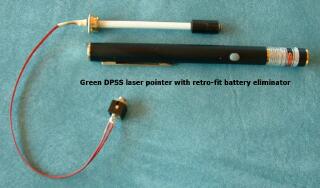
| Here's a Green laser. It comes in the form of a pointer in this case, since that's all I can afford so far for this type of laser. When I bought it, it cost more than my blue argon and power supply both together. Since then the prices for green laser pointers have come down considerably. Being a pointer, it's power is limited to under 5 mW, but because of the green color which is the wavelength at which the human eye is most sensitive, it looks very bright. In fact, a green laser pointer can look 5 to 7 times brighter than a red laser pointer of the same power output! There are more powerful green solid state lasers available, but the prices are still too high for my hobby tastes. The actual laser diode in this, and other solid state green lasers, is actually NOT green. The wavelength for the green output of these lasers is 514nm (nano meters), and the output of the laser diode in the unit is at 808nm which isn't even visible to the eye. So how does the 'invisible' laser beam get changed to a very visible green beam?? The optical 'circuitry' used to do this is the reason green laser pointers are so much more expensive than red ones. For a technical explanation of this, go to this page in the Laser FAQ. Green laser pointers are larger because they need the room for the extra optical components inside, as well as larger batteries to meet the demands of the more powerful pump diode. They look simple from the outside, but are much more complicated on the inside. To get an idea of the complexity, take a look at this diagram. They are much more fragile than the red pointers too, so be VERY careful with it if you buy one. If you drop it, chances are good it will discontinue functioning. |

 |
 |
 |
 |
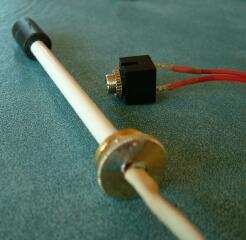
| This is the device used to power the laser from an external DC power source. I drilled a hole in the battery cap just large enough for the plastic tubing to fit into. The other end has a small washer with the negative wire soldered to it. The positive is soldered to the inside of the cap. The black tape is to center it in the barrel. |
 |
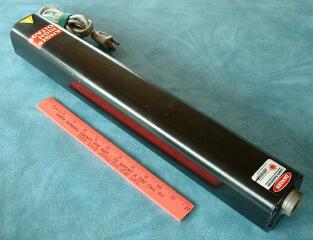 |
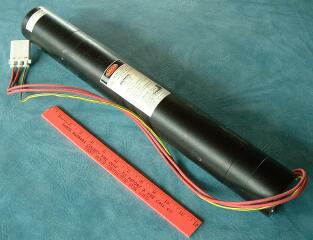
| These are a couple of helium neon gas red lasers. The upper one is just the head and is fairly large (a 12" ruler sits next to it). It's output is about 15mW. The lower one is a self contained laser (has it's own internal power supply) and puts out about 10mW.. |
| Updated 8-21-06 |