Application Areas/Subjects: Science, Physics, Applied Examples, Differential Equations, Laser Physics, Nonlinear Optics
Keywords: Ultrashort pulse, solid-state laser, semiconductor absorber, Kerr-lens mode locking, Bloch equations, ultra-short pulse
As one can see from "Solitons and quasi-solitons
in the lasers: basic conceptions'', there is a quasi-soliton generation
in the Kerr-lens mode-locked laser with a coherent semiconductor absorber. A
condition of the quasi-soliton generation in the presence of self-phase modulation
and group-velocity dispersion is the pulse chirp compensation. In the other
words, the coherent quasi-soliton in the absorber corresponds to the Schrödinger
quasi-soliton of the laser part of a master equation. Note, that the quasi-soliton
of the master equation containing the laser and absorber parts is the soliton-like
solution of each part separately. This fact allows to find the solution-like
solution as a common self-consistent solution of both parts of the master equation.
Now, we will consider the possibilities of the chirped pulse generation. For
this aim we have to modify the system of Bloch's equations:
> restart:
bloch_1:=diff(b(t),t)=q*rho(t)*w(t)-diff(phi(t),t)*a(t);
bloch_2:=diff(a(t),t)=diff(phi(t),t)*b(t);
bloch_3:=diff(w(t),t)=-q*rho(t)*b(t);
|
|
|
Here
[(�)/(�t)] f(t) is the pulses' phase modulation (we will suppose that the shift of
the pulse carrier frequency from the absorber resonance is equal to
zero).
There is a soliton solution of this system [L. Allen and J. H. Eberly, Optical Resonance and Two-Level Atoms (Wiley, New York, 1975)]:
> sol_1 := b(t) = b0*sech(t/tp);
sol_2 := a(t) = a0*sech(t/tp);
sol_3 := w(t) = tanh(t/tp);
sol_4 := rho(t) = rho0*sech(t/tp);
sol_5 := diff(phi(t),t) = psi*tanh(t/tp)/tp;
|
|
|
|
|
Here
y is the pulse chirp.
The substitution of the solution in the system produces:
> eq1 :=
expand(numer(simplify(subs(b(t)=rhs(sol_1),lhs(bloch_1)) - subs( {diff(phi(t),t)=rhs(sol_5),rho(t)=rhs(sol_4),
w(t)=rhs(sol_3),a(t)=rhs(sol_2)}, rhs(bloch_1))))/sinh(t/tp))=0;
eq2 := expand(numer(simplify(subs(a(t)=rhs(sol_2),lhs(bloch_2)) - subs({diff(phi(t),t)=rhs(sol_5),b(t)=rhs(sol_1)},
rhs(bloch_2))))/sinh(t/tp))=0;
eq3 := numer(simplify(subs(w(t)=rhs(sol_3),lhs(bloch_3)) - subs({b(t)=rhs(sol_1),rho(t)=rhs(sol_4)},rhs(bloch_3))))=0;
bloch_sol := allvalues(solve({eq1,eq2,eq3},{a0,b0,rho0})); #solutions for the pulses' and absorbers' parameters
|
|
|
| |||||||||||||||||||||||||||||||||||||||
So, we have one physical solution
r0 = [(�{1 + y2})/(q tp)], b0 = - [1/(�{1 + y2})], a0 = [(y )/(�{1 + y2})], and this solution exists both in the case of
y = 0 (it is so-called
p - soliton) and in the case of
y0 (it is a chirped quasi-soliton with
variable area). Note, that the
p - soliton is unstable in the absorber due to noise amplification on
the pulse tail because of
lim t� � w(t) = 1 (it corresponds to the full population inversion in the
absorber). But the pulse chirp can transform the pulse stability
conditions essentially (see L. Allen and J. H. Eberly, Optical
Resonance and Two-Level Atoms (Wiley, New York, 1975)) and,
additionally, the pulse stability can be changed in the presence of
the lasing factors. In the last case, the soliton of the Bloch's
system have to be the soliton-like solution of the laser part of a
master equation:
> master_laser :=
alpha*rho(t)-gam*rho(t)+I*phi*rho(t)+diff(rho(t),`$`(t,2)) +I*disp*diff(rho(t),`$`(t,2))+
sigma/lambda2*Intensity(t)*rho(t)-
I*beta/lambda2*Intensity(t)*rho(t);
| |||||||||||||||||
> collect(expand(numer(simplify(subs( {Intensity(t)=rho02*sech(t/tp)2,
rho(t)=rhs(sol_4)(1-I*psi)}
,master_laser)))/(rho0*(rho0/cosh(t/tp))(-I*psi))),cosh(t/tp)2);
eq4 := evalc(coeff(%,cosh(t/tp0)2));
eq5 := evalc(expand(%%-eq4*cosh(t/tp)2));
| |||||||||
| |||||||||
Now we have to take into account the result of the solution of the
Blochs' equations:
> eq6 :=
subs(rho02=(1+psi2)/tp2,coeff(eq5,I));
eq7 := subs(rho02=(1+psi2)/tp2,coeff(eq5,I,0));
eq8 := coeff(eq4,I);
eq9 := coeff(eq4,I,0);
|
|
|
|
In the beginning we will consider the bandwidth-limited
pulses (i. e. the solitons with y=0).
> sys := {subs(psi=0,eq6)=0,
subs(psi=0,eq7)=0, subs(psi=0,eq8)=0, subs(psi=0,eq9)=0}:
solve(sys,{disp,sigma,phi,tp2});
|
The obtained result differs from one for the the 2 p- pulses (see "Solitons and quasi-solitons in
the lasers: basic conceptions''): the Kerr-lensing parameter is greater
in four times, the dispersion is less in four times because of p - pulses' amplitude is two times less than 2 p - pulses' amplitude. It should be noted, that the saturated gain is less than
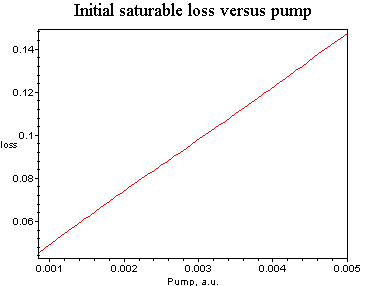
the linear loss. This fact causes the pulse stability against laser noise if
the initial loss into absorber is less than the difference between linear loss
and saturated gain.
Now we have to take into account the gain saturation obviously:
> Energy = 2*rho02*tp:
eq10:=Pump*alphamx/(Pump+tau*Energy+1/Tr)-alpha:
eq11:=numer(simplify(subs({tp=1/sqrt(gam-alpha)},subs(rho0=1/tp, subs(Energy=2*rho02*tp,eq10))))):
alpha_sol:=solve(eq11=0,alpha): #This is solution for the saturated gain
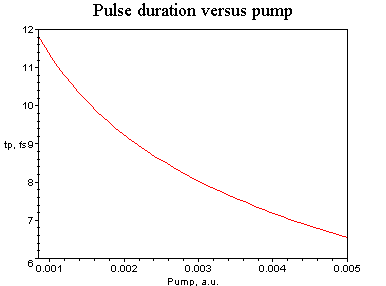
The dependence of the pulse duration versus dimensionless pump
coefficient is:
> with(plots):
fig := plot( Re(evalf(subs(lambda=0.2,subs( {alphamx=0.1,Tr=300,tau=6.25e-4/lambda2,gam=0.01},
subs(alpha=alpha_sol[2],2.5/sqrt(gam-alpha)))))), Pump=0.00085..0.005,axes=boxed,labels=[`Pump,
a.u.`, `tp,
fs`],title=`Pulse duration versus pump`,color=red):
display(fig,view=6..12);
> plot( Re(evalf(subs(lambda=0.2,subs( {alphamx=0.1,Tr=300,tau=6.25e-4/lambda2,gam=0.01},
subs(alpha=alpha_sol[2],gam-alpha))))), Pump=0.00085..0.005,axes=boxed,labels=[`Pump,
a.u.`,
`loss`],title=`Initial saturable loss versus pump`,color=red);
> sol_6 :=
subs(solve({eq8=0,eq9=0},{phi,tp2}),phi);
sol_7 := subs(solve({eq8=0,eq9=0},{phi,tp2}),tp2):
sol_8 := solve(eq6=0,disp):
chirp_1 := solve(numer(simplify(subs(disp=sol_8,eq7)))=0,psi)[3];
chirp_2 := solve(numer(simplify(subs(disp=sol_8,eq7)))=0,psi)[4];
disp_1 := simplify(subs(psi=chirp_1,sol_8));
disp_2 := simplify(subs(psi=chirp_2,sol_8));
sq_dur_1 := simplify(subs({psi=chirp_1,disp=disp_1},sol_7));
sq_dur_2 := simplify(subs({psi=chirp_2,disp=disp_2},sol_7));
inten_1 := simplify((1+chirp_12)/sq_dur_1);
inten_2 := simplify((1+chirp_22)/sq_dur_2);
|
|
|
| ||||||||||||||
| ||||||||||||||
| |||||||||||||||||||||||||||
| |||||||||||||||||||||||||||
| |||||||||||||||||||||||||||||
| |||||||||||||||||||||||||||||
Unlike "Solitons and quasi-solitons in the lasers:
basic conceptions", there is the obvious condition for the value of l (in the absence of the chirp this condition is satisfied automatically):
> 9*beta2-8*lambda2*sigma+8*sigma2-16*lambda4
> 0;
solve(9*beta2-8*x*sigma+8*sigma2-16*x2 = 0,
x);
|
|
That is
l2
- [(1 s)/4] + [(3 �{s2 + b2})/4].
Additionally we have to find the solution for the saturated gain
coefficient:
> Energy := 2*sqrt(gam-alpha)*A:
eq12 := Pump*alphamx/(Pump+tau*Energy+1/Tr)-alpha:
eq13 := solve(numer(simplify(eq12))=0,alpha):
sol_alpha_1 :=
subs(A=(1+chirp_12)*sqrt(coeff(-1/sq_dur_1,(alpha-gam))),eq13[1]):
sol_alpha_2 :=
subs(A=(1+chirp_22)*sqrt(coeff(-1/sq_dur_2,(alpha-gam))),eq13[1]):
sol_alpha_3 :=
subs(A=(1+chirp_12)*sqrt(coeff(-1/sq_dur_1,(alpha-gam))),eq13[2]):
sol_alpha_4 :=
subs(A=(1+chirp_22)*sqrt(coeff(-1/sq_dur_2,(alpha-gam))),eq13[2]):
sol_alpha_5 :=
subs(A=(1+chirp_12)*sqrt(coeff(-1/sq_dur_1,(alpha-gam))),eq13[3]):
sol_alpha_6 :=
subs(A=(1+chirp_22)*sqrt(coeff(-1/sq_dur_2,(alpha-gam))),eq13[3]):
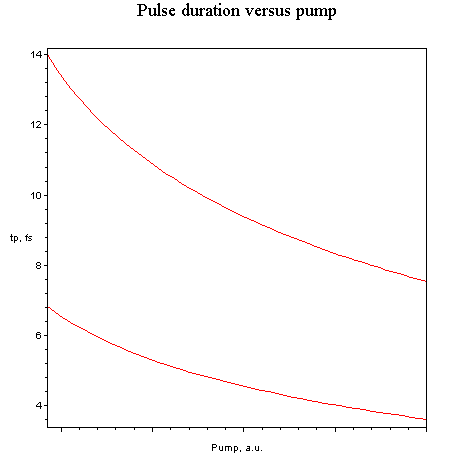
> fig2 :=
plot({Re(evalf(subs(lambda=0.2,subs( {beta=0.26,sigma=0.14,alphamx=0.1,Tr=300,
tau=6.25e-4/lambda2,gam=0.01 },subs(alpha=sol_alpha_4,2.5*sqrt(sq_dur_2)))))),
Re(evalf(subs(lambda=0.3,subs( {beta=0.26,sigma=0.14,alphamx=0.1,Tr=300,
tau=6.25e-4/lambda2,gam=0.01 },subs(alpha=sol_alpha_4,2.5*sqrt(sq_dur_2))))))},
Pump=0.00085..0.005,axes=boxed,labels=[`Pump, a.u.`, `tp, fs`],title=`Pulse
duration versus pump`,color=red):
display(fig2);
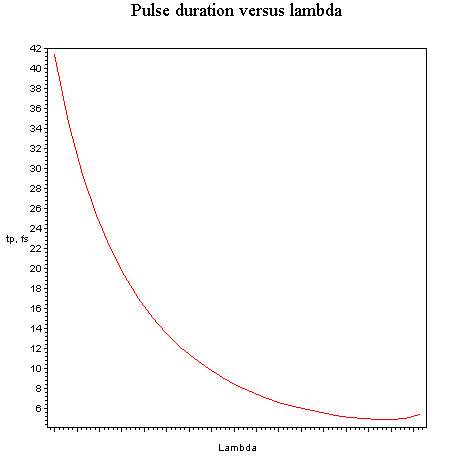
> lambda := 'lambda':
par1 := array(1..40):
par2 := array(1..40):
i := 1:
for lambda from 0.1 to 0.425 by 0.0125 do par1[i] :=
[lambda,Re(evalf(subs(Pump=0.001,subs( {beta=0.26,sigma=0.14,alphamx=0.1,Tr=300,
tau=6.25e-4/lambda2,gam=0.01 },subs(alpha=sol_alpha_4,2.5*sqrt(sq_dur_2))))))]:
par2[i] := [lambda,Re(evalf(subs({beta=0.26,sigma=0.14},chirp_2)))]:
i:=i+1: od:
plot([seq(par1[i], i=1 .. 27)],axes=boxed,labels=[`Lambda`, `tp, fs`],title=`Pulse
duration versus lambda`);
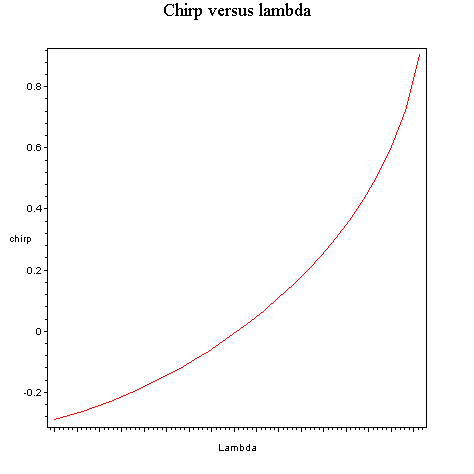
plot([seq(par2[i], i=1 .. 27)],axes=boxed,labels=[`Lambda`, `chirp`],title=`Chirp
versus lambda`);
> lambda := 'lambda':
par2_2 := array(1..40):
i := 1:
for lambda from 0.1 to 0.425 by 0.0125 do par2_2[i] :=
[lambda,Re(evalf(subs({beta=0.26,sigma=0.14},sqrt(1+chirp_22))))]:
i:=i+1: od:
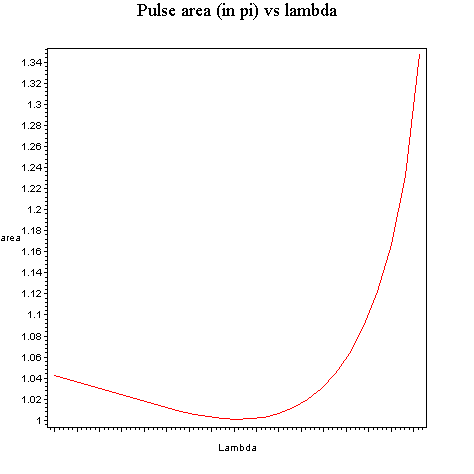
plot([seq(par2_2[i], i=1 .. 27)],axes=boxed,labels=[`Lambda`, `area`],title=`Pulse
area (in pi) vs lambda`);
> lambda := 'lambda':
par3 := array(1..101):
par4 := array(1..101):
par5 := array(1..101):
j := 1:
for s from 0.01 to 0.1 by 0.0009 do par3[j] :=
[s,Re(evalf(subs(lambda=0.2,subs(Pump=0.001,subs( {beta=0.26,sigma=s,alphamx=0.1,Tr=300,
tau=6.25e-4/lambda2,gam=0.01 },subs(alpha=sol_alpha_4,2.5*sqrt(sq_dur_2)))))))]:
par4[j] :=
[s,Re(evalf(subs(lambda=0.2,subs({beta=0.26,sigma=s},chirp_2))))]:
par5[j] :=
[s,Re(evalf(subs(lambda=0.2,subs({beta=0.26,sigma=s}, sqrt(1+chirp_22)))))]:
j:=j+1: od:
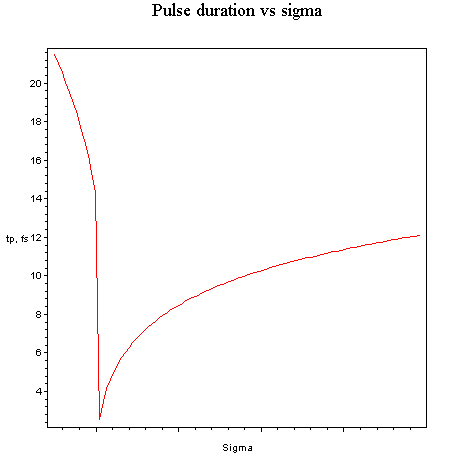
plot([seq(par3[j], j=1 .. 99)],axes=boxed,labels=[`Sigma`, `tp, fs`],title=`Pulse
duration vs sigma`);
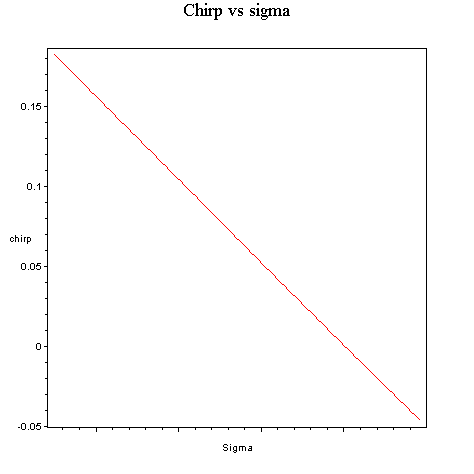
plot([seq(par4[j], j=1 .. 99)],axes=boxed,labels=[`Sigma`, `chirp`],title=`Chirp
vs sigma`);
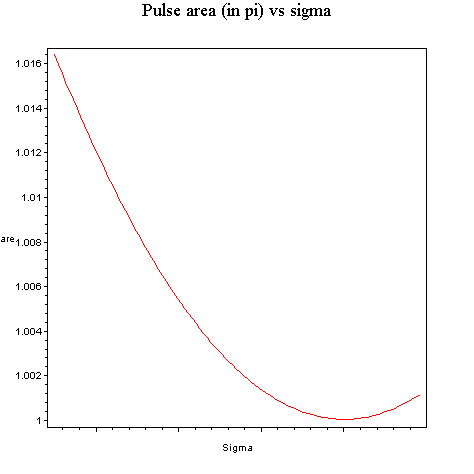
plot([seq(par5[j], j=1 .. 99)],axes=boxed,labels=[`Sigma`, `area`],title=`Pulse
area (in pi) vs sigma`);
> sigma := 'sigma':
lambda := 'lambda':
par5 := array(1..40):
i := 1:
for lambda from 0.1 to 0.425 by 0.0125 do par5[i] :=
[lambda,Re(evalf(subs({beta=0.26,sigma=0.14},disp_2)))]:
i:=i+1: od:
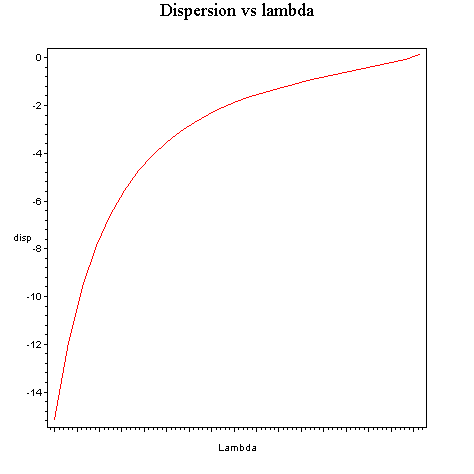
plot([seq(par5[i], i=1 .. 27)],axes=boxed,labels=[`Lambda`, `disp`],title=`Dispersion
vs lambda`)
sigma := 'sigma':
lambda := 'lambda':
par6 := array(1..101):
j := 1:
for s from 0.01 to 0.1 by 0.0009 do par6[j] :=
[s,Re(evalf(subs(lambda=0.2,subs({beta=0.26,sigma=s},disp_2))))]:
j:=j+1: od:
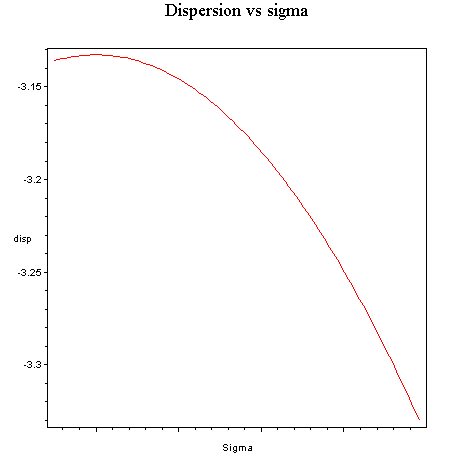
plot([seq(par6[j], j=1 .. 99)],axes=boxed,labels=[`Sigma`, `disp`],title=`Dispersion
vs sigma`);
In the conclusion, the combined action of the Kerr-lensing, self-phase modulation, group-velocity dispersion and coherent absorption causes the formation of the sech-shaped pulse with p - area or chirped pulse with variable area. The duration of the chirped pulse in this case is close to the fundamental limit and can be controlled by the variation of the Kerr-lensing parameter or the relative mode radius in the active medium and absorber.