Based on the analysis of KYW:Yb3+ gain band the estimation of the minimal ultrashort pulse duration was obtained
Science, Physics, Applied Examples, Lasers, Input and Approximation
Ultrashort pulses, solid-state laser, gain band
As was shown, the KYW and KGW crystals activated by Yb3+-ions are very promising media for high-efficient continuous-wave lasing tunable in near-IR diapason [N.V.Kuleshov, A.A.Lagatsky, A.V.Podlipensky, V.P.Mikhailov, G.Huber, Opt. Lett. 22 (1997) 1317].
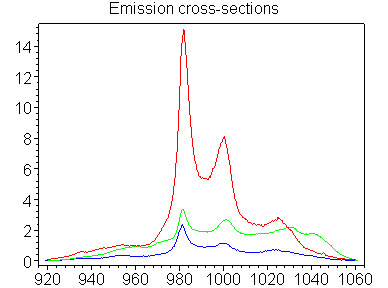
We used the spectrum dates, which were kindly given by Dr. A. Lagatsky (International Laser Center) and contained in files `F:\\kyw_em_(index)_x.txt` (wavelength in nm) and `F:\\kyw_em_(index)_y.txt` (cross section in 10-20 cm2) (here (index) corresponds to the different polarizations a, b, c).
>restart: with(plots): gain_a_x := readdata(`F:\\kyw_em_a_x.txt`,1,float):
gain_a_y := readdata(`F:\\kyw_em_a_y.txt`,1,float):
gain_b_x := readdata(`F:\\kyw_em_b_x.txt`,1,float):
gain_b_y := readdata(`F:\\kyw_em_b_y.txt`,1,float):
gain_c_x := readdata(`F:\\kyw_em_c_x.txt`,1,float):
gain_c_y := readdata(`F:\\kyw_em_c_y.txt`,1,float):
>g1 := plot([[gain_a_x[k],gain_a_y[k]] $k=1..353],color=red):
g2 := plot([[gain_b_x[k],gain_b_y[k]] $k=1..593],color=green):
g3 := plot([[gain_c_x[k],gain_c_y[k]] $k=1..355],color=blue):
display(g1,g2,g3,axes=boxed,title=`Emission cross-sections`);
To define the minimal pulse width we have to find the gain bandwidth in Hz. The minimal pulse duration approximately corresponds to the inverse gain bandwidth.
>max_cross_section := max(gain_a_y[k] $k=240..353);#gain
band maximum
half_cross_section :=evalf(max_cross_section/2):#half of the gain band maximum
P := array(1..353):
Q := array(1..353):
for i from 240 to 353 do
P[i] := evalf(2*Pi*3*1e10/(gain_a_x[i]*1e-7)):
Q[i] := [P[i],gain_a_y[i]]:
if gain_a_y[i]=max_cross_section then X_max := P[i] else fi:
if gain_a_y[i]
then X_half := evalf((P[i-1]+P[i])/2) else fi: od:
X_max;#position of the gain maximum
X_half;#position of the half of maximum
bandwidth := evalf(abs(X_half-X_max));
minimal_pulse_width:=evalf(1/bandwidth);

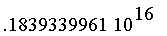
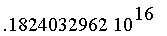


So the minimal pulse duration is about of 65 fs. Now we normalize the frequency to the gain bandwidth and shift the zero of frequencies to the band center. As result we can compare the gain profile with Lorenzian and Gaussian profiles (for same bandwidth.
>for i from 1 to 353 do
P[i] := evalf((2*Pi*3*1e10/(gain_a_x[i]*1e-7)-X_max)/bandwidth):
Q[i] := [P[i],gain_a_y[i]]: od:
j := 'j':
loren := (x)->max_cross_section/(1+x^2):#Lorenzian gain profile
gauss := (x)->max_cross_section*exp(-x^2*ln(2)):#Gaussian gain profile
plot({[Q[j] $j=1..353],loren,gauss},axes=BOXED, title=`gain cross section
versus normalized frequency`);
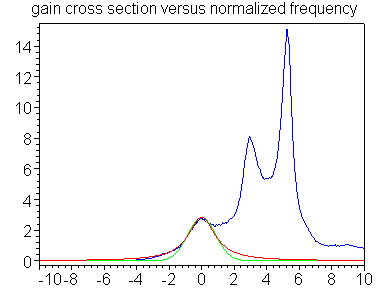
Thus we have a good approximation by the Lorenzian profile.
2000© Kalashnikov